Ethiopia Vows Direct Role in Shaping Red Sea Security Architecture, Maritime Governance - ENA English


Ethiopia Vows Direct Role in Shaping Red Sea Security Architecture, Maritime Governance
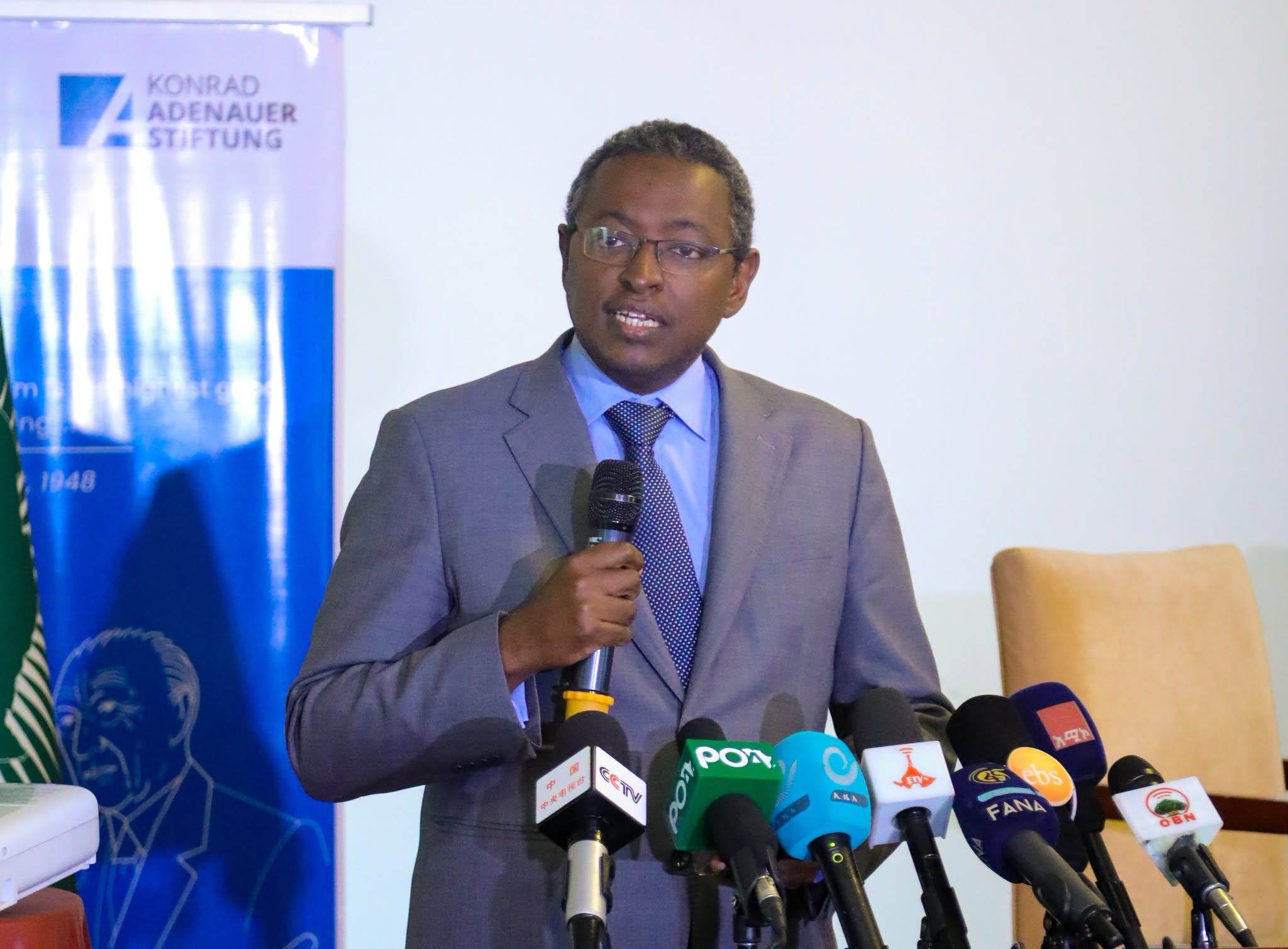
Addis Ababa, November 25, 2026 (ENA)— Red Sea security is an integral part of Ethiopia’s national security, and the country will continue to play a direct and constructive role in regional maritime governance, Chief of Staff at the Ministry of Foreign Affairs, Ambassador Adam Tesfaye, said.
The two-day fifth edition of the Horn Dialogue Series is underway in Addis Ababa under the theme: “Re-collaborating Regionalism in the Horn of Africa: Building Strategic Trust, Regional Agency, and Cooperative Interdependence.”
Opening the dialogue series, Ambassador Adam described the Horn Dialogue Series as an important platform that brings together scholars, diplomats, and other stakeholders to exchange views on pressing regional issues and explore solutions to shared challenges.
He pointed out that the Horn of Africa is among the world's most strategically significant regions, with considerable potential for economic growth, supported by its geographical proximity and strong economic and social ties among countries in the region.
However, he said the region continues to face multiple challenges.
The ambassador pointed out that this geopolitically significant part of the world continues to face multiple challenges, including interstate tensions, internal conflicts, competing national priorities, differing security perceptions, and shifting regional alliances.
According to him, these challenges cannot be addressed through individual efforts, stressing the need for coordinated regional responses to economic, social, traditional, transnational, and maritime security concerns.
He stated that regional integration remains essential to addressing the region's multifaceted challenges, although translating shared interests in peace, stability, economic development, and connectivity into concrete collective action remains a major challenge.
Adam reaffirmed Ethiopia's commitment to regional and continental integration. He further noted that the government firmly believes economic integration serves the best interests of the peoples of the region.
He also emphasized Ethiopia's efforts to strengthen regional connectivity through investments in transport and energy infrastructure, as well as its active engagement in regional peace and security initiatives within the frameworks of the Intergovernmental Authority on Development (IGAD), the African Union (AU), and the United Nations (UN).
Addressing maritime security, Ambassador Adam underscored the strategic importance of the Red Sea to regional stability, reiterating that its security is directly linked to Ethiopia's national security.
In this regard, Ethiopia will continue to play a direct and constructive role in Red Sea governance while pursuing secure and reliable access to the sea through peaceful dialogue, diplomacy, international law, and mutual benefit, he noted.
"We strongly believe that Red Sea security plays a pivotal role in the security of our region and is an integral part of Ethiopia’s national security," he said.
He reiterated that Ethiopia would continue to play a direct and constructive role in Red Sea governance, stressing that such an approach would contribute to advancing peace, prosperity, and strategic cooperation across the region.
For his part, Gizachew Asrat, Chief of Staff at the Institute of Foreign Affairs, highlighted the region’s critical position linking the Red Sea, the Gulf of Aden, and the Indian Ocean.
He stressed that persistent trust deficits and fragmented cooperation have prevented Horn nations from fully capitalizing on their geographical proximity.
"The central question is how we can transform the Horn of Africa from a region characterized by geopolitical competition into one defined by shared interests and economic complementarities," Gizachew said.
Paul-Simon Handy, Regional Director for East Africa and Representative to the AU at the Institute for Security Studies (ISS), traced the evolution of the dialogue series since its inception in Djibouti in 2022, noting that the fifth edition convenes at a critical juncture marked by renewed regional instability.
Handy explained that this year’s panels are structured around three core pillars: fostering strategic trust among neighbors with competing interests, asserting regional agency so external actors do not dictate the Horn's security agenda, and advancing "cooperative interdependence" even when political relations remain strained.
Jan-Ole Voss, Director of the Konrad Adenauer Stiftung (KAS) Regional Programme Security Dialogue for East Africa, underscored that sustainable solutions must be locally driven rather than externally imposed.
"The future of the Horn will ultimately be decided and determined by the countries and peoples of the region," Voss said, noting that recalibrating regionalism means building upon existing AU and IGAD frameworks rather than replacing them.
Reaffirming Germany and the European Union's support for multilateral dialogue in the region, he added that trust cannot be built overnight but develops gradually through transparency, predictability, and sustained engagement.


