Natural Gas-Powered Buses Mark Milestone in Ethiopia’s Drive for Economic Resilience and Sustainability - ENA English


Natural Gas-Powered Buses Mark Milestone in Ethiopia’s Drive for Economic Resilience and Sustainability
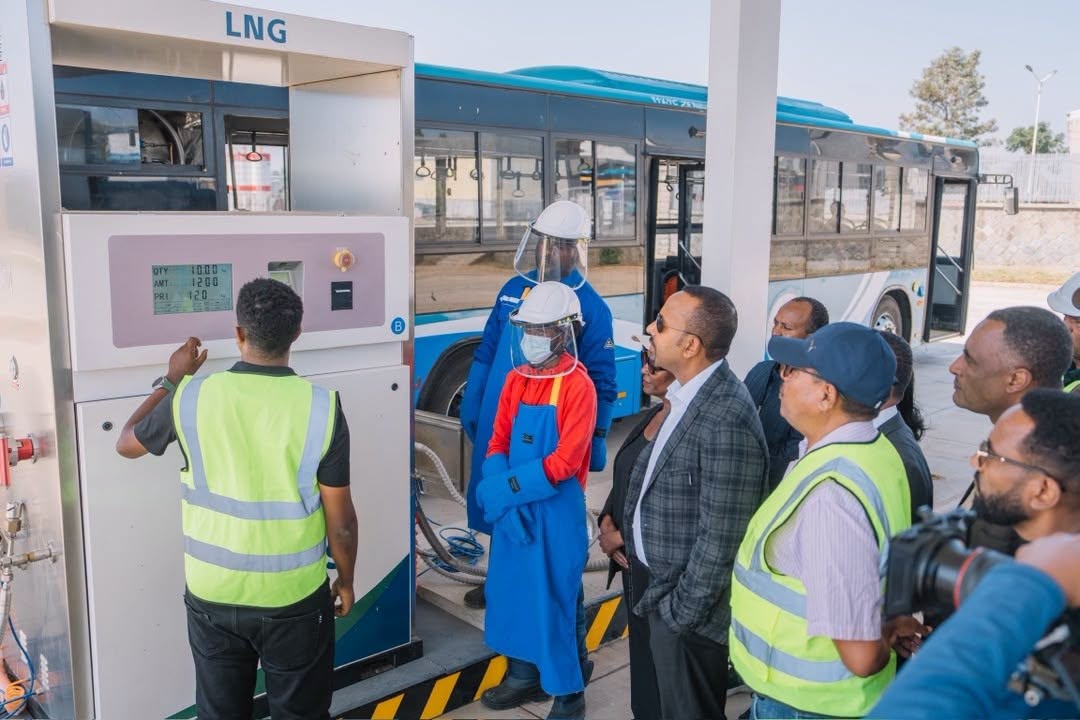
Addis Ababa, October 30, 2026 (ENA) — Ethiopia has taken a significant step toward sustainable energy use and economic self-reliance with the launch of natural gas-powered public transport buses in Addis Ababa, inaugurated by Prime Minister Abiy Ahmed today.
The initial rollout of 26 converted city buses marks a strategic shift toward harnessing domestically produced natural gas as a cleaner and more affordable alternative to imported petroleum.
The initiative is expected to reduce public transport operating costs, ease the country's dependence on imported fuel, and curb urban carbon emissions while creating new opportunities for the wider use of locally produced energy.
Speaking at the inauguration ceremony, Prime Minister Abiy highlighted the extensive coordination and infrastructure development required to transform Ethiopia's domestic natural gas resources into a practical energy source for public transportation. He said the initiative builds on the initial phase of natural gas production in Gode, Somali Region.
“The gas we produced there is not like liquid fuel. Because it is in gaseous form, extracting it from the well, transporting it, and delivering it to users requires significant additional work,” PM Abiy said.
He explained that, unlike conventional liquid fuels, natural gas requires specialized infrastructure for storage, transportation, and distribution.
“For that reason, dedicated storage facilities and specialized stations like this are necessary. A standard fuel station will not work for gas because their physical characteristics are entirely different,” he said.
The conversion initiative builds on existing public transport infrastructure, drawing on domestic technical expertise to retrofit former diesel-powered Anbessa buses to operate on natural gas.
“These buses you see are former Addis Ababa Anbessa buses that were previously fueled by diesel. By bringing them in, completely modifying them, adjusting their interiors, and adapting them for natural gas, considering we are beginners in this, we have successfully converted around 256 buses over the past few months,” the Prime Minister noted.
Alongside the retrofitting programme, the government is expanding the city's fleet through the procurement of new gas-powered buses to accelerate the transition.
“If we proceeded only by retrofitting, it would take too long. Therefore, we have ordered around 400 new gas buses, which will arrive within the next three months,” he announced.
“When those 400 arrive, gas-powered vehicles will make up at least 30 percent of the current Anbessa bus fleet in Addis Ababa. Once we reach that benchmark in three to four months, we will scale up further to completely convert all fuel-using city buses in Addis Ababa to natural gas within a few years.”
The transition to locally produced natural gas is also expected to lower public transport fares, ease the financial burden on urban households, and reduce Ethiopia's expenditure on imported petroleum.
“Under current realistic conditions, [transport costs] drop by a minimum of 50 percent,” Prime Minister Abiy explained. “If you pay one Birr on this bus, you would have paid two Birr on the previous one.”
Identifying transportation, housing, and food as major financial pressures facing low-income citizens, he said reducing costs in these areas remains central to improving living standards.
“For low-income people, transportation and housing are the main burdens in Ethiopia,” he noted.
“If we reduce transport costs, provide housing through our initiatives, and maintain our efforts on food security, we address the three issues that concern people most. Resolving these gives citizens the opportunity to live better lives.”
“Our primary desire is to produce enough food to feed ourselves. When transport is imported, it comes with a lot of hassle,” PM Abiy stated, highlighting the importance of strengthening domestic production and industrial capacity.
“We have ordered nearly 100 gas trucks, arriving in two to three months,” he added.
He said lower transportation costs from factories to construction sites, combined with reduced manufacturing expenses, would generate broader economic benefits, particularly in housing construction, agricultural produce distribution, and urban economic activities.
The next phases of the strategy will extend natural gas utilization to fertilizer production, electricity generation, and other commercial applications.
“Gas extraction is an exciting beginning, but it must expand,” he said. “If taxis convert their cylinders and switch to gas, fares will decrease. In the next phase, gas will serve as an input for fertilizer and electricity generation.”
He cited the Mojo and Debre Berhan ceramics manufacturing factories, which together meet more than 100 percent of national demand and have been converted to natural gas.
“We will no longer import fuel for them. Because they utilize local energy and labor, ceramics will be delivered to the public at an affordable price,” he said.
To facilitate the wider distribution of natural gas and support industrial operations, the government has also ordered additional transportation infrastructure.
“We have ordered nearly 100 gas trucks, arriving in two to three months,” he added.
He said lower transportation costs from factories to construction sites, combined with reduced manufacturing expenses, would generate broader economic benefits, particularly in housing construction, agricultural produce distribution, and urban economic activities.
The next phases of the strategy will extend natural gas utilization to fertilizer production, electricity generation, and other commercial applications.
Acknowledging the technical and financial challenges involved in developing the sector, the Prime Minister reaffirmed the government's commitment to addressing existing limitations through sustained investment, knowledge development, and national collaboration.
“This work is complex. Beyond financial constraints, there are knowledge limitations, but we will address them diligently,” he remarked, adding that “very commendable results are being seen.”
“The coming times for Ethiopia and our children are very promising and bright,” he said.
“There is no result achieved without effort, work, and diligence. When we join forces, immense energy, capacity, knowledge, and wealth are gathered. Applied to nation-building, Ethiopia will flourish and achieve its aspirations through a united effort.”


