How President Hassan Sheikh Mohamud’s Betrayal Undermines Regional Realities - ENA English


How President Hassan Sheikh Mohamud’s Betrayal Undermines Regional Realities
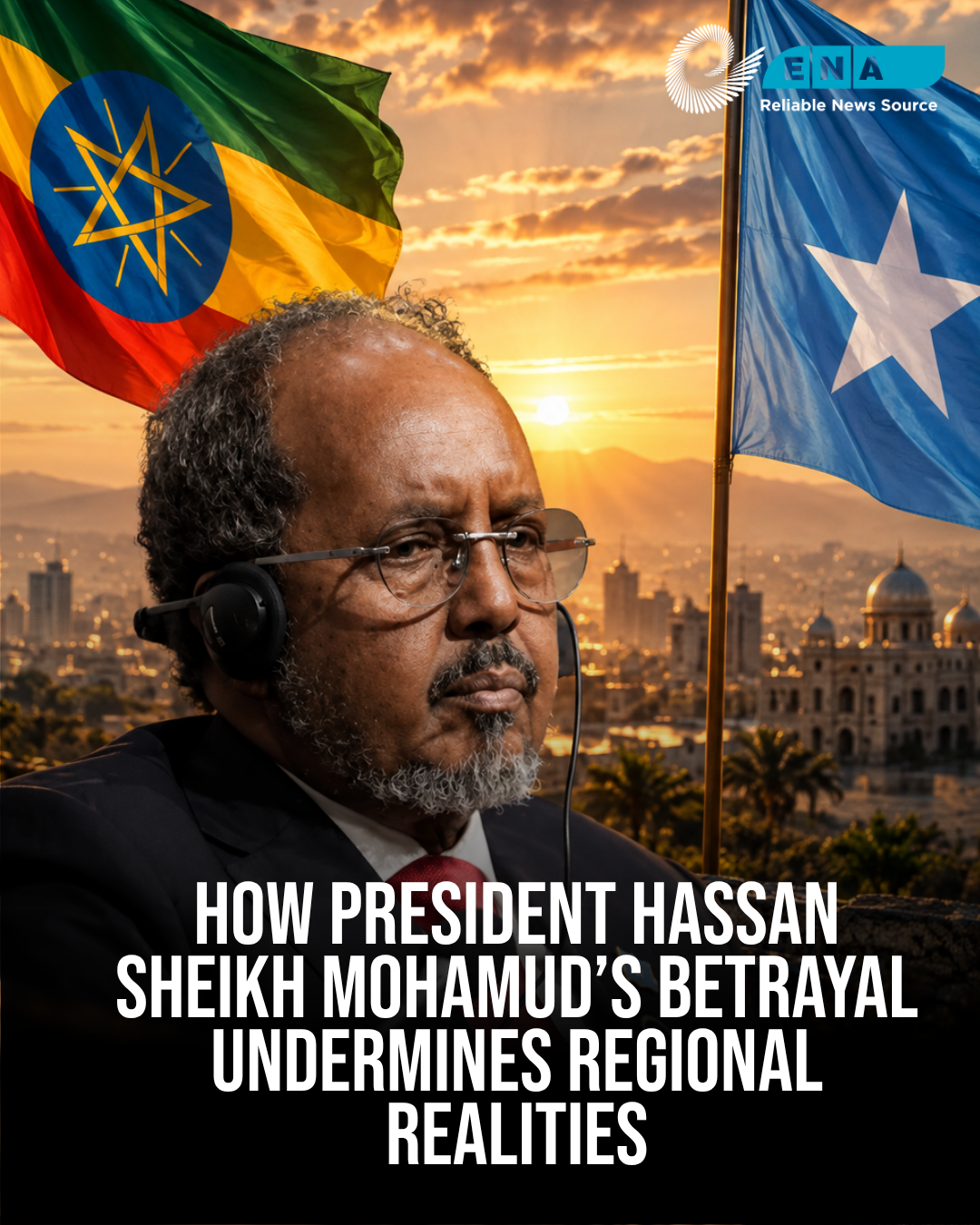
By Gezmu Edicha
On October 4, 2026, President Hassan Sheikh Mohamud of Somalia stood alongside some regional leaders in New El-Alamein City to sign a quadrilateral joint declaration. Beneath the polished diplomatic rhetoric of regional stability and shared governance, the summit consolidated an external geopolitical bloc explicitly designed to restrict Ethiopia’s economic self-determination and sovereign security interests across both the Nile Basin and the Red Sea corridor. However, President Hassan Sheikh's endorsement of this declaration reveals a profound disconnect between Mogadishu's current foreign policy and the historical sacrifices that preserved the Somali state.
For over three decades, Ethiopia has expended immense resources to secure Somalia's territorial integrity and institutional survival. Following the breakdown of central governance in Mogadishu in 1991, Ethiopia served as the political anchor for Somali reconciliation. It hosted foundational conferences in Sodere and Mbagathi, which directly created the Transitional Federal Government—the structural framework enabling Hassan Sheikh’s presidency today. When extremist networks threatened to destroy state authorities, Ethiopian defense forces took to the frontlines. Through bilateral security operations and deployments under AMISOM, ATMIS, and AUSSOM, thousands of Ethiopian peacekeepers made significant sacrifices. Their efforts helped liberate key economic and agricultural hubs like Baidoa, Luuq, and Beledweyne from Al-Shabaab, securing vital areas.
Despite this long-standing security support, President Hassan Sheikh has chosen to align Mogadishu with a coalition aimed at constraining Ethiopia’s vital development rights. The El-Alamein Declaration, specifically Section (e), demands adherence to a principle of not causing harm and requires consensus before any action, rejecting unilateral moves. Under international water law, as outlined in the 1997 United Nations Watercourses Convention, countries must avoid significant harm to others and use water resources equitably and reasonably. By endorsing the 'non-harm' principle, President Hassan Sheikh supported a stance that could give downstream states veto power over upstream projects, potentially denying Ethiopia and other upper Nile countries their right to develop their own resources.
The situation is further complicated by Eritrean regime’s President Isaias Afwerki participation. By joining this alignment against Ethiopia, Eritrea, Egypt’s longstanding proxy and its trojan horse adopted the same strict stance on Nile water issues. Although Eritrea lies partially within the Nile Basin, its endorsement of Cairo's strict 'non-harm' clause and historical water claims surrenders its own future Nile rights and its right to develop water infrastructure within the basin. Eritrea's endorsement prioritizes Egyptian interests over its own, showing Asmara's continued role as a proxy against Ethiopia, despite the cost to its economic interests.
The timing of this endorsement shows a notable disregard for the broader regional consensus. The El-Alamein summit occurred as six Nile Basin nations have implemented the Cooperative Framework Agreement (CFA), a modern and equitable legal framework. The CFA replaces outdated allocations from the colonial era, aiming for a more just distribution of water resources. By joining this external alignment, Presidents Hassan Sheikh and Isaias diverged from the majority of Nile Basin countries, undermining a collective African agreement to support Egypt's historical control over Nile water resources.
The irony in demanding strict 'prior notification and consensus' lies in Egypt's historical actions. Cairo has built significant water infrastructure along the Nile, including several major dams and projects, without prior consent or consultation with Ethiopia or other upper riparian nations. The 1959 Nile Waters Agreement between Egypt and Sudan allocated the Nile's water entirely between them, leaving no share for the countries upstream where most of the Nile's water comes from. Egypt's demand for permission from upper riparian states to build infrastructure, while considering its own projects untouchable, aims to establish Cairo as the sole authority over the Nile, rather than a partner.
Furthermore, the declaration’s attempt to dismiss Ethiopia's legitimate stake in Red Sea security ignores both geographic reality and complex regional history. Ethiopia’s landlocked status was not an unalterable historical baseline, but the result of an unconstitutional transitional process between 1991 and 1993, during which an interim custodial government exceeded its constitutional mandate by permitting secession without a nationwide parliamentary vote or securing binding maritime access rights under international law. Despite these historical anomalies, Ethiopia remains an inescapable economic and demographic pillar of the Horn of Africa.
Portraying a nation of over 135 million people as an outsider to Red Sea governance ignores the fundamental security dynamics of the region.
Beneath the diplomatic courtesy and smiles in New El-Alamein is a strategy that lacks foresight. By supporting a bloc that aims to restrict Ethiopia's water rights and maritime security, President Hassan Sheikh Mohamud betrays his neighbor. This action undermines the regional security cooperation that has supported Somalia's state-building for decades. Sustainable peace in the Horn of Africa cannot be built on containment tactics, but on honoring historical sacrifices and recognizing the equitable rights of all nations to their shared natural resources.


