Prime Minister Abiy as the Face of Ethiopia’s Transformation and Emerging Global Influence - ENA English


Prime Minister Abiy as the Face of Ethiopia’s Transformation and Emerging Global Influence
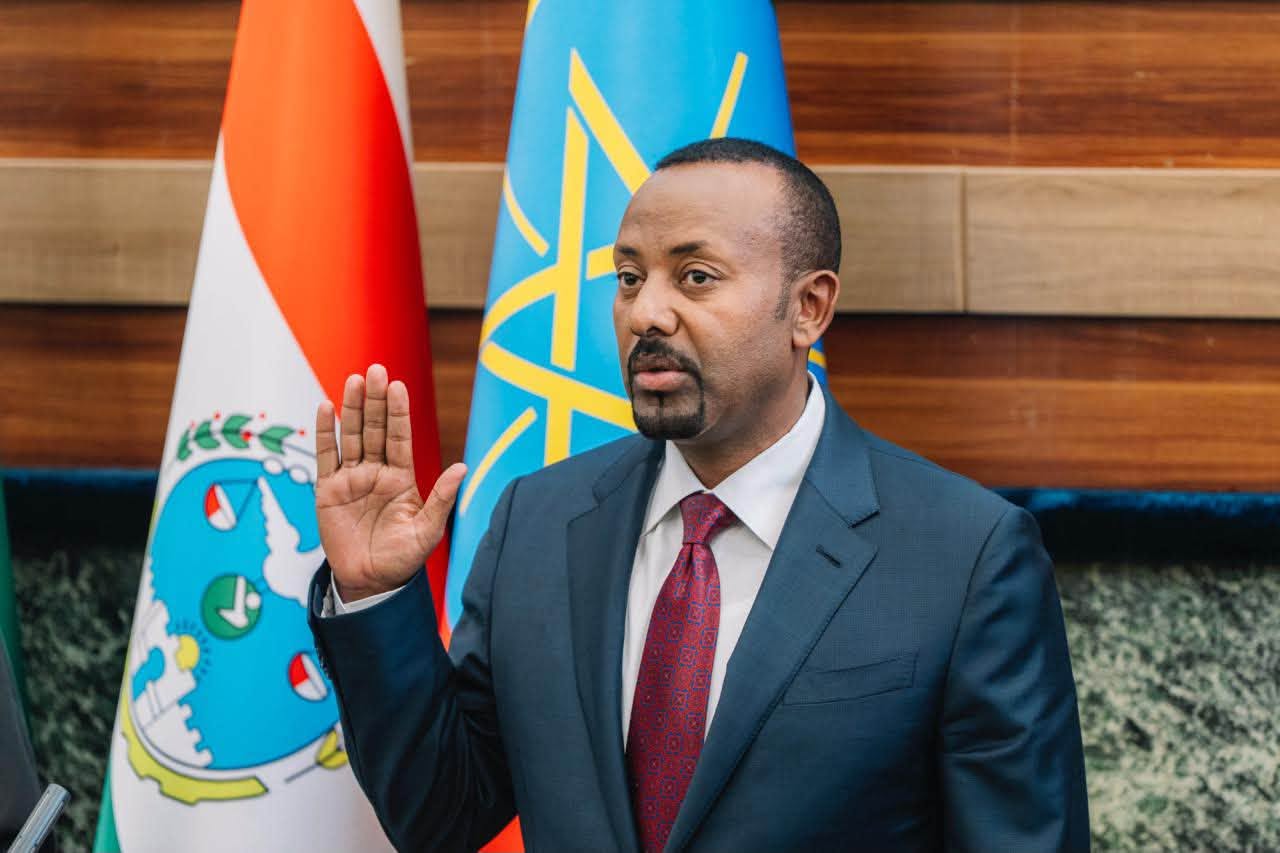
Biography presented by Deputy Prime Minister Temesgen Tiruneh during the appointment of Dr. Abiy Ahmed as Prime Minister of the Federal Democratic Republic of Ethiopia
Honorable Speaker, Distinguished Members of the House, Honorable Invited Guests,
Today, before this honored Parliament, and in accordance with Article 73, Sub-Article 2 of the Constitution of the Federal Democratic Republic of Ethiopia, I have the immense honor, pride and privilege, on behalf of the Prosperity Party—which has secured the profound trust of the Ethiopian people and won a parliamentary majority in the 7th General Election—to nominate a great Ethiopian of our time for the position of Prime Minister of Ethiopia.
At this defining moment, when the foundation of a new chapter in Ethiopian civilization is being laid, our party, Prosperity, demonstrates its unwavering determination to place Ethiopia firmly on the foundation of her greatness by presenting this great Ethiopian for the Premiership.
He is a leader created for Ethiopia, called to serve, untiring and undaunted; a leader who knows no fatigue, endless in innovation, tireless with his pen, rich in compassion and defined by resilience. From his parents, he learned patriotism and respect for the people at an early age. Raised among Ethiopia's diverse peoples and faiths, history shaped him to belong to all and to serve all.
From the small village of Beshasha, he looked far beyond his immediate surroundings and dreamed of a greater Ethiopia. Whether she was grieving or rejoicing, whether facing hardship or moving forward, he longed for the day when he could serve this great nation and help her rise to the height of her history and prosper to the full measure of her riches.
It was for this reason that, at the tender age of 14, he entered the armed struggle to serve his country and make sacrifices for it.
He possesses a character that fights to the very end against anything he believes is not beneficial to Ethiopia.
After the fall of the Derg regime, he joined the regular military. During the Ethio-Eritrean War, he served on the front lines in defense of his country's sovereignty.
Yet, inside the foxholes of the Badme front, he did more than fight. He wept, he reflected, he planned, and he weighed ideas about change. His military journey, which took him to the rank of Lieutenant Colonel, became a chapter in which he came to know Ethiopia intimately and, in doing so, contemplated the fate of tomorrow's Ethiopia.
He paid the price of service by traveling to different parts of the country and observing Ethiopia firsthand. As he looked upon her, his love for her deepened; her weariness concerned him; her poverty angered him; and the fact that this great country was not yet truly great gave him no rest.
In particular, when he was deployed to Rwanda as part of a United Nations peacekeeping mission to help halt the genocide, he began to see Ethiopia through a comparative lens.
He reflected: If we do not preserve our multinational unity, if each of us does not respect the rights of all, if we do not make our unity our strength and our diversity our ornament, and if we do not resolve our problems through consultation and dialogue, how will our fate differ from Rwanda's?
From that point onward, he sought to live by this conviction.
He demonstrated that it is possible to live together by resolving differences through peace, dialogue and reconciliation. In the small town of Beshasha, he played a remarkable peacebuilding role, helping resolve faith-based tensions through dialogue, counsel and forgiveness.
It was from this experience that he resolutely declared that the sword of reconciliation—carrying peace, forgiveness and love—is far better than the sword that beheads.
He holds a Bachelor's Degree in Computer Engineering from Microlink Information Technology College, an MBA in Transformational Leadership from Leadstar Management and Leadership College, an MA from the University of Greenwich, and a PhD in Peace and Security Studies from Addis Ababa University.
In addition to numerous national and international awards, he was awarded the Nobel Peace Prize.
He also sought to usher Ethiopia into a new chapter of transformation through his former membership and leadership in the Ethiopian People's Revolutionary Democratic Front (EPRDF), his role as founder of the Information Network Security Agency (INSA), and his service as Minister of Science and Technology.
Cultivating people and transforming lives, providing leadership and service free from corruption and theft, working alongside employees like a brother, and turning every responsibility—no matter how small—into a center of change for a greater Ethiopia became his daily way of life.
Eight years ago, Ethiopia yearned for change.
Poverty and backwardness had embittered the people. Division and fragmentation distressed the nation. Growth was being stifled, and grievances were accumulating. Fairness had vanished, the dominance of a single faction prevailed, and the country was suffering. Projects had stalled. Rights had been suppressed. Prisons were filled. Political divisions had sharpened. Ethiopia had entered a period of profound trial.
At that critical moment, Ethiopia needed not merely change, but an apostle of change—a leader who would not draw the sword, incite revolution, demand destruction or build upon the grave of another. She needed a leader who would unite the people, bring partners and affiliates together as one, safeguard the rights of all peoples equitably, and focus on tomorrow rather than yesterday.
At that critical hour, from within the EPRDF leadership, among its intellectuals, from the Oromia Region and from the womb of Ethiopia, a man named Abiy emerged.
With wisdom and skill, through peaceful struggle, by aligning the people behind a shared purpose, strengthening the multinational bonds among Ethiopians, and challenging the dominance of a single faction, he brought about the envisioned change.
Change was achieved through organizational appeal, public struggle and popular momentum.
Ethiopia had repeatedly experienced bloody and destructive revolutions. This time, however, through reform, she sought to uproot only the thorn. She ceased demolishing her existing capacities simply to build anew.
Erasing yesterday completely proved painful, yet accepting it exactly as it was offered no solution.
Thus, building upon yesterday's foundation, she repaired what was broken, uprooted the weeds and embarked upon a new path toward tomorrow.
Eight years ago, before this very Parliament, the name of the Creator was invoked with honor. The name of Ethiopia was called with love and respect. Opponents were described as competitors. A call for peace was extended to all engaged in conflict. Mothers were honored and appreciated.
The herald of an Ethiopia embarking on a new journey toward prosperity was proclaimed. Forgiveness was sought for all misdeeds committed in the name of the EPRDF. Peace, forgiveness and love were declared. A fresh breeze swept across modern Ethiopian politics.
Since that time, this man has remained at work.
He introduced a new tradition into Ethiopian political history. He enabled competing political parties and the governing party to serve together in one government. He traveled across America, Europe, Africa and the Middle East, calling upon Ethiopians and partners to embrace peace and development. He secured pardons and the release of numerous political prisoners. Media outlets opened more freely. Politicians who had been living in exile returned home and were even entrusted with positions of government leadership.
He worked to reconcile the separated fathers of the Orthodox Synod and the Islamic Affairs leadership. He ensured legal recognition for the Supreme Council for Islamic Affairs and the Evangelical Council. He sought to make security institutions free from political bias and transform them into guardians of the constitutional order.
The Election Board and the Ethiopian Human Rights Commission became independent and impartial institutions. Laws considered oppressive and restrictive—laws deemed unfitting for a modern Ethiopia—were amended, while judicial and court independence was upheld. He traveled from district to district to consult directly with the people. He facilitated efforts to resolve regional statehood demands in Southern Ethiopia.
He transformed the concept of the Ethiopian revolution from a political revolution into a wheat and rice revolution.
Through the Gebeta le Sheger (Dine for Sheger), Gebeta le Hager (Dine for the Nation), and Gebeta le Twolde (Dine for Generations) initiatives, he brought to fruition visionary projects designed to protect Ethiopia's heritage while creating new destinations for the future. He transformed Ethiopia through initiatives such as Clean and Green Ethiopia, Bountiful Development, Rural-Urban Corridors, Summer Wheat, Ease of Doing Business, Sharing Meals, Winter Volunteerism and Digital Ethiopia. Through writing, publishing and training, he worked tirelessly to build competent leadership for Ethiopia.
He conceived the Moseb One-Stop Service initiative and expanded it across all regions. Under the Green Legacy Initiative, he oversaw the planting of 56 billion trees. He published four Medemer books and used the proceeds to build schools across all regions. He enabled Ethiopia to stop importing wheat and move toward self-sufficiency.
He expanded fruit production and positioned it for export markets.
He lifted Ethiopia's mining sector out of backwardness, enabling it to generate five years' worth of output compared with the previous century. Through Digital Ethiopia, he made it possible for money to reside in our mobile phones. By guiding macroeconomic reform, he restored balance to Ethiopia's fragile economy.
Through a fiercely challenging struggle, he navigated the completion of the Grand Ethiopian Renaissance Dam (GERD).
He built a strong and modern defense force for Ethiopia.
He raised Ethiopian industries from the brink of decline and positioned them as drivers of the economy.
He initiated and successfully guided the National Dialogue to fruition—an idea that had once been dismissed and criticized.
He dismantled the separation between "allies" and "core affiliates" in order to build a unified multinational party.
He emerged from the trials of the COVID-19 pandemic, recurring conflicts, locust invasions and severe droughts refined like a diamond and stronger through adversity.
From his youth, he has shown little tolerance for anyone who deliberately rises against Ethiopia.
He endures much and tolerates much; but when it comes to Ethiopia's sovereignty, he tolerates no one.
That is why, when enemies rose believing they could destroy Ethiopia, he set aside his office as Prime Minister, exchanged his tie for fatigue uniforms and marched to the front line.
Today, this is a man fighting for Ethiopia to secure access to the sea.
He is leading Ethiopia toward the construction of the massive Bishoftu International Airport.
He is working tirelessly, day and night, to ensure Ethiopia achieves food self-sufficiency.
He is enabling Ethiopia to become interconnected through digital identity. He is paving the way for Ethiopia to build a civilization that connects yesterday, today and tomorrow. He is facilitating the transition of farmers toward modern cluster farming. He is crafting a new rural strategy to enable pastoralists to transition into modern ways of living.
He works day and night so that urban dwellers can enjoy better and more comfortable urban infrastructure. In Addis Ababa, for instance, he has sought to turn into action his promise:
"We will make her new and a flower, just like her name."
He is a priceless leader. He is enabling the structural transformation of the Ethiopian economy. He is building a political culture in which governing and competing parties can lead the nation together and collaborate on matters of national interest. Girding his loins and dedicating his time to the country, he works relentlessly to make a great Ethiopia even greater.
He has reshaped Ethiopia's foreign relations beyond rigid notions of "enemy" and "friend," pursuing instead a pragmatic and action-oriented diplomacy.
This is why, today, before this august assembly, I nominate Honorable Dr. Abiy Ahmed Ali to serve as Prime Minister of Ethiopia.
He has envisioned change. He has led change. And he has lived change for all to see.
Born in Beshasha town, Jimma Zone, Oromia Region of Ethiopia, he is now 50 years old. He has dedicated three-quarters of his life to national service. He is married, a father of four children, and a friend to millions.
Distinguished Members of the House,
As our Prosperity Party nominates Honorable Dr. Abiy Ahmed Ali—a gifted son of Ethiopia who has emerged refined like gold through the furnace of change, who has not merely lived through history but changed its course, and whom Ethiopia has sought and found across the eras—to serve as Prime Minister of Ethiopia, we do so with the greatest honor, pride and sense of privilege.
I thank you.


