Any Discussion about Utilization and Management of Abay River, Red Sea Must Consider Ethiopia’s Geographic Reality and Legitimate Nat'l Interests: Ministry - ENA English


Any Discussion about Utilization and Management of Abay River, Red Sea Must Consider Ethiopia’s Geographic Reality and Legitimate Nat'l Interests: Ministry
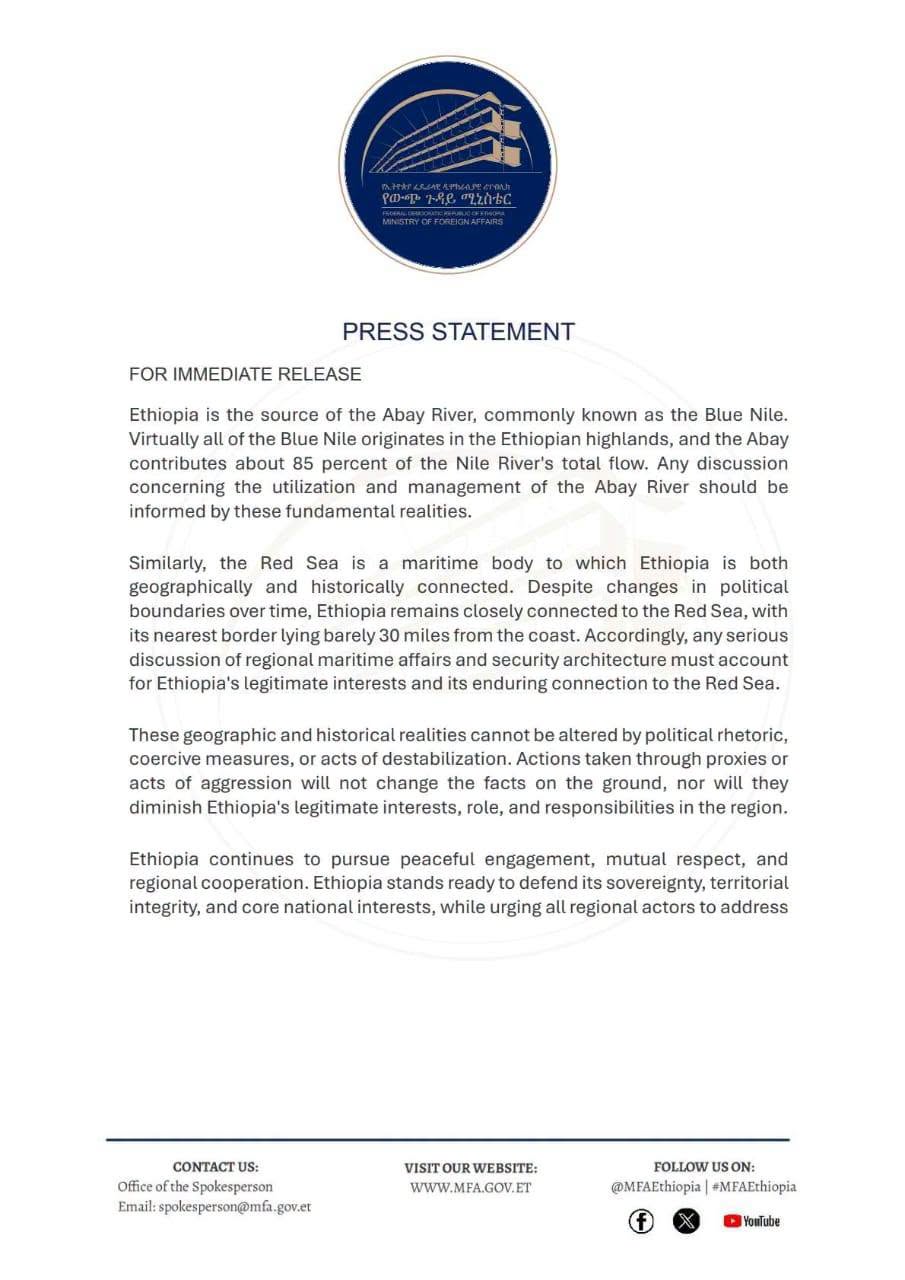
Addis Ababa, October 5, 2026 (ENA)— The Ministry of Foreign Affairs underscored today that any discussion regarding the utilization and management of the Abay River and the issue of Red Sea must take into account Ethiopia’s geographic reality and legitimate national interests.
In its press statement, the Ministry noted that Ethiopia is the origin of the Abay River, commonly known as the Blue Nile, with virtually all of its flow originating in the Ethiopian highlands and contributing about 85 percent of the Nile’s total water.
The Ministry also said that Ethiopia remains geographically and historically tied to the Red Sea, situated barely 30 miles from its coast.
"Despite changes in political boundaries over time, Ethiopia remains closely connected to the Red Sea, with its nearest border lying barely 30 miles from the coast. Accordingly, any serious discussion of regional maritime affairs and security architecture must account for Ethiopia's legitimate interests and its enduring connection to the Red Sea."
Consequently, any comprehensive regional security framework and maritime discussion must factor in Ethiopia’s vital interests, the statement emphasized.
It pointed out that these geographic and historical facts cannot be altered by political rhetoric, coercive actions, or acts of destabilization.
Proxy actions or acts of aggression will neither change the facts on the ground nor diminish Ethiopia’s legitimate regional role and responsibilities.
Reaffirming the nation's commitment to peaceful engagement, mutual respect, and regional cooperation, the Ministry declared that Ethiopia stands ready to defend its sovereignty, territorial integrity, and core interests; urging all regional actors to address shared challenges through constructive dialogue and good neighborliness rather than confrontation and zero-sum approaches.


