Ethiopia’s Diplomatic Momentum—From Regional Weight to Global Reach - ENA English


Ethiopia’s Diplomatic Momentum—From Regional Weight to Global Reach
By Staff Writer
Sept. 27, 2026 (ENA)
Ethiopia’s diplomacy is entering a new era—less confined to traditional political relations and increasingly driven by economic interests, strategic partnerships and a wider global footprint.
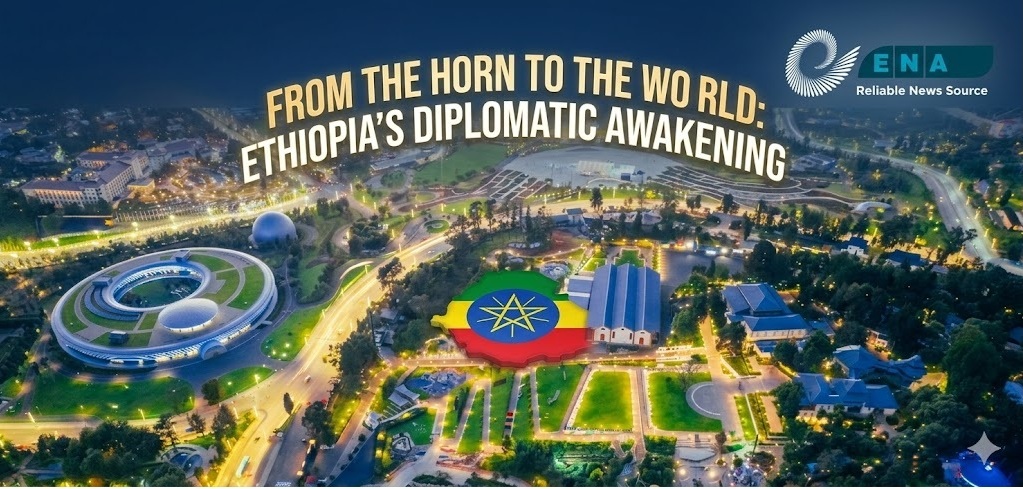
Over the past eight years, Ethiopia has significantly broadened the arenas in which it engages the world. From Addis Ababa’s role as the diplomatic capital of Africa to its entry into BRICS, from the Pretoria peace process to the Ankara Declaration, from renewed WTO negotiations to a seat on the UN Human Rights Council, Ethiopia has expanded the platforms through which it seeks to shape regional and international affairs.
The story is not about one diplomatic breakthrough. It is about the widening of Ethiopia’s diplomatic space.
From Addis Ababa to BRICS
One of the clearest symbols of this expansion is Ethiopia’s entry into BRICS. At the Johannesburg Summit in August 2023, BRICS leaders invited Ethiopia to become a full member, with membership taking effect on January 1, 2024.
For Addis Ababa, BRICS opened another channel to engage major emerging economies and participate in discussions spanning politics and security, economic and financial cooperation, and people-to-people relations.
More importantly, the move reflected a broader diplomatic strategy: diversification.
Ethiopia has sought to deepen relations simultaneously with African partners, emerging economies, Western countries, Gulf states and Asian powers rather than allowing its international engagement to depend on a narrow circle of partners.
Diplomacy With an Economic Purpose
Perhaps the most important change has been the growing weight of economic diplomacy. Foreign policy is increasingly being connected to investment, trade, tourism, technology, infrastructure and market access.
Diplomatic missions are expected not only to represent Ethiopia politically, but also to help connect the country with capital, markets and commercial opportunities. That shift mirrors Ethiopia’s own economic transformation. As the country seeks greater export capacity, investment and industrial development, diplomacy increasingly becomes an economic instrument.
The embassy is no longer only a political bridge; it is increasingly part of the economic bridge.
Regional Diplomacy Under Strategic Pressure
Ethiopia’s geographic position makes regional diplomacy unavoidable.
The country sits at the intersection of the Horn of Africa, the Nile Basin and the Red Sea, where security, trade, migration, infrastructure and political interests overlap.
The Ankara Declaration with Somalia in December 2024 demonstrated the role of dialogue in addressing difficult regional questions. Ethiopia and Somalia reaffirmed respect for each other’s sovereignty, unity, independence and territorial integrity and agreed to pursue cooperation toward shared prosperity.
The significance extends beyond one declaration. It illustrates Ethiopia’s attempt to keep contentious regional questions within diplomatic channels while pursuing its strategic and economic interests.
From Conflict Management to African Diplomacy
Pretoria put Ethiopia at the center of one of Africa’s most consequential peace efforts. But even under the scrutiny of African and international mediators, the TPLF repeatedly came under fire for actions that threatened to undermine the commitments of the agreement—exposing the difficult path from a signed peace deal to durable stability.
The broader lesson is that Ethiopia’s diplomatic weight is not derived only from its size or geographic position. It also comes from its role in continental institutions.
Addis Ababa hosts the African Union headquarters, making the city a permanent meeting point for African leaders, diplomats and international organizations. That institutional position gives Ethiopia a distinctive platform from which to engage debates on peace, security, development and continental integration.
A Seat at the Global Table
Ethiopia’s election to the UN Human Rights Council for the 2025–2027 term further expanded its multilateral presence. The UN General Assembly elected Ethiopia among 18 members on October 9, 2024; the Council consists of 47 states. Such positions provide Ethiopia with additional opportunities to participate directly in international policymaking and multilateral diplomacy.
The significance is therefore not simply symbolic.
Representation creates another diplomatic channel through which Ethiopia can present its positions, negotiate interests and participate in shaping international discussions.
The WTO Door Is Opening Wider
Ethiopia’s long-running WTO accession process has also regained momentum.
The WTO said in September 2025 that the process had entered a “decisive phase.” By April 2026, the organization described the negotiations as having reached a “decisive juncture,” with Ethiopia reporting further domestic reforms and continued engagement with WTO members. The accession process matters because it connects diplomacy directly to the structure of Ethiopia’s economy.
Joining the multilateral trading system would deepen Ethiopia’s engagement with global markets while requiring continued reforms to trade-related institutions and regulations.
In this sense, WTO diplomacy is not simply about Geneva.It is about transforming how Ethiopia trades with the world.
The Red Sea Enters the Diplomatic Equation
Few issues demonstrate the changing character of Ethiopian diplomacy more clearly than the Red Sea.
For a landlocked country whose economy depends heavily on maritime trade, developments around the Red Sea and Bab el-Mandeb have direct economic and strategic consequences. Maritime connectivity has consequently moved higher on Ethiopia’s diplomatic agenda.
The issue intersects with trade, logistics, regional security and economic integration, bringing Ethiopia into discussions that extend well beyond its borders. The Red Sea question therefore illustrates the central feature of Ethiopia’s evolving diplomacy: national economic interests and regional strategy are becoming increasingly intertwined.
A Wider Circle of Partners
Ethiopia’s engagement with China, India, Russia, the United States, European countries and Gulf states has developed alongside its relationships with African neighbors and its participation in BRICS.
The objective is not necessarily to choose one geopolitical camp.
It is to expand Ethiopia’s room for diplomatic and economic engagement. That wider network gives Addis Ababa more channels for cooperation in investment, infrastructure, trade, technology, security and development. The result is a foreign policy increasingly built around multiple partnerships rather than a single diplomatic axis.
The Real Test Begins Now
Yet diplomatic expansion is not an end in itself.
The coming years will determine whether Ethiopia can convert diplomatic access into concrete economic opportunities, stronger regional connectivity, expanded investment, deeper trade and durable partnerships. Memberships, declarations, elections and summits create platforms.
What matters next is what Ethiopia builds on those platforms.
The past eight years have nevertheless marked a notable expansion of Ethiopia’s diplomatic reach. BRICS has opened another global platform. The Human Rights Council has strengthened its multilateral presence. Pretoria demonstrated the potential of African-led diplomacy. Ankara created a framework for renewed engagement with Somalia. WTO negotiations have gained fresh momentum. Economic diplomacy has become increasingly central to foreign policy, while the Red Sea has emerged as a strategic priority.
Consequently, these developments point to a broader transformation.
Ethiopia is no longer approaching diplomacy simply as a means of maintaining relationships. It is increasingly using diplomacy to pursue markets, partnerships, connectivity, security and national development. From the African Union headquarters in Addis Ababa to the BRICS table, from regional peace initiatives to global trade negotiations, Ethiopia’s diplomatic map has expanded considerably.
The next chapter will be defined not by how many doors Ethiopia has opened, but by how effectively it turns those openings into lasting national and regional gains.


