Ethiopia and the Red Sea: The Inevitable Return to a Historic Connection - ENA English


Ethiopia and the Red Sea: The Inevitable Return to a Historic Connection
By Neway Abay S.
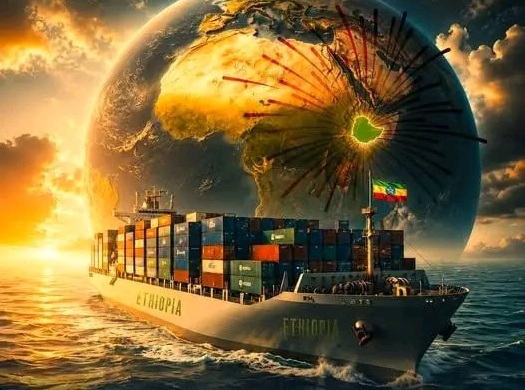
Ethiopia has never truly been a stranger to the Red Sea.
Long before modern borders redrew the map of the Horn of Africa, Ethiopian civilization was connected to the Red Sea through trade, diplomacy and coastal gateways linking the highlands with Arabia, the Mediterranean and the wider Indian Ocean world.
That historic connection was eventually severed.
But geography was not.
Today, Ethiopia is a country of more than 130 million people, one of Africa’s largest economies and a major economic center in the Horn of Africa—yet it remains without a coastline. For decades, its international trade has depended heavily on neighboring ports, particularly Djibouti. The World Bank continues to describe Djibouti as Ethiopia’s primary maritime gateway, while recent assessments underline how disruptions along the corridor can translate directly into higher logistics costs and economic pressure inside Ethiopia.
That reality has turned maritime access from a historical question into a contemporary economic, security and strategic one.
Geography Cannot Be Negotiated Away
Ethiopia’s loss of direct access to the sea did not erase its geographic position.
The country remains at the center of the Horn of Africa, immediately adjoining one of the world’s most consequential maritime regions. The Red Sea, Gulf of Aden and Bab el-Mandeb connect Africa with the Middle East, Asia and Europe and disruptions there can reverberate through global trade, energy markets and supply chains.
For Ethiopia, the consequences are particularly direct.
A landlocked economy of this scale cannot treat maritime connectivity as a peripheral concern. Every container entering or leaving the country ultimately depends on a corridor connecting the interior to the coast.
The current system has created an important economic relationship with Djibouti, but it has also exposed the structural vulnerability of relying overwhelmingly on a single maritime gateway. The Addis-Djibouti corridor remains vital to Ethiopian trade, while the World Bank notes that disruptions and inefficiencies along the wider logistics chain can affect businesses and consumers.
The question, therefore, is no longer whether Ethiopia is interested in the sea. It is how a country of Ethiopia’s demographic and economic weight can build reliable, diversified and sustainable maritime connectivity.
Most importantly, the rapidly shifting political and military dynamics in the Red Sea and Horn of Africa have made sovereign sea access not merely desirable for Ethiopia, but increasingly unavoidable.
The Red Sea Is No Longer Just a Trade Route
The strategic importance of the Red Sea has become impossible to ignore.
The Bab el-Mandeb is a critical maritime chokepoint. Recent disruptions have demonstrated how quickly insecurity at sea can become an economic problem on land, raising freight costs, extending shipping times and disrupting supply chains. UN Trade and Development has recently warned that renewed disruptions around Bab el-Mandeb are creating longer routes, higher fuel consumption, greater costs and additional pressure on global trade.
For Ethiopia, this creates a striking paradox. Although the country has no coastline, instability along the Red Sea can affect its economy directly.
Ethiopia therefore has a substantial stake in the security of a maritime space in which it currently has limited direct presence.
This is why the Red Sea question cannot be reduced to the search for a port.
It is about connectivity, economic security and regional stability.
From a Port to a Corridor
Ethiopia’s maritime ambition makes greater sense when viewed not as a search for a single coastal facility, but as part of a much larger economic corridor.
A functioning maritime connection would link the coast to Ethiopia’s roads, railways, dry ports, industrial parks, agricultural production centers and consumer markets.
The objective would not simply be to move containers andiIt would be to move an economy.
That distinction matters.
A port without an efficient inland network is only a point on a map. A port connected to production, manufacturing, agriculture and regional markets becomes an engine of economic integration.
Ethiopia’s experience with the Djibouti corridor already demonstrates the importance of this wider system. The World Bank’s recent work on Modjo Dry Port, for example, highlights how improvements in inland logistics can reduce processing delays and strengthen Ethiopia’s links to international markets.
The next stage of Ethiopia’s maritime thinking can therefore be understood as the search for multiple corridors, multiple gateways and greater resilience.
Economic Security Is Maritime Security
The Red Sea has also exposed another reality: maritime security and economic security are increasingly inseparable.
When shipping routes are threatened, insurance costs rise. When vessels divert around dangerous waters, delivery times increase. When freight costs rise, the consequences eventually reach factories, farmers, traders and households far from the coastline.
Ethiopia does not need to be a coastal country to experience these consequences.
Indeed, its landlocked position makes reliable maritime access even more important.
A diversified maritime strategy could give Ethiopia greater resilience against disruptions while creating additional opportunities for trade, investment and industrial development.
It could also strengthen the economic interests that Ethiopia shares with its coastal neighbors.
A Return to the Sea Need Not Mean a Return to Rivalry
There is another dimension to Ethiopia’s maritime question that deserves greater attention. Access to the sea does not necessarily have to become another source of regional competition.
It can become an instrument of regional integration.
A port serving Ethiopian trade can generate business for a coastal state. A road or railway linking the interior to the coast can connect multiple economies. Industrial and logistics zones can create jobs and investment on both sides of a border. In that sense, Ethiopia’s maritime aspirations can be framed not simply as a national demand, but as part of a broader Horn of Africa economic equation.
The region has spent decades treating geography as a source of strategic rivalry. It can also treat geography as an opportunity for integration.
Ethiopia’s Maritime Question Is Growing, Not Fading
Prime Minister Abiy Ahmed has repeatedly underscored that Ethiopia’s desire for sea access in terms of geography, economic necessity, dialogue and mutually beneficial cooperation rather than military expansion. The Ethiopian government has stated that the country’s demographic and economic scale makes dependable maritime connectivity an important national interest.
That argument sits within a broader reality. Ethiopia is not the same country it was three decades ago.
Its population and economy have expanded. Its trade ambitions have grown. Its industrial and agricultural production is becoming more integrated with international markets. And its exposure to disruptions along global shipping routes is increasing.
The maritime question will therefore become more—not less—important as Ethiopia’s economy expands.
The revival of attention to maritime affairs, including the re-establishment of the Ethiopian Navy in 2018, reflects this broader strategic shift.
But the ultimate objective need not be the projection of power.
It can be the protection of economic interests, participation in regional maritime security and the creation of durable commercial links between the Ethiopian interior and the global economy.
The Geography of the Future
The central fact remains remarkably simple:
Ethiopia’s landlocked status is a historical tragedy shaped by external forces and political decisions made during a turbulent period—decisions that profoundly altered the country’s relationship with the sea. Yet the giant nation has never truly been disconnected from the Red Sea.
Its economy depends on maritime trade. Its security environment is shaped by the Red Sea and Bab el-Mandeb. Its geographic position places it at the heart of the Horn of Africa. And its growing population and economy make dependable access to international trade routes increasingly consequential.
The challenge, therefore, is not to recreate history exactly as it was. It is to build a new relationship with the sea suited to the realities of the 21st century.
That means ports—but also corridors. It means trade—but also security.
It means national interest—but also regional cooperation.
And above all, it means recognizing that the Red Sea is not a distant body of water separated from Ethiopia by political boundaries.
It is part of the strategic geography in which Ethiopia’s future is being shaped.
For a country whose civilization has been connected to the Red Sea for centuries, the renewed search for maritime connectivity is not simply a journey backward into history.
It is Ethiopia looking toward the future and back toward the sea.


