Ethiopia's Meskel-Demera : Where Faith and Heritage Come Alive - ENA English


Ethiopia's Meskel-Demera : Where Faith and Heritage Come Alive
By Yordanos D.
Sept. 26, 2026 (ENA)
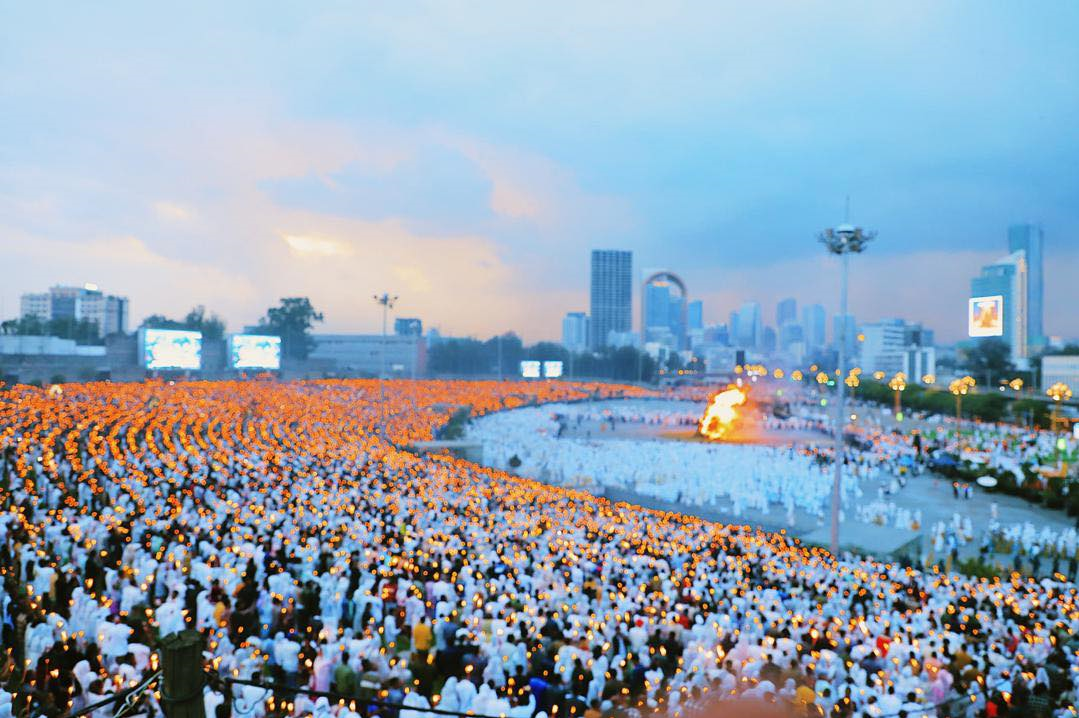
Every year as Ethiopia approaches the festival of Meskel, communities across the country gather around towering bonfire structures known as Demera, carefully constructed from poles, branches, grass, and yellow Meskel flowers. As evening approaches, clergy, Sunday school students, families, and worshippers gather in public squares, church compounds, and local neighbourhoods. Together, they fill the air with prayers, hymns, traditional songs, and ceremonial rites in anticipation of lighting the central fire.
The Demera bonfire serves as the primary ceremonial symbol of the Ethiopian Meskel celebration, which commemorates the discovery of the True Holy Cross of Christ. Although deeply anchored in the religious life of Ethiopian Orthodox Christians, the tradition has evolved into a vibrant expression of civic participation, cultural continuity, and social interaction. Beyond its spiritual significance, the sheer scale and distinctiveness of these public gatherings have given Demera growing importance as a driver of cultural tourism and local economic vitality.
Recognizing its profound cultural value, UNESCO inscribed the Commemoration Feast of the Finding of the True Holy Cross of Christ on the Representative List of the Intangible Cultural Heritage of Humanity in 2013. Official UNESCO documentation identifies Demera as the central catalyst of the celebration, noting that Meskel is observed across Ethiopia regardless of age, gender, language, or ethnicity, while highlighting the vital role local churches play in coordinating communities and safeguarding this living tradition.
Expression of Faith
At its core, Demera is a sacred religious observance. Every element, from the physical construction of the pyramid-shaped bonfire to the solemn prayers, liturgical chants, and ritual lighting, connects directly to Christian traditions surrounding Queen Helena's discovery of the Cross.
Consequently, Demera is far more than a public spectacle for worshippers; it is a profound expression of faith, devotion, thanksgiving, and spiritual renewal. Gathering around the flame fosters a shared religious experience that binds individuals to their families, congregations, and broader communities.
This religious meaning endures largely through active intergenerational transmission. Children and young people observe the preparation of the bonfire, listen to traditional chants, and actively join the festivities alongside their parents, elders, and spiritual leaders. Through this repeated participation, sacred knowledge and ritual practices are seamlessly passed from one generation to the next.
This intergenerational dynamic is precisely why UNESCO recognized Meskel as a heritage deeply rooted in Ethiopian life. Because its continuity relies not on static written archives but on the active dedication of communities who build the bonfire, chant the hymns, and maintain the rituals, Demera remains a dynamic, living heritage.
Social Unity
Beyond its spiritual dimension, Demera provides a vital venue for communal gathering in shared public spaces. The festival brings together clergy, families, youth, elders, and visitors around a unifying cultural heritage. Because it is celebrated simultaneously across the nation, Demera allows local variations to thrive while maintaining a cohesive connection to the broader national tradition.
UNESCO's 2013 inscription explicitly highlighted the festival's contribution to social cohesion, integration, and diversity. Furthermore, UNESCO documented the customary practice of resolving personal disputes and social grievances prior to the lighting of the fire, framing Meskel as a powerful ritual for reconciliation and peaceful coexistence.
The gathering around Demera creates a recurring opportunity for social interaction and family reunions, particularly as migrant workers return to their hometowns. In this sense, Demera serves as an annual bridge connecting religious devotion, family life, and civic harmony—facilitating the exchange of ideas, resources, and social ties between urban and rural populations.
Cultural Tourism
The vivid sensory details of Demera, the ceremonial vestments of the clergy, rhythmic chanting, traditional attire, and the dramatic blaze against the evening sky, create a uniquely authentic Ethiopian experience. This distinctiveness gives the festival immense potential for cultural and religious tourism.
Celebrations at major venues, such as Addis Ababa's Meskel Square, draw hundreds of thousands of participants, serving as landmark events on the national cultural calendar. Domestic visitors travel across regions to participate in rituals and reconnect with relatives, while international visitors encounter a living, unmanufactured tradition rather than a staged performance.
Over the past three years, tourist flow around the festival period has reflected a strong recovery and upward trajectory following post-pandemic and regional stabilization efforts. Nationwide international tourist arrivals rose from approximately 658,000 in 2023 to 725,000 in 2024, followed by a 15 percent increase in 2025 that brought annual arrivals past 830,000. This momentum accelerated further into 2026, with overall annual international visits surpassing 1.6 million.
During the Meskel and Demera season each September, key urban centers, most notably Addis Ababa, experience significant seasonal spikes in visitor volume, as tens of thousands of international tourists and hundreds of thousands of domestic travelers gather for the ceremony.
This movement of people stimulates demand for transportation, accommodation, food services, and artisanal crafts, generating economic activity that extends beyond the immediate site of the ceremony into the wider regional economy.
The relationship between religious heritage and community development is supported by academic research. A 2013 study by Berhanu Esubalew at Addis Ababa University on religious tourism in Lalibela demonstrated that religious heritage can drive sustainable development and community empowerment when local populations are actively involved. Similarly, a 2019 study by Muluemebet Semaw highlighted how religious heritage generates intertwined economic and spiritual value for local residents. While these studies focused on Lalibela, their underlying insights apply directly to Demera: religious traditions yield meaningful economic value only when communities remain the primary stewards and beneficiaries.
Economic Contribution, Community Bondage
The economic benefits of Demera emerge naturally through the influx and gathering of visitors. Hotels, guesthouses, restaurants, transport providers, street vendors, and local craftspeople all experience heightened demand during the festival season.
In alignment with UNESCO's guidelines on intangible cultural heritage, commercial activity can strengthen local economies as long as it does not threaten the authenticity of the tradition. The key is ensuring that economic benefits are not monopolized by large corporate players. Local traders, food providers, artisans, and small accommodation providers must be given opportunities to participate meaningfully in the tourism economy created around the celebration.
As visitor interest in Demera expands, safeguarding its sacred identity becomes paramount. In line with UNESCO guidelines, commercial expansion must be carefully managed to prevent decontextualization or the conversion of a holy rite into mere entertainment.
To preserve the integrity of Demera, local authorities and tourism organizers should focus on several key management practices. First, they must prioritize the sacred rite by ensuring that liturgical services, prayers, and long-standing community traditions remain the central focus, completely uninhibited by commercial staging.
In addition, providing clear cultural context through pre-arrival digital guides and interpretive materials can help educate visitors on the theological and historical significance of the event. Furthermore, managing event infrastructure effectively, by implementing robust crowd control, public safety protocols, sanitation, and waste management, is vital to protecting church grounds and surrounding public spaces during large gatherings. Finally, organizers should actively distribute economic benefits by directing tourism opportunities toward local small businesses, artisans, traditional food vendors, and regional transport operators, ensuring that the community remains the primary beneficiary.
Living Heritage
The true strength of Demera lies in the fact that it is actively lived and practiced. Its value cannot be measured solely by tourist headcount or economic output; these are secondary benefits that arise naturally from protecting a tradition whose primary value is spiritual and social.
As one of the most recognizable public expressions of Ethiopia's living cultural heritage, Demera brings together faith, family, and national identity. UNESCO's recognition reinforces its importance while bestowing a clear responsibility: as the festival becomes more visible globally, preserving its authenticity and keeping local communities at the center of its stewardship remain essential.
In conclusion, Ethiopian Demera is far more than a ceremonial bonfire; it is a living testament to faith, communal solidarity, and cultural memory transmitted through generations. While its visual magnificence offers extraordinary potential for responsible tourism and local economic development, its true value remains anchored in its spiritual meaning and community ownership.
By balancing heritage preservation with thoughtful management, Ethiopia can foster economic opportunities around Demera without altering its sacred character, ensuring that its flame continues to illuminate faith, unity, and shared identity for generations to come.


