Cairo–Asmara Alignment: Fueling Proxy Conflict in the Horn of Africa - ENA English


Cairo–Asmara Alignment: Fueling Proxy Conflict in the Horn of Africa
Mahder Nesibu from POA
Sept. 26, 2026 (ENA)
An alignment between Cairo and Asmara has come to define much of the recent turbulence in the Horn of Africa. The two capitals are now coordinating in ways that deepen division across the region and, more troublingly, that foster rebellion and insurgency aimed at undermining legitimate governments and entrenching instability.
The alignment has emerged directly from each capital's posture toward Addis Ababa. For Egypt, the driving factor is Nile basin politics. Unable to halt Ethiopia's construction of the Grand Ethiopian Renaissance Dam, Cairo spent years pursuing other means of resistance, lobbying internationally and cultivating opposition to the dam among basin states. These efforts proved futile. On 9 September 2025, Ethiopia formally inaugurated the dam and presented it as an engine of regional prosperity, one already exporting electricity to neighbouring states with plans to expand that role. To the further detriment of Egyptian hegemony over the Nile, a hegemony Cairo has long asserted through claims of exclusive rights as the lower basin state, Ethiopia has signalled its intent to build additional dams on the Abbay, defying Egyptian objections and ushering in a new order on the river.
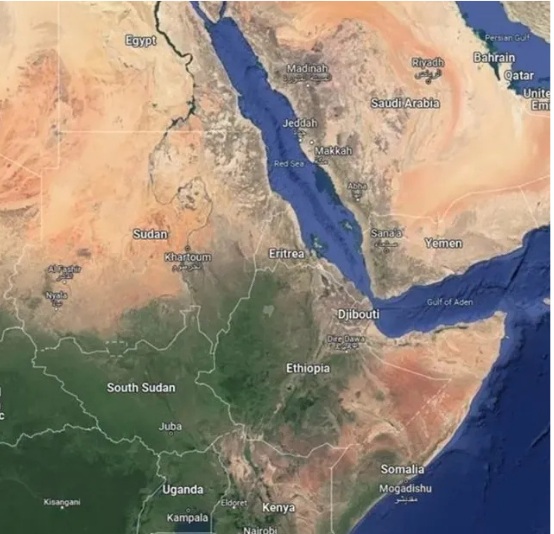
Eritrea's logic is more conflict-prone. The regime in Asmara, one of the most authoritarian in the world and long defined by a policy of interference and destabilisation, has revived its antagonism toward Ethiopia, a posture it has held since Eritrea's secession in 1991. Framing the Ethiopian government as an adversary, Asmara has returned to a familiar instrument, indirect conflict. Over the decades this has played out across Sudan, Djibouti and Somalia, including support for Al-Shabaab, as well as inside Ethiopia itself, where Asmara has cultivated rebel groups and non-state actors against governments it regarded as hostile to its interests.
That policy has been active again in recent years. Eritrea has gradually built-up rebel movements inside Ethiopia, among them the Tigray People's Liberation Front and the Amhara Fano National Movement. Asmara has been providing backing through Ethiopia's Tigray border and through Sudan, whose own instability has made the latter route possible, supplying arms, finance and coordination, and playing a central role in engineering the coalition itself.
Cairo's part has largely been played from the rear. As Eritrea cultivated these insurgencies, Egypt built closer ties with Asmara, calculating that a weakened, unstable Ethiopia would strengthen its own hand in the long-running rivalry between the two capitals.
The emerging strategic alignment between Cairo and Asmara represents a dangerous shift in the geopolitics of the Horn of Africa, as both regimes increasingly resort to proxy politics and indirect warfare to destabilize the region. Driven by Cairo’s lingering anxieties over the Grand Ethiopian Renaissance Dam and Asmara’s deep-seated doctrine of viewing Ethiopia as a permanent regional rival, this coalition seeks to undermine Addis Ababa’s political stability from within. By cultivating, funding, and arming internal insurgencies—such as non-state actors along Ethiopia’s borders—and exploiting the ongoing civil war in Sudan as a staging ground, the regimes in Egypt and Eritrea are fostering conditions that risk fracturing the fragile security apparatus of the broader Horn.
Ethiopia is not the only theatre. In Sudan, Cairo and Asmara have coordinated support for the Sudanese Armed Forces, one of the two belligerents that pushed out the civilian administration in 2021 alongside the Rapid Support Forces before turning on each other in 2023, plunging the country into civil war. Egypt and Eritrea have used their leverage with the Sudanese army to advance their own interests inside Sudan, among them using the country as a staging ground for the anti-Ethiopian elements. Eritrea has funnelled arms through Sudanese territory and established positions there, with TPLF forces operating from inside Sudan. That presence has fed directly into fighting along the Ethiopian border, With TPLF forces launching attacks against Ethiopia from the Sudanese side.
The Horn of Africa is a vital global transit corridor and a linchpin of continental security, anchored by the strategic waters of the Red Sea and the Bab-el-Mandeb Strait. Stability in this region is essential not only for surrounding nations, but also for international trade, energy corridors, and counter-terrorism efforts across East Africa and the Middle East. When regional powers actively promote rebellion, weaponize state fragmentation, and fuel cross-border warfare, the fallout extends far beyond diplomatic friction—it threatens to destabilize sea lines of communication, exacerbate severe humanitarian crises, and trigger massive population displacement across fragile borders.
Addressing the United Nations General Assembly's high-level debate in New York this week, President Taye Atske-Selassie referred to external actors he described as habitually engaged in fomenting instability in the region. He said Ethiopia had exercised restraint despite continued interference in its internal affairs, and reaffirmed its conviction to becoming one of the continent's most dynamic centres of development. He called on those responsible to respect the right of the people of the Horn of Africa to live in peace and prosperity.
For the international community, Ethiopia's stability, and that of the Horn more broadly, ought to be a matter of real concern. The most serious threat to that stability is not the domestic insurgencies and political divisions themselves, which remain amenable to negotiation and political consensus. It is the role played by outside states, Egypt and Eritrea foremost among them, that regard the weakening of Ethiopia and its neighbours as being in their own strategic interest. That conduct deserves to be named and addressed by those with the standing to do so.
In the face of these coordinated provocations, Ethiopia's strategic patience has served as a critical bulwark against full-scale regional collapse. Rather than responding with immediate military escalation or matching proxy interventions, Addis Ababa has largely emphasized diplomatic restraint, regional integration, and economic interdependence—positioned around infrastructure projects and energy exports. This restrained posture, reinforced by public calls at international forums such as the UN General Assembly for external actors to respect regional sovereignty, highlights a commitment to peaceful development. However, as proxy pressures intensify along multiple borders, the international community must recognize that regional stability cannot rely indefinitely on Ethiopia's tolerance; holding outside actors accountable for covert interference is essential to securing long-term peace in the Horn.


