President Taye Urges Global Shift from Renewable Generation to Electricity Delivery - ENA English


President Taye Urges Global Shift from Renewable Generation to Electricity Delivery
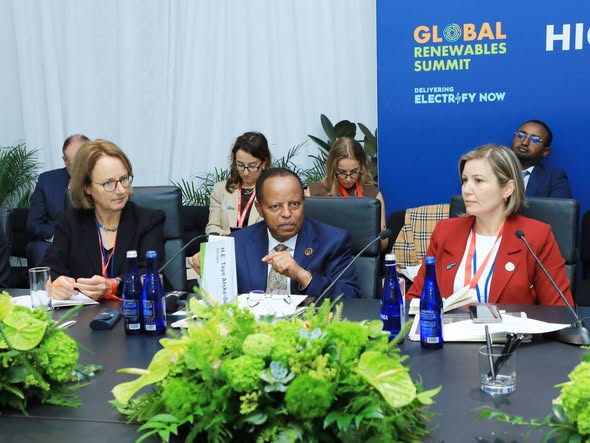
Addis Ababa, September 21, 2026 (ENA) —Ethiopia’s President Taye Atske Selassie called for a fundamental shift in the global renewable-energy agenda—from simply expanding power generation to building the grids, storage, financing and productive systems needed to turn clean electricity into economic transformation.
Addressing the “Delivering Electrify Now” High-Level Leaders Dialogue of the Global Renewables Summit in New York, President Taye said countries endowed with abundant renewable resources need stronger international support to convert their energy potential into reliable electricity access, industrial growth and inclusive prosperity.
“Generation without grids, storage and robust utility capacity cannot drive economic transformation,” the President said, stressing that international financing must support the entire electricity value chain—from generation and transmission to distribution, storage and last-mile connections.
The Global Renewables Summit, held during Climate Week NYC alongside the UN General Assembly, is bringing together political leaders, businesses, investors and international institutions to accelerate renewable-powered electrification and address the infrastructure and investment barriers slowing the energy transition.
President Taye said Ethiopia brings substantial renewable-energy potential to the global discussion, with more than 95 percent of its installed generation capacity coming from renewable sources.
He highlighted the Grand Ethiopian Renaissance Dam (GERD) and other renewable-energy investments as key foundations for expanding electricity access and powering the country’s industrialization.
He outlined three interconnected priorities for Ethiopia: expanding and diversifying renewable generation, with installed capacity targeted to reach up to 14,000 MW by 2030 and non-hydro renewables accounting for at least 15 percent; using clean and affordable electricity to strengthen industrial competitiveness, including through industrial parks; and pursuing macroeconomic and energy-sector reforms to attract greater private investment, including increased private-sector participation in transmission and distribution.
But the President emphasized that finance remains the critical link between renewable-energy potential and actual development.
He called for more bankable projects supported by public resources and international partners, including the World Bank, African Development Bank and the European Union through Global Gateway. Particular attention, he said, should go to transmission infrastructure, substations, grid reinforcement, reconductoring and last-mile connections.
President Taye cited Ethiopia’s experience financing the GERD through domestic resources and broad public mobilization as an example of the importance of national ownership and commitment.
At the same time, he stressed that international financial cooperation remains essential for developing countries seeking to build modern, reliable and interconnected electricity systems.
He expressed appreciation for international support to Ethiopia’s power sector, including the European Union’s RISED programme, as well as assistance from the World Bank and African Development Bank in modernizing, rehabilitating and digitalizing electricity infrastructure.
The President also warned that the global energy transition cannot deliver its full promise if renewable investment remains concentrated in a limited number of wealthy regions.
For developing countries, he said, the ambition must go beyond generating renewable power: from energy potential to electricity access, from access to productive use, and from productive use to industrialization and job creation.
As Ethiopia prepares to host COP32 in Addis Ababa in 2027, President Taye said the country will work to help ensure that global climate and renewable-energy commitments translate into concrete implementation across Africa.
His message comes as the international renewable-energy agenda increasingly focuses not only on expanding generation but also on scaling grids, storage and electrification to make clean power usable across economies.


