Egypt’s Anti-Ethiopia Strategy Goes Beyond the GERD - ENA English


Egypt’s Anti-Ethiopia Strategy Goes Beyond the GERD
By Tewodros Habenom
August 29, 2026
For more than a decade, the Grand Ethiopian Renaissance Dam (GERD) has stood at the center of one of Africa’s most consequential geopolitical and hydropower shifts. Yet reducing Egypt’s unfounded propaganda against Ethiopia over water risks missing a larger and increasingly important story.
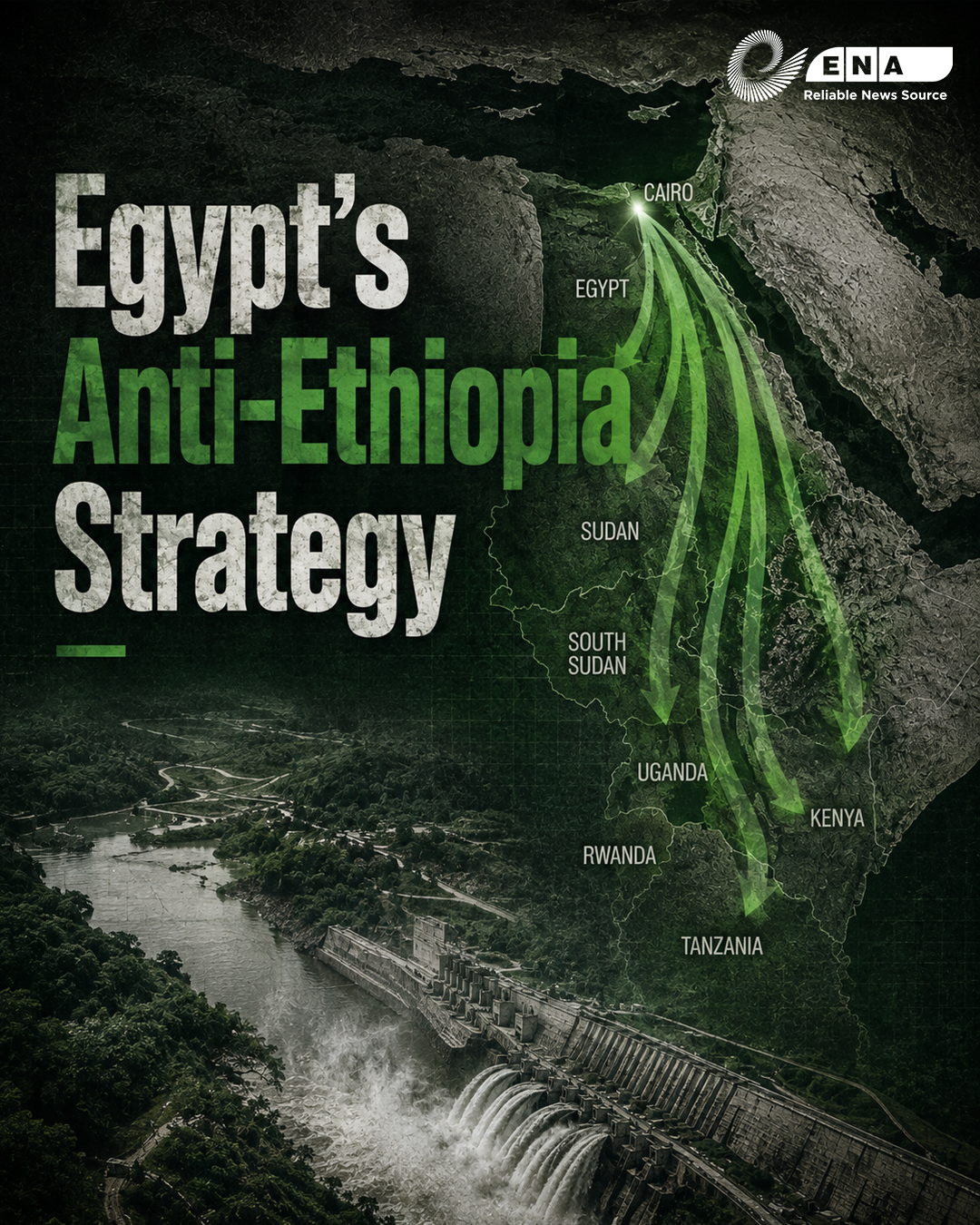
Egypt’s opposition to Ethiopia’s development of the Abay (Nile) River did not begin with the GERD, and Cairo’s latest escalation about Ethiopia’s plans to develop additional water infrastructure cannot be understood in isolation. They form part of a broader strategic contest involving water security, regional influence, the Red Sea, Ethiopia’s internal politics and the shifting balance of power in the Horn of Africa.
The central question, therefore, is no longer simply how the two countries should manage the Nile.
It is whether a dispute over a river is gradually becoming a wider struggle over Ethiopia’s strategic choices and regional position.
A dispute that escaped the negotiating table
The most revealing evidence that the dispute has long extended beyond technical questions of water came into public view in 2013.
During a meeting chaired by then-Egyptian President Mohamed Morsi to discuss the GERD crisis, several Egyptian political figures were inadvertently heard discussing possible ways of pressuring Ethiopia. The meeting was being broadcast live, apparently without all participants realizing that their comments were on air.
The statements were extraordinary.
Younis Makhyoun, then head of Egypt’s Al-Nour Party, suggested supporting Ethiopian opposition movements as a means of putting pressure on Addis Ababa. He specifically referred to the Oromo Liberation Front and the Ogaden National Liberation Front. He also discussed strengthening Egypt’s relations with Eritrea, Somalia and Djibouti and viewing those relationships as potential pressure points against Ethiopia.
Ayman Nour, then head of the Ghad al-Thawra Party, went even further. He advocated a political and intelligence presence capable of engaging with Ethiopia’s internal affairs and argued that relations with Eritrea, Somalia and Djibouti could constitute an important card for pressuring the giant East African nation. Contemporary reporting recorded his call for political, intelligence and military teams to operate in Ethiopia.
These were not diplomatic communiqués. Nor should statements by individual politicians automatically be treated as proof of a formal, enduring Egyptian state policy.
But their significance cannot simply be dismissed.
They exposed, in unusually direct fashion, the thinking circulating within an influential segment of Egypt’s political establishment at one of the most sensitive moments in the GERD dispute.
The world did not learn about these ideas through leaked intelligence documents or diplomatic speculation.
It heard them on live television.
From water politics to pressure politics
What makes the 2013 episode particularly important today is the logic behind the proposals.
The discussion was not limited to negotiating the operation of a dam. It included internal Ethiopian political dynamics, neighboring states, intelligence capabilities and even the possibility of military pressure.
Makhyoun referred to Ethiopian opposition groups as potential “pressure cards,” while contemporary accounts reported discussion of using intelligence capabilities against the dam if other options failed. Nour, meanwhile, proposed creating the perception that Egypt was preparing for military action as a means of intensifying pressure on Ethiopia. Yet Egypt has never tested Ethiopia through direct military confrontation. The military option remains a dead end for Cairo, constrained by Ethiopia’s geography, strategic depth and military capabilities.
Taken together, the remarks revealed a broader conception of the dispute: pressure could potentially be applied not only through diplomacy, but also through Ethiopia’s internal political vulnerabilities and its regional environment.
That distinction matters.
A disagreement between two sovereign states over the management of a transboundary river belongs at the negotiating table. Efforts to manipulate a country’s internal political divisions or transform neighboring states into instruments of strategic pressure belong to a fundamentally different category.
This is precisely why the 2013 episode remains relevant.
The Horn of Africa has changed—and so has the battlefield
More than a decade later, the geopolitical landscape surrounding Ethiopia has become considerably more complicated.
The Nile dispute now intersects with Red Sea security, Ethiopia’s pursuit of maritime access, the conflict in Sudan, Somalia’s security concerns and competition for influence across the Horn of Africa.
Egypt’s relations with countries surrounding Ethiopia have also become more strategically significant.
In June 2026, Egyptian President Abdel Fattah El-Sisi received Eritrean President Isaias Afwerki in Cairo, with the two sides discussing bilateral cooperation, Sudan and coordination on Red Sea security. Egypt and Eritrea have subsequently continued consultations on their strategic partnership and regional security.
When today’s regional alignments are viewed alongside the strategic thinking publicly articulated during the 2013 GERD crisis, a legitimate question emerges:
Is Cairo’s strategy fundamentally about water interests—or is it increasingly about managing Ethiopia’s growing regional influence?
That question has become more relevant as competition over the Red Sea and the Horn of Africa intensifies.
Recent regional analysis has noted that Egypt’s concerns now extend beyond the Nile to Ethiopia’s maritime ambitions, regional partnerships and expanding geopolitical role. In July 2026, consultations involving Egypt, Somalia, Eritrea and the United States also highlighted the increasingly interconnected nature of Red Sea security, Ethiopia’s regional ambitions and broader Horn of Africa competition.
Ethiopia’s rise changes the calculation
There is another reality that Cairo must confront.
Ethiopia today is not the Ethiopia of previous decades.
The GERD itself has become a symbol of this transformation.
For Ethiopia, the project is not simply an electricity-generating facility. It represents a national effort to mobilize domestic resources, expand energy production and demonstrate that a major African development project can be financed and built through national determination.
That transformation has altered the political psychology surrounding the Nile.
Ethiopia is increasingly asserting that development, sovereignty and regional economic integration cannot be subordinated indefinitely to downstream preferences.
This does not mean Ethiopia has no responsibility toward downstream countries.
It does.
As an upstream country, Ethiopia has demonstrated its commitment to the sustainable and equitable use of shared water resources, maintained communication with downstream states, and acted with due regard for the interests of downstream countries. But responsibility does not mean surrendering sovereign rights. Ethiopia does not need Cairo’s permission to develop projects on Ethiopian soil, just as Egypt does not require Addis Ababa’s permission to develop its own territory.
Ethiopia’s responsibility is cooperation. Not submission.
The line is crossed when Egypt’s water concerns are transformed into an entitlement to dictate what Ethiopia can build, where it can build it, or how it can use its own natural resources.
Abay (Nile) is a shared resource. But Ethiopia’s territory, sovereignty and right to development are not Egyptian possessions. Cooperation requires mutual respect; it cannot mean Ethiopia develops only when Cairo approves.
The question Cairo must answer
If Cairo’s case is truly about water, why does it increasingly look like a struggle for political leverage over Ethiopia?
And if Cairo’s objective is stability in the Horn of Africa, how can the region achieve lasting peace if neighboring states increasingly view one another through the lens of containment and strategic rivalry?
These are not questions directed against the Egyptian people.
Ethiopians and Egyptians have centuries of historical, cultural and human connections. The two societies have far more reasons to cooperate than to become permanent adversaries.
The real issue is not the GERD alone. But it is a decades-old strategic logic of confrontation against Ethiopia embedded in Egyptian political thinking—a pattern that has repeatedly treated pressure, regional alliances and political leverage as instruments for containing Ethiopia’s rise.
A dangerous cycle for the Horn
The greatest danger is that Abay (Nile) dispute becomes a gateway into a much wider regional confrontation.
The Horn of Africa is already one of the world’s most strategically sensitive regions. It sits alongside the Red Sea and Bab el-Mandeb, through which critical global trade routes pass. It is also affected by conflicts in Sudan and Somalia, unresolved regional rivalries and growing competition over ports, maritime access and security partnerships.
Adding Egypt’s reckless proxy strategy to an already fragile regional environment carries risks far beyond the borders of the two countries.
A strategy of containment could produce the opposite of its intended outcome.
Instead of forcing Ethiopia to abandon its development ambitions, it could encourage Addis Ababa to deepen strategic partnerships elsewhere, accelerate efforts to diversify its regional relationships and adopt an even more security-oriented approach to its foreign policy.
That would make compromise harder—not easier.
Ethiopia cannot be treated as a pressure card
The central lesson of the 2013 episode is therefore not simply that Egyptian politicians once discussed aggressive measures against Ethiopia.
It is that the idea of influencing Ethiopia through its internal vulnerabilities and regional surroundings was publicly articulated at a critical moment in the Nile dispute. That history deserves to be remembered—not to perpetuate hostility, but to prevent the repetition of a dangerous logic.
Ethiopia’s internal political affairs belong to Ethiopians.
Its development choices belong to its sovereign institutions and people. And its relationships with neighboring countries cannot legitimately be transformed into a permanent geopolitical battlefield.
The answer to pressure should not be escalation. It should be strategic confidence, diplomacy and regional engagement.
Beyond the GERD: Abandon the Politics of Fear and Pressure
Egypt has no reason to fear Ethiopia’s development. Thus, Egypt should stop treating Ethiopia’s development as one.
Ethiopia has repeatedly demonstrated maximum generosity and a willingness to negotiate under the African Union-led framework, grounded in a simple principle: "African solutions to African problems"
What is needed is not pressure, proxy competition, or regional maneuvering, but dialogue, transparency, mutual respect and genuine African-led solutions. Egypt must abandon the outdated assumption that political pressure can dictate Ethiopia’s strategic choices or produce a sustainable outcome.
Rather than turning the Horn of Africa into a geopolitical chessboard, Egypt should choose cooperation over confrontation and dialogue over destabilizing regional competition. The consequences of continued brinkmanship will ultimately be borne by the people of the region.
GERD was built as a development project. But politically, it has become something far greater: a symbol of Ethiopia’s determination to control its own development, pursue its national interests and shape its own future.
That reality cannot be negotiated away through pressure, threats or alliances forged beyond Ethiopia’s borders.
Nor can Ethiopia’s future be written in Cairo or in any other capital, without Ethiopia at the table.
The era when Ethiopia’s strategic choices could be dictated from outside its borders is over.
Egypt’s choice is now clear: negotiate with Ethiopia as an equal partner—or remain trapped in a politics of fear that cannot stop Ethiopia’s rise.
Egypt’s choice is now clear: negotiate with Ethiopia as an equal partner—or remain trapped in a politics of fear that cannot stop Ethiopia’s rise.


