The Red Sea Cannot Be Stable While Ethiopia Is Shut Out - ENA English


The Red Sea Cannot Be Stable While Ethiopia Is Shut Out
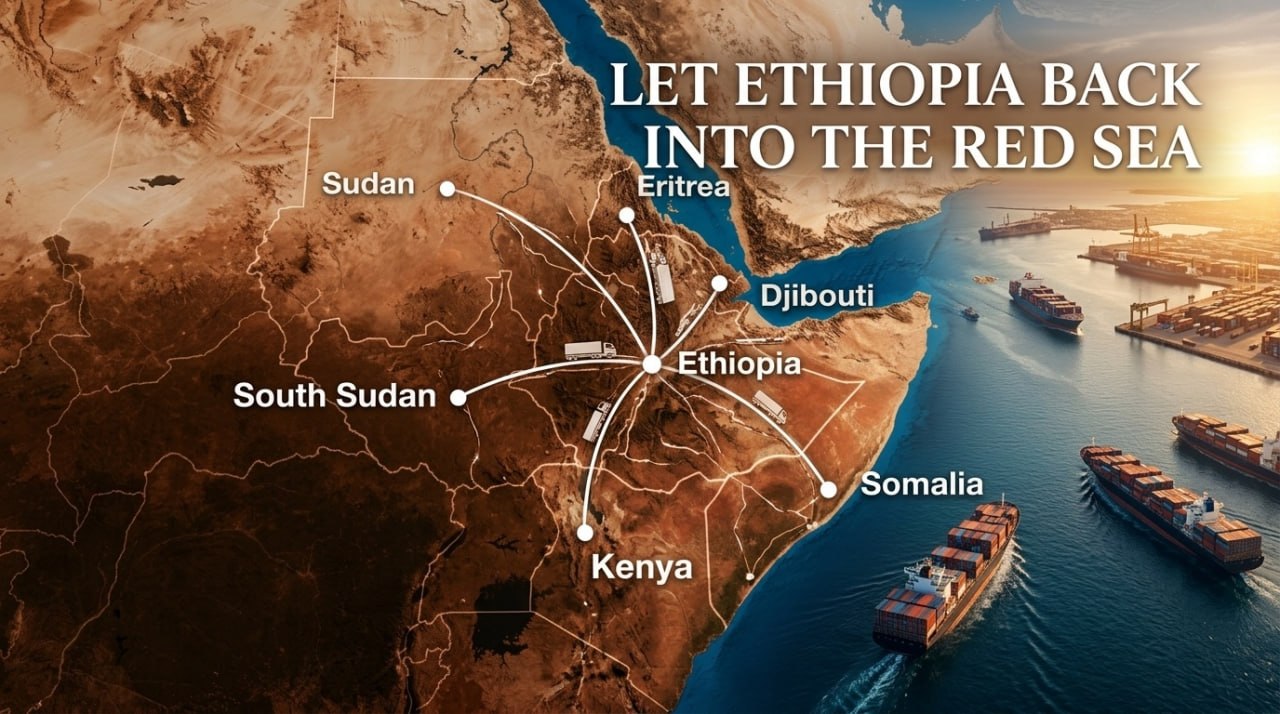
It Is Time to Stop Pretending Ethiopia Has No Stake in the Red Sea
By Yordanos D.
August 22, 2026
The strategic importance of Ethiopia’s maritime question has become increasingly difficult to separate from the wider security crisis unfolding across the Middle East, the Red Sea and the Horn of Africa. Recent disruptions around the Strait of Hormuz have demonstrated how quickly instability at a single maritime chokepoint can affect energy prices, shipping networks, insurance markets, supply chains and consumers thousands of kilometres away.
These developments offer a wider lesson: maritime chokepoints are not simply geographical passages. They are arteries of the global economy. When their security deteriorates, the consequences can spread rapidly across continents.
This raises a critical question for the Horn of Africa: what would happen if prolonged disruption in the Strait of Hormuz were accompanied by a major disruption at Bab el Mandeb?
The consequences could be severe. Hormuz is vital to the movement of energy from the Persian Gulf, while Bab el Mandeb connects the Indian Ocean with the Red Sea and the Suez Canal, forming a crucial trade route between Asia and Europe.
A simultaneous disruption at both chokepoints could force ships to choose between navigating dangerous waters and taking substantially longer routes around Africa. The resulting increase in fuel consumption, insurance costs, freight rates and transit times could create another major shock to global trade.
It is against this backdrop that Ethiopia’s pursuit of reliable access to the Red Sea assumes significance far beyond its own commercial interests. For a country of more than 130 million people, secure maritime access is an economic necessity. But Ethiopia’s return to the Red Sea could also have broader implications for regional connectivity, maritime security, investment and the resilience of international trade. Let us break down the calculus.
The central question, therefore, is not simply whether Ethiopia should regain access to the sea. It is whether a stable and legally negotiated Ethiopian maritime presence could become part of a broader regional system capable of protecting one of the world’s most important trade corridors.
Let us break down the strategic calculus.
Hormuz and Rising Cost of Global Maritime
The strategic importance of the Strait of Hormuz is enormous. In the first half of 2025, about 20.9 million barrels of oil and petroleum liquids per day passed through the strait, equivalent to roughly one fifth of global petroleum liquids consumption and about one quarter of global maritime oil trade. The strait also carries substantial volumes of liquefied natural gas, making it one of the world’s most important energy corridors.
The disruption of these flows illustrates the vulnerability created by such dependence. By the second quarter of 2026, data from the U.S. Energy Information Administration showed that oil flows through Hormuz had fallen sharply compared with 2025 levels, reflecting the impact of regional conflict and maritime restrictions.
Oil prices have responded to the uncertainty. Brent crude reached about $91.62 per barrel on August 19, 2026, and remained above $93 per barrel on August 21 amid continuing concerns over supply disruptions. The lesson is clear: instability at a strategically located maritime chokepoint can increase the cost of energy, transportation and insurance almost immediately.
The significance of Hormuz, however, cannot be understood only through oil prices. The strait is embedded in a wider commercial system that connects energy producers in the Gulf with consumers across Asia, Europe and other regions. Any prolonged disruption can therefore generate secondary effects across manufacturing, transportation, electricity generation and food production.
Bab el Mandeb: The Other Critical Gateway
Bab el Mandeb connects the Red Sea with the Gulf of Aden and the wider Indian Ocean. Together with the Red Sea and the Suez Canal, it forms part of one of the world’s most important maritime corridors linking Asia and Europe.
When vessels cannot safely navigate the Red Sea, many are forced to travel around the Cape of Good Hope. The longer route requires more fuel, crew time and vessel capacity and significantly increases voyage times. According to the U.S. Energy Information Administration, disruptions around Bab el Mandeb or the Suez Canal can force ships onto the longer southern African route, increasing freight rates and shipping costs.
Container ships carrying manufactured goods, bulk carriers transporting commodities, tankers carrying petroleum products and vessels carrying agricultural inputs can all be affected. A ship that spends several additional weeks at sea is also unavailable for another shipment during that period. Consequently, effective global shipping capacity can decline even when factories, warehouses and ports remain operational.
The world has already experienced this problem following attacks on commercial vessels in the Red Sea, which prompted major shipping companies to divert vessels around Africa. The resulting increase in voyage distances and transit times demonstrated how quickly maritime insecurity can spread through freight markets, supply chains and consumer prices.
For Africa, the implications are particularly serious. Many countries depend on imported fuel, fertilizers, machinery, food and manufactured products. Higher shipping costs can therefore translate into higher domestic prices and increased pressure on foreign exchange reserves.
The Dual Chokepoint Crisis
A simultaneous or successive disruption of Hormuz and Bab el Mandeb would transform two regional security problems into a potentially much larger global maritime crisis. Hormuz is principally critical for Gulf energy exports, while Bab el Mandeb is a key gateway for commercial vessels moving between the Indian Ocean and the Red Sea. If both were seriously disrupted, shipping companies could face a difficult choice between navigating insecure waters and taking dramatically longer alternative routes.
Freight rates and insurance premiums could rise sharply. European manufacturers could experience delays in receiving Asian components and finished products, while Asian exporters could face higher costs in reaching European and North African markets. African economies would also be exposed because many depend heavily on imported fuel, fertilizers, machinery, food and manufactured goods.
Governments could require more foreign currency to purchase the same volume of imports, while businesses could pass higher transportation, insurance and energy costs on to consumers. Recent shipping data further illustrates the sensitivity of the two corridors to regional insecurity. Reuters reported that only nine commodity vessels passed through the Strait of Hormuz on both August 18 and 19, 2026, while traffic through Bab el Mandeb fell from 32 to 27 vessels over the same period. By August 21, Reuters reported that Hormuz traffic had fallen further to seven commodity vessels, while Bab el Mandeb recorded 23 vessels.
These figures do not establish that either waterway has been permanently closed. They do, however, demonstrate how quickly geopolitical uncertainty can change commercial shipping behaviour. Even without a formal blockade, heightened security risks can discourage operators, increase insurance costs and force vessels onto longer routes.
A prolonged disruption at both chokepoints would therefore be more than a regional maritime crisis. It could become a major shock to global energy markets, international trade and supply chains.
Egypt’s Spoiler Role in Both Horn Africa and Red Sea Region
Evidently, Egypt’s destabilizing activities in the Horn of Africa can be examined historically through its security and political engagement with countries surrounding Ethiopia. Its growing military cooperation with Somalia has particular strategic significance because Somalia lies close to the Bab el Mandeb, one of the world’s most important maritime chokepoints. The deployment or potential deployment of Egyptian military forces in Somalia could intensify strategic rivalry with Ethiopia and contribute to the militarization of an already fragile security environment.
Egypt’s close political and security alignment with Sudan’s military establishment is another source of regional concern. The continuing war in Sudan has weakened state institutions, expanded armed networks and generated displacement and instability across the region. External military and political involvement risks prolonging the conflict and creating additional security pressures along Ethiopia’s western frontier and the Red Sea. A prolonged crisis in Sudan, where Egypt is behind this ongoing catastrophic civil war, could also create wider instability across the Horn, disrupting trade routes and increasing the movement of armed groups and illicit networks.
Egypt has also supported Eritrea’s regime, whose strategic position on the Red Sea gives a leverage its proxy ambition. Closer Egyptian engagement with Eritrea, combined with its military cooperation with Somalia and its relationship with Sudan, could contribute to competing security alignments around Ethiopia and increase tensions across the Horn.
The most serious concern is the strategic importance of the Bab el Mandeb. Egypt has a vital interest in the waterway because it provides access to the Suez Canal and is central to Egypt’s maritime trade. Egypt has an operational plan to physically close the Bab el Mandeb, the expansion of Egyptian military and political influence around the Horn raises concerns that the waterway could become an instrument of strategic pressure. Any attempt by Egypt or forces aligned with its interests to obstruct navigation through the Bab el Mandeb would have consequences far beyond the Horn of Africa.
Such a disruption could create chaos in world trade. The Bab el Mandeb is a critical link between the Red Sea, the Gulf of Aden and the wider Indian Ocean trade system. Its disruption could force ships to take longer routes around the Cape of Good Hope, sharply increasing transportation costs, insurance premiums, delivery times and fuel consumption. It could also disrupt energy supplies and the movement of food, manufactured goods and essential commodities between Asia, Europe, Africa and the Middle East. Coming on top of instability around other major maritime chokepoints, a serious disruption at Bab el Mandeb could place additional pressure on already vulnerable global supply chains.
Taken together, Egypt’s expanding military partnerships, political alliances and strategic positioning in Somalia, Sudan and Eritrea risk intensifying polarization in the Horn of Africa. If these relationships are used as instruments of confrontation with Ethiopia, they could contribute to greater militarization around the Red Sea and Bab el Mandeb. The consequence would not be limited to Ethiopia or the Horn. A crisis affecting Bab el Mandeb could escalate into a wider maritime emergency, threatening regional stability and creating severe disruption to international commerce and global trade.
Why Ethiopia’s Maritime Return Matters?
This is where Ethiopia’s maritime question takes on significance beyond national economic interests. Ethiopia’s dependence on external maritime gateways leaves its international trade vulnerable to disruption along regional transport corridors. More than 90 percent of Ethiopia’s import and export trade has historically moved through the Addis Djibouti corridor. Heavy dependence on a single principal gateway creates economic exposure when congestion, conflict, political disputes or maritime insecurity affect that route.
A reliable and legally negotiated Ethiopian maritime presence could provide an additional option. It could diversify transport corridors, reduce dependence on a single gateway and strengthen Ethiopia’s ability to withstand regional disruptions.
The objective should not be Ethiopian control of the Red Sea. Rather, it should be predictable and mutually agreed access established through arrangements that respect the sovereignty and territorial integrity of coastal states.
Such an arrangement could provide benefits extending well beyond Ethiopia’s immediate maritime interests. It could strengthen the resilience of global trade by creating additional options for the movement of goods and reducing the risks associated with excessive dependence on a limited number of vulnerable maritime corridors.
It could also contribute to stronger maritime security by encouraging greater cooperation among Red Sea and Horn of Africa countries in protecting shipping routes and responding to emerging security threats. At the same time, improved access to the Red Sea could reduce pressure on existing trade corridors, particularly those facing congestion, insecurity or rising transportation costs, while providing Ethiopia and neighbouring countries with more efficient routes to international markets.
Ethiopia’s maritime engagement could also deepen regional economic integration by linking its large domestic market with the economies and ports of the Horn of Africa and the wider Red Sea region. Greater connectivity could support cross border trade, logistics, manufacturing and infrastructure development, creating opportunities for countries to benefit from Ethiopia’s expanding economy while strengthening regional supply chains.
Improved access to maritime trade would further enhance food and energy security by giving Ethiopia more reliable and diversified channels for importing essential commodities, fuel and industrial inputs. Such connectivity could also make the region more attractive to investors by improving access to markets, lowering logistics costs and encouraging investment in ports, transport networks, industrial parks and related infrastructure.
Ethiopia’s maritime agenda should therefore be approached as part of a wider regional economic and security framework rather than as a contest for control over strategic territory.
A negotiated arrangement could bring together Ethiopia’s need for reliable maritime access with the legitimate interests of coastal states. Ethiopia could secure predictable commercial access, while coastal states could benefit from transit revenues, infrastructure investment, employment, expanded markets and stronger economic links with one of Africa’s largest domestic markets.
Such a framework could also help separate economic connectivity from military confrontation. Commercial maritime access does not necessarily require territorial control. A carefully negotiated arrangement can provide access while preserving the sovereignty of the coastal state and supporting the security interests of neighbouring countries.
This distinction is critical. Ethiopia’s maritime return will be sustainable only if it is based on mutual interest, international law, transparency and respect for sovereignty. The wider strategic objective should be a Red Sea in which economic interdependence becomes a source of stability rather than a trigger for confrontation. Greater trade, infrastructure connectivity and shared maritime security could create incentives for countries to protect the same commercial system from which they benefit.
In this sense, Ethiopia’s return to the Red Sea could become part of a broader effort to build a more resilient regional economy. The country’s large population, expanding domestic market and growing industrial and agricultural potential could generate substantial demand for maritime services, while improved access could help connect neighbouring economies to Ethiopian markets.
In a nutshell, the significance of Ethiopia’s return to the Red Sea extends far beyond the question of ports, trade routes or national economic interests. In an era when disruptions at Hormuz and Bab el Mandeb can reverberate through energy markets and global supply chains, the Horn of Africa needs a more resilient and balanced maritime system.
Reliable Ethiopian access to the Red Sea, achieved through a peaceful, legally negotiated and mutually beneficial arrangement, could provide such an opportunity. It could diversify regional trade routes, reduce dependence on a single corridor, strengthen maritime security, attract investment, improve access to essential commodities and deepen economic integration across the Horn of Africa.
For Ethiopia, maritime access would reduce a fundamental vulnerability associated with being landlocked. For coastal states, it could generate investment, transit revenues and expanded markets. For international shipping, it could contribute to a stronger regional security environment. For global markets, it could add another layer of resilience at a time when maritime chokepoints are increasingly vulnerable to geopolitical disruption.
The strategic objective, therefore, should not be domination of the Red Sea by any single state. It should be the creation of a stable maritime order in which Ethiopia has legitimate and predictable access, coastal states retain their sovereignty, and international shipping enjoys greater security.
In this sense, Ethiopia’s return to the Red Sea should be understood not merely as a national aspiration but as a potential contribution to regional stability and global trade resilience. A peaceful maritime settlement could turn Ethiopia from a vulnerable landlocked economy into a more active economic and security stakeholder in one of the world’s most consequential maritime regions.


