Countering Egypt’s Destabilizing Campaign in the Horn of Africa - ENA English


Countering Egypt’s Destabilizing Campaign in the Horn of Africa
By Staff Writer
August 17, 2026 (ENA)
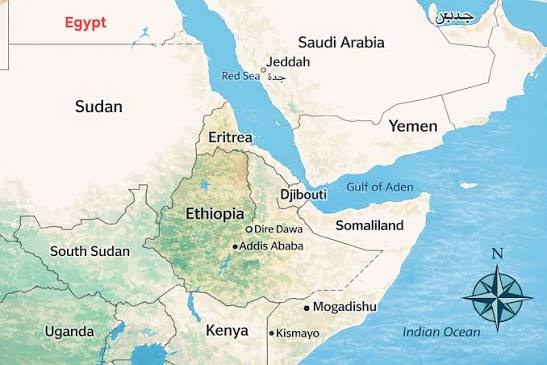
The Horn of Africa is entering another consequential phase in its long-running struggle over security, sovereignty, economic development and access to strategic waterways. At the center of these tensions is Ethiopia’s increasingly assertive pursuit of national development, regional integration and reliable sovereign access to the sea. Unfortunately, there have been mounting efforts by neighboring actors to contain, undermine and ultimately frustrate that trajectory.
Predominantly, Egyptian officials have been at the forefront of reinforcing a destabilizing regional agenda driven by their ambition to prevent Ethiopia, a giant African nation, from rising and asserting its rightful place in the region.
Recent provocations against Ethiopia, involving forces aligned with the banned TPLF and Eritrean-backed elements, have added a dangerous new dimension to an already volatile regional environment. Emerging reports indicate that the now-defunct TPLF opened a new military front in northwestern Ethiopia, only to face a decisive setback. Several TPLF forces reportedly backed by the Eritrean government suffered a heavy defeat on the Shererina front, with hundreds of combatants reportedly captured alive.
The episode has exposed the fragility of what has been portrayed as the so-called “Tsemdo” alliance, an alignment spearheaded by the Eritrean regime alongside local anti-peace forces, including TPLF elements. Its setback represents more than a battlefield reversal. It strikes at a broader strategy aimed at exploiting Ethiopia’s internal divisions, exporting conflict across its borders and obstructing the country’s development and regional ambitions.
For the regime in Asmara, the setback is particularly consequential. Eritrea has repeatedly positioned itself at the center of political and security calculations directed against Ethiopia. The latest developments therefore raise a fundamental question: Is the Horn of Africa witnessing yet another attempt to use proxy forces and cross-border alliances to keep Ethiopia politically divided, economically constrained and strategically isolated?
If so, the implications extend far beyond a single battlefield. They touch the very foundations of sovereignty, regional stability, economic integration and Ethiopia’s legitimate pursuit of sovereign access to the sea.
To understand why Shabia, Eritrean regime, consistently positions itself at the forefront of internal subversion against Ethiopia, one must examine its historical underpinnings. From its inception, the modern Eritrean architecture was fostered by Cairo not as an isolated geopolitical entity, but as a strategic proxy designed to exert leverage against Ethiopia, the source of Abay (Nile). For millennia, the adage that "Egypt is the gift of the Nile" has shaped Cairo's strategic doctrine.
However, this narrow conception of exclusive entitlement, which entirely disregards upper riparian nations, most notably Ethiopia, which contributes 86 percent of the river’s total flow has generated persistent friction across the basin. Rather than embracing equitable utilization and collaborative resource management, successive Egyptian administrations have sought to undermine the rights of upper riparian states and maintain regional hegemony.
The political, geostrategic, and geopolitical landscape of the Horn of Africa has taken on critical dimensions that bear directly on regional security and equilibrium. Cairo’s current posture, which acts as a catalyst for containment and strategic destabilization against Ethiopia, carries far-reaching consequences.
Much of this dynamic stem from the institutional legacies of the colonial era. British administrative structures in Sudan and Egypt prioritized the development of powerful military and security apparatuses at the expense of resilient civilian political institutions. Following independence, both nations inherited centralized state frameworks lacking deep-rooted democratic traditions.
In Sudan, civilian administrations faced political fragmentation and economic instability, leading to eight military coups since 1956. In Egypt, the 1952 Free Officers Revolution established the armed forces as the dominant political authority and the self-proclaimed custodian of national continuity.
This institutional dominance expanded over time into the economic realm. In Egypt, the military apparatus maintains substantial holdings across critical sectors, including manufacturing, infrastructure, construction, and agriculture. Similarly, in Sudan, military and security networks historically exercised control over key commercial domains, such as gold mining and agricultural trade. These commercial interests have solidified institutional autonomy, making transitions to civilian oversight exceedingly complex.
These domestic military structures have significantly influenced regional dynamics in the Horn of Africa through several interconnected mechanisms. First, protracted internal conflicts in Sudan have precipitated massive population displacements, driving millions of refugees into neighboring states, including Ethiopia, South Sudan, Chad, and Egypt. These flows place acute strains on host communities, public infrastructure, and border security management.
Second, Egyptian military-led administrations have consistently framed Nile water allocation strictly through a national security lens, particularly regarding the Grand Ethiopian Renaissance Dam. This rigid approach has frequently complicated diplomatic negotiations over shared water resources and impeded efforts toward equitable basin-wide governance.
Third, regional political volatility discourages direct foreign investment, disrupts critical trade corridors, and delays cross-border infrastructure initiatives intended to link the Red Sea trade routes to the broader African hinterland.
At present, Egyptian strategic maneuvers involve coordinating diplomatic and logistical alignments with the Sudanese Armed Forces, the Eritrean administration, and local insurgent factions active in the Amhara, Oromia, and Tigray regions—collectively referred to as Tsimdo. This coordinated effort aims to constrain Ethiopia's economic trajectory, impede its national development programs, and restrict its legitimate access to Red Sea maritime commerce.
The primary objective of this coalition is to export armed conflict into Ethiopian territory and regionalize domestic friction. By providing logistical and operational backing to groups acting in opposition to the constitutional order, these external actors directly challenge established international norms regarding state sovereignty and territorial integrity.
Despite repeated strain placed upon the Pretoria Permanent Cessation of Hostilities Agreement, the Ethiopian Government has exercised notable restraint. Rather than resorting to force, federal authorities allocated over 30 billion Birr toward rapid socio-economic rehabilitation, infrastructure reconstruction, and public service restoration in affected areas. Nevertheless, sub-regional actors and hostile elements have sought to exploit this measured approach, misrepresenting developments on the ground to the international community.
Furthermore, recent maritime initiatives—such as the Red Sea council framework involving Egypt, Eritrea, and Sudan, appear deliberately structured to bypass Ethiopia, seeking to reinforce its landlocked status and impede its integration into regional maritime trade. Unless these coercive postures are set aside in favor of genuine regional cooperation, the Horn of Africa risks being drawn into broader geopolitical instability.


