Ethiopia’s National Dialogue: A Historic Path Toward Peace and National Consensus - ENA English


Ethiopia’s National Dialogue: A Historic Path Toward Peace and National Consensus
By Yordanos D.
August 12, 2026 (ENA)
Ethiopia is approaching one of the most defining moments in its modern political history. After decades marked by political polarization, recurring conflicts, constitutional disagreements and competing national narratives, the country is embarking on one of its most ambitious efforts to address fundamental political and social questions through dialogue rather than confrontation.
The ongoing Ethiopian National Dialogue represents an attempt to create a nationally owned platform where citizens from diverse political, ethnic, religious and social backgrounds can openly discuss issues that have shaped the country’s political landscape and collectively seek solutions based on consensus, mutual understanding and peaceful engagement.
Beyond being a political consultation process, the National Dialogue carries broader significance for Ethiopia’s future. It is expected to provide an opportunity to rebuild public trust, strengthen democratic institutions, promote reconciliation and establish a culture where disagreements are managed through dialogue, compromise and constitutional mechanisms rather than through conflict.
The importance of the process lies not only in the issues it addresses but also in the approach it introduces. In a country where political disagreements have often resulted in instability and violence, the National Dialogue seeks to create a new framework for resolving differences through inclusive participation and shared responsibility.
Inception
The Ethiopian National Dialogue Commission (ENDC) doesn’t emerge out of the blue. There was a long-lasting question among the entire public, many described it as “National Consensus”. However, attention was not given to it before the government change that took in the 2018.
Being recognizant of such demands and other critical issues that have been leading Ethiopians to conflict, the government decided to let Ethiopians to come together round a table and discuss major national challenges and resolve them for good. As a result, the Ethiopian National Dialogue commission (ENDC) was established under Proclamation No. 1265/2021 as an independent and impartial federal institution accountable to the House of Peoples’ Representatives.
The establishment of the Commission followed years of political uncertainty, armed conflicts, constitutional disputes and disagreements among political actors and communities over fundamental questions related to Ethiopia’s identity, governance system, federal arrangement, historical interpretation and state building process.
For decades, these unresolved questions have influenced political competition and contributed to recurring tensions across the country. Different groups have developed competing perspectives on issues such as national identity, political representation, administrative structures and the relationship between the federal government and regional states.
Recognizing that these complex issues could not be sustainably addressed through political competition, security measures or isolated reforms, the Ethiopian Parliament established the National Dialogue Commission to facilitate a comprehensive national conversation aimed at identifying common ground and building consensus.
The Commission operates based on principles of inclusivity, transparency, impartiality, credibility, mutual respect, democracy, national interest, rule of law and recognition of Ethiopia’s indigenous traditions of conflict resolution.
Its mandate includes identifying the root causes of national disagreements, collecting agenda items from citizens, organizing consultations at different administrative levels, facilitating discussions among stakeholders, documenting recommendations and supporting the implementation of agreed outcomes.
Consultation Process and Progress
One of the defining characteristics of Ethiopia’s National Dialogue is its emphasis on broad public participation. Unlike political initiatives that have historically been limited to government institutions or political elites, the process has been designed to involve communities across the country and provide space for diverse voices.
The agenda collection process has reached communities from the woreda level to regional and federal platforms, allowing citizens to identify issues they consider central to Ethiopia’s future. Ethiopians living abroad have also been included through diaspora consultations aimed at ensuring that perspectives from outside the country contribute to the national conversation.
The process has sought participation from a wide range of social groups, including political parties, civil society organizations, religious institutions, women and youth associations, professional groups, universities, business communities, media organizations, traditional leaders, elders, persons with disabilities and internally displaced people.
To support this extensive consultation process, the Commission has trained thousands of facilitators and collaborators responsible for organizing discussions, gathering public concerns and supporting participant selection.
The emphasis on inclusion reflects the understanding that the credibility of the National Dialogue depends on whether citizens across different regions and social backgrounds believe their concerns are represented. Special attention has been given to communities that have historically experienced limited participation in national decision making, including rural populations, pastoralist communities, women, youth and conflict affected groups.
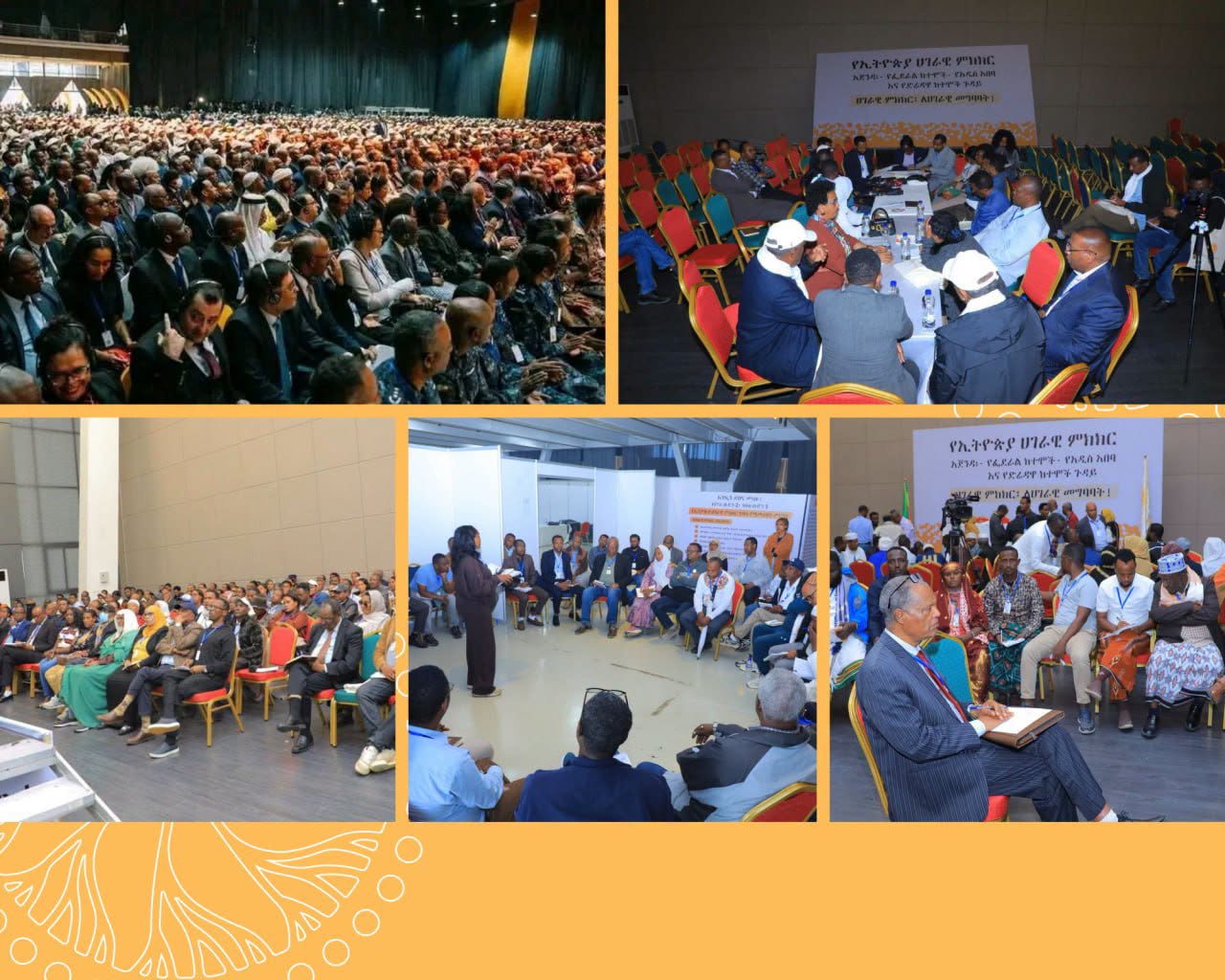
Following extensive consultations across the country, the National Dialogue process is entering a decisive phase through the planned National Dialogue Conference. The conference represents the central stage where representatives from different sectors of Ethiopian society will engage in structured discussions on issues identified through previous consultations.
The conference has brought together thousands of participants representing regional states, federal institutions, political organizations, civil society groups, religious institutions, professional associations, youth, women, elders and members of the Ethiopian diaspora.
The scale of participation reflects the ambition of the process. Rather than being a negotiation among political elites, the conference seeks to become a national platform where diverse groups can deliberate on issues affecting the country’s political future.
Participants are now discussing major areas of national concern, including state building and national identity, constitutional and federal arrangements, rule of law and human rights, peacebuilding and reconciliation, socioeconomic development and good governance.
The structure of the conference is designed to encourage meaningful discussion rather than simple political debate. Participants will engage through smaller discussion forums before moving into broader sessions where ideas and recommendations can be consolidated.
This approach is intended to allow participants to examine complex issues carefully, identify areas of agreement and disagreement, and develop recommendations based on collective deliberation.
The Commission has indicated that recommendations emerging from the conference will undergo further review before being incorporated into its final report. These recommendations could provide guidance for future policy reforms, legislative measures and possible constitutional adjustments.
An important feature of the process is the principle that all participants will engage as equals. Government officials, political representatives, academics, military officers, religious leaders, business figures, traditional elders and ordinary citizens are expected to participate without institutional privilege. This approach is intended to encourage open discussion and create an environment where different perspectives can be expressed freely.
Addressing Criticval National Questions
At the heart of the National Dialogue are some of Ethiopia’s most complex and long-standing questions. The country’s history, identity, political structure and governance system have been interpreted differently by various groups. These competing perspectives have shaped political movements and contributed to tensions over issues such as federalism, national identity, resource distribution and representation.
The National Dialogue provides an opportunity to address these issues through peaceful discussion rather than through political confrontation. Participants are expected to explore questions related to constitutional reform, democratic governance, electoral systems, institutional accountability, protection of rights and mechanisms for resolving disputes peacefully.
The objective of the dialogue is not necessarily to eliminate all disagreements, as differences are natural in a diverse society. Instead, the goal is to establish a shared framework where disagreements can be managed through democratic institutions and peaceful processes.
Peacebuilding Via National Reconciliation
Peacebuilding remains one of the most important expectations surrounding the National Dialogue. Years of conflict have resulted in loss of life, displacement, economic disruption and deep social divisions in different parts of Ethiopia. These experiences have created a need for mechanisms that can address grievances, rebuild trust and promote reconciliation among communities.
The National Dialogue could contribute to peace by creating opportunities for groups with different experiences and perspectives to engage directly and seek common understanding.
The process is also expected to complement transitional justice efforts by supporting discussions around accountability, truth seeking, reconciliation, reparations, institutional reform and national healing. A successful dialogue could help reduce political polarization by encouraging competing groups to pursue solutions through negotiation and democratic engagement rather than violence.
Strengthening Democracy
Another major expectation of the National Dialogue is the strengthening of Ethiopia’s democratic institutions. Democracy depends not only on elections but also on the ability of institutions to manage disagreements, protect rights and ensure that citizens have confidence in the political system.
If the dialogue produces widely accepted recommendations, it could contribute to stronger institutions, improved accountability and greater public trust in government structures. The process could also support efforts to strengthen institutions such as the judiciary, electoral bodies and law enforcement agencies, which play essential roles in ensuring political stability and protecting citizens’ rights. Through inclusive participation and consensus building, the National Dialogue has the potential to create conditions for more peaceful political competition and stronger democratic governance.
Economic Opportunities through Political Stability
Political stability remains one of the most important foundations for Ethiopia’s economic transformation. If the National Dialogue succeeds in reducing uncertainty and strengthening peace, it could improve investor confidence, encourage economic activity and create better conditions for reconstruction and development in conflict affected areas.
Resources previously directed toward managing conflicts could increasingly support national priorities such as education, healthcare, infrastructure development, agricultural modernization, industrial growth and employment creation.
A more stable political environment would strengthen Ethiopia’s ability to attract investment, expand trade and improve its position as one of Africa’s major emerging economies. The experience demonstrates that peace and development are deeply connected. Sustainable economic progress requires political stability, strong institutions and public confidence.
Regional, Continental Significance
The importance of Ethiopia’s National Dialogue extends beyond the country’s borders. As the diplomatic center of Africa and the host of major continental institutions, Ethiopia plays a significant role in regional peace, security and economic cooperation.
A more peaceful and stable Ethiopia would contribute to broader stability in the Horn of Africa by supporting regional trade, infrastructure connectivity, migration management and diplomatic cooperation. The process could also provide valuable lessons for other African countries facing political divisions, constitutional disputes and post conflict challenges.
If successful, Ethiopia’s experience could demonstrate the potential of nationally owned dialogue processes as tools for resolving complex political challenges and strengthening democratic transitions.
A Defining Moment for Ethiopia
In a nutshell, the Ethiopian National Dialogue represents one of the country’s most comprehensive efforts to address political, constitutional and social disagreements through peaceful consultation.
Its success will depend not only on the discussions themselves but also on whether recommendations are translated into meaningful reforms and whether stakeholders remain committed to implementing agreed outcomes.
If broad consensus is achieved and reforms are carried forward, the dialogue could become a historic turning point for Ethiopia, creating stronger institutions, deeper reconciliation and a more inclusive political environment.
For Ethiopia, the process represents an opportunity to move beyond cycles of confrontation and establish a culture of dialogue, compromise and shared responsibility.
For Africa, it could become an important example of how inclusive national consultation can contribute to peace, democratic renewal and sustainable development.
Ultimately, the National Dialogue is not only about resolving today’s disagreements. It is about determining whether Ethiopia can transform its diversity and differences into a foundation for cooperation, stability and a shared national future.


