Eritrean Leadership Obstructing Regional Stability, Development: Uppsala University Professor - ENA English


Eritrean Leadership Obstructing Regional Stability, Development: Uppsala University Professor
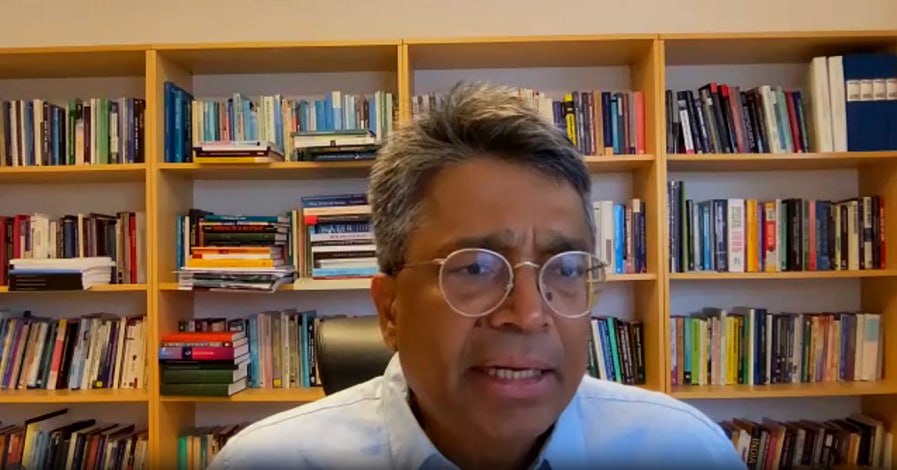
Addis Ababa, August 8, 2026 (ENA) — Eritrea’s long-entrenched leadership has continued hindering regional stability and development, Uppsala University Professor Ashok Swain said.
The Peace and Conflict Research professor at the Swedish university noted that the Eritrean leadership is once again playing a disruptive role in the Horn of Africa instead of delivering meaningful national development.
In an exclusive interview with ENA, he stated that the regime in Asmara has maintained a belligerent posture in the aftermath of the Pretoria Peace Agreement, which brought an end to the devastating conflict in Ethiopia’s Tigray region.
Recent reports indicate that the Eritrean military forces, in total disrespect of international law, have entered Tigray, Ethiopia’s northernmost territory, re-igniting concerns over Asmara’s activities in regional destabilization.
The Eritrean regime, recognized as the primary party opposed to the Pretoria Peace Agreement, is actively supporting the "Tsimdo" anti-Ethiopia alliance.
Under the guise of this alliance, the regime is openly using a faction of the banned Tigray People’s Liberation Front (TPLF) as a proxy to re-ignite war against Ethiopia, militarize Tigray, and plunge the region into a devastating war.
Rather than contributing to regional stability, Eritrea has been acting in a manner consistent with violating Ethiopia’s territorial integrity, Professor Swain noted.
“What we have seen in recent months, especially after the peace deal in Tigray, is Eritrea not acting the way it should when it comes to respecting Ethiopia’s sovereignty,” he said.
Concerns about Eritrea’s conduct are rooted in a long history of conflict between the two neighboring countries.
The 1998–2000 Ethio-Eritrean war claimed hundreds of thousands of lives and left lasting scars across the region.
Those tensions appeared to ease in 2018 when Ethiopian Prime Minister Abiy Ahmed initiated a historic peace agreement with Eritrea, ending two decades of hostility and raising hopes for a new era of regional cooperation.
The agreement earned Prime Minister Abiy Ahmed the Nobel Peace Prize and was widely welcomed across the Horn of Africa.
Professor Swain said those expectations have largely collapsed due to the acts of the Eritrean leadership.
Addressing Ethiopia’s parliament earlier this year, Prime Minister Abiy Ahmed explained his government’s policy of restraint despite growing tensions with Eritrea.
“For five years, we appealed and exercised patience,” the premier told the lawmakers. “After we came to office, we tried to move away from past grievances, believing it was unnecessary to dwell on them.”
PM Abiy rejected suggestions that current tensions were driven by Ethiopia’s interest in accessing the Red Sea, arguing that relations deteriorated during the Tigray war.
He revealed that Eritrean forces entered areas behind Ethiopian positions, committed serious abuses and destroyed civilian properties. Those abuses intensified tensions.
“When our the defense forces moved out of Axum, Eritrean forces entered the town and carried out mass killings of young people. And when our forces reached Adigrat town, they saw the pharmaceutical factory looted. These acts escalated tensions”, the PM elaborated.
Professor Swain linked Eritrea’s regional behavior to its domestic political system, describing the country as being governed by an authoritarian leadership with a long record of repression and human rights abuses.
“We all know that Eritrea has been ruled by a force which is not democratic, with all sorts of human rights violations and authoritarianism,” he noted.
Reflecting on Eritrea’s post-independence trajectory, the professor said the country had squandered a historic opportunity.
“I was in Eritrea in the early 1990s. Those were hopeful days. Eritrea was expected to develop, but that opportunity has been completely lost.
“The development in Eritrea has not really taken place. Instead of contributing to development, infrastructure, and nation-building, Eritrea has increasingly become associated with creating instability in the region.”
In contrast, he described Ethiopia as a larger and more economically dynamic state with significant development ambitions and a broader responsibility for regional stability.
“Ethiopia is a larger country, a bigger country, and economically much stronger than Eritrea,” he said. “It has a role as a responsible regional power.”
However, Professor Swain stressed the need for a diplomatic response rather than military escalation.


