The Perpetual War Doctrine of the Regime in Asmara - ENA English


The Perpetual War Doctrine of the Regime in Asmara
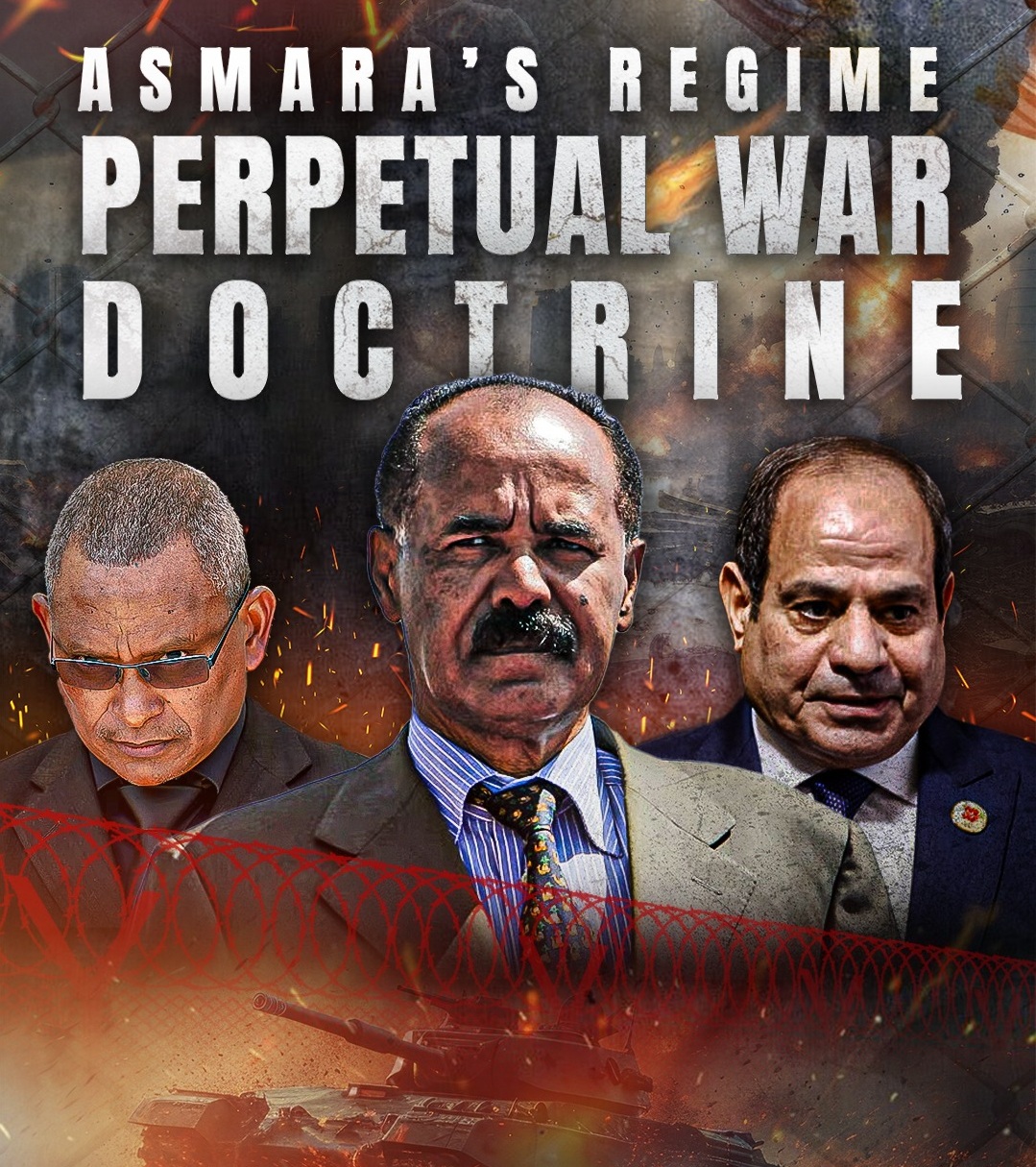
With analysis from Pulse of Africa (POA)
By Mathias Bule
For decades, the political survival of the EPLF/PFDJ regime in Eritrea has been fundamentally anchored in a singular strategy focused on the systemic weakening of Ethiopia. Rather than fostering regional integration and mutual economic prosperity, the regime in Asmara has consistently acted as a vector of instability in the Horn of Africa, serving both its own authoritarian survival and the strategic interests of external actors seeking to constrain Ethiopia's potential.
The groundwork for this policy began long before the regime formalized its control, playing an instrumental role in nurturing and building the military capacity of proxy groups to dismantle the Ethiopian state structure from within. Working in coordination with external forces—including the regime in Egypt—it actively orchestrated outcomes that left Ethiopia landlocked, severely restricting its economic independence and maritime security.
When internal subversion failed to permanently cripple Ethiopia, the regime resorted to direct military aggression, culminating in the 1999 invasion of Badme. The Ethiopian people mobilized en masse to repel the invasion and neutralize the regime's core military capabilities, but even after the Algiers Agreement was signed in the name of peace, the Asmara regime never abandoned its hostile doctrine.
Instead, it shifted back to asymmetrical warfare, proxy sponsorship, and regional subversion across the Horn of Africa. This included providing tactical and material support to extremist elements in Somalia like Al-Shabaab, engaging in destabilizing operations around Djibouti and the Red Sea, and systematically financing and arming insurgent factions within Ethiopia. These persistent acts of transnational terror and violation of international law ultimately led to severe United Nations sanctions against the regime.
To sustain this permanent state of confrontation, the regime transformed Eritrea into a heavily militarized state through mandatory, indefinite national service, centered around the long-operating Sawa military training center. This oppressive policy has stripped generations of young Eritreans of their freedom and economic future, resulting in mass human flight out of the country. The reality of this internal crisis was made starkly clear following the Ethiopian Prime Minister's historic peace initiative, which was immediately met with a massive influx of young Eritreans crossing into Ethiopia to escape the regime's forced servitude.
Beyond the immediate human toll, this perpetual militarization has completely paralyzed the domestic Eritrean economy, transforming what could have been a thriving Red Sea trade hub into a closed, command-style state. By redirecting the nation’s entire workforce and limited financial resources toward sustaining an oversized military apparatus, the leadership in Asmara has willfully neglected infrastructure, trade, and civil institutions. The regime relies on manufacturing external crises to justify this domestic stagnation, deliberately convincing its populace that survival requires total subjugation to the military state in the face of an exaggerated foreign threat.
Furthermore, Asmara’s foreign policy operates on a zero-sum logic that views any progress, economic expansion, or diplomatic triumph by Ethiopia as a direct security threat to its own existence. This paradigm drives the regime to ally itself with any regional power seeking to leverage the Horn of Africa for geopolitical dominance, effectively acting as an enforcer for foreign interests at the expense of regional sovereignty. By attempting to keep Ethiopia distracted, fragmented, and defensively oriented, the regime hopes to prevent Ethiopia from fully realizing its potential as a regional economic engine and hydro-energy leader.
Today, the regime is once again escalating tensions by preparing for renewed conflict against Ethiopia, relying on external backing and collusion with internal disruptive elements. While Ethiopia continues to extend calls for peace and diplomacy, Asmara responds with war rhetoric, paranoia-driven mobilization, and hostile propaganda. This pattern demonstrates that the leadership in Asmara views peace not as an opportunity for regional growth, but as a structural threat to the narrative of perpetual siege that keeps it in power.
Currently, the Shaebia regime is actively echoing warmongering rhetoric by leveraging the TPLF and aligning itself with Egyptian leadership in a coordinated effort aimed at creating a weakened, fragmented Ethiopia. The core strategy of the leaders in Cairo is to secure undisputed economic and geopolitical hegemony over the region, effectively utilizing both Shaebia and the TPLF as geopolitical instruments to achieve this goal. For its part, Shaebia is driven by an ungrounded, paranoid fear and an obsessive desire to preserve its grip on power by fending off imaginary threats.
It has now become an undeniable reality, publicly broadcast across media outlets, that Shaebia’s military commanders are violating the sovereign borders of Ethiopia under the disingenuous pretext of facilitating 'people-to-people relations' within the Tigray region. This reckless and lawless aggression has been openly enabled by the TPLF, serving its historic role as a compliant proxy. It is worth recalling that the TPLF itself was originally created, nurtured, and weaponized by Shaebia to advance its own long-term interests."
Meanwhile, the TPLF operates under the illusion that it can forcibly reclaim the dictatorial dominance it once exercised over Ethiopia, hoping to reinstate its historical patterns of systemic exploitation. However, this coalition is chasing an unattainable fantasy, as their calculations fail to grasp the structural resilience of the contemporary Ethiopian state.
Because Ethiopia stands as the strategic anchor of stability and the demographic center of the Horn of Africa, it cannot allow its national sovereignty or long-term security to be compromised by hostile agendas. It is obvious that Ethiopia retains the full right to take all necessary defensive measures to protect its citizens, infrastructure, and territorial integrity against foreign-backed destabilization. The international community must recognize that ignoring these continuous warmongering risks triggering a wider regional explosion, making decisive international diplomatic pressure urgent before the regime's actions force a destructive military confrontation.
Ultimately, the "perpetual war doctrine" of the regime in Asmara is a strategic relic that has outlived its utility and now serves only to jeopardize the future of the entire Horn of Africa. By subordinating national development to an obsessive, zero-sum campaign against Ethiopia, the Eritrean leadership has not only impoverished its own people but has become a primary architect of regional fragility. This cycle of manufactured hostility—fueled by external alliances and domestic repression—is unsustainable and inherently dangerous. Peace, for the regime in Asmara, is viewed as an existential threat because it would dismantle the narrative of siege that secures its authoritarian grip; yet, in reality, it is this very refusal to embrace peace that ensures the regime’s increasing isolation.
For Ethiopia, the path forward remains clear: while committed to regional cooperation, equitable development, and the peaceful resolution of disputes, the state will not stand idly by as its sovereignty is systematically challenged. The international community faces a critical choice: either continue to tolerate the reckless warmongering of a regime that profits from chaos, or exercise decisive diplomatic pressure to neutralize this source of instability.
Ethiopia, a population of over 130 million remains an anchor of resilience and growth in the region, but its patience is grounded in the necessity of national survival. The time for passive observation has passed; only a collective, firm stance against the politics of subversion can prevent the Horn of Africa from sliding into yet another avoidable and catastrophic conflict.


