Ethiopia’s Green Legacy in Restoring Nature and Transforming Agriculture - ENA English


Ethiopia’s Green Legacy in Restoring Nature and Transforming Agriculture
By Yordanos D.
Addis Ababa, August 3, 2026 (ENA) — Independent, peer reviewed scientific research published in leading international journals, including Nature Scientific Reports, Elsevier, and Springer, has validated the effectiveness of Ethiopia's Green Legacy Initiative (GLI) in restoring degraded ecosystems, mitigating climate change, strengthening agricultural productivity, and improving rural livelihoods.
The studies conclude that the initiative has achieved an estimated seedling survival rate of about 80 percent through scientific forestry practices and strong community stewardship. Research also shows that forest cover in some areas increased from 27.64 percent to 38.24 percent within six years, while local land surface temperatures declined by as much as 1.16 degrees Celsius, creating more favorable conditions for agriculture and enhancing climate resilience.
Further studies employing artificial intelligence and geospatial analysis project continued forest expansion through 2035. Researchers also identify Ethiopia's exceptional level of voluntary public participation, described as climate patriotism, as one of the principal drivers behind the initiative's success. Collectively, these findings recognize the GLI as a scientifically validated model for large scale ecosystem restoration and sustainable development.
Since its launch in May 2019, the GLI has evolved from an ambitious nationwide tree planting campaign into one of Africa's most comprehensive environmental restoration and green development programs. Introduced under the leadership of Prime Minister Abiy Ahmed, the initiative was designed to reverse decades of deforestation, land degradation, biodiversity loss, declining agricultural productivity, and growing vulnerability to climate change.
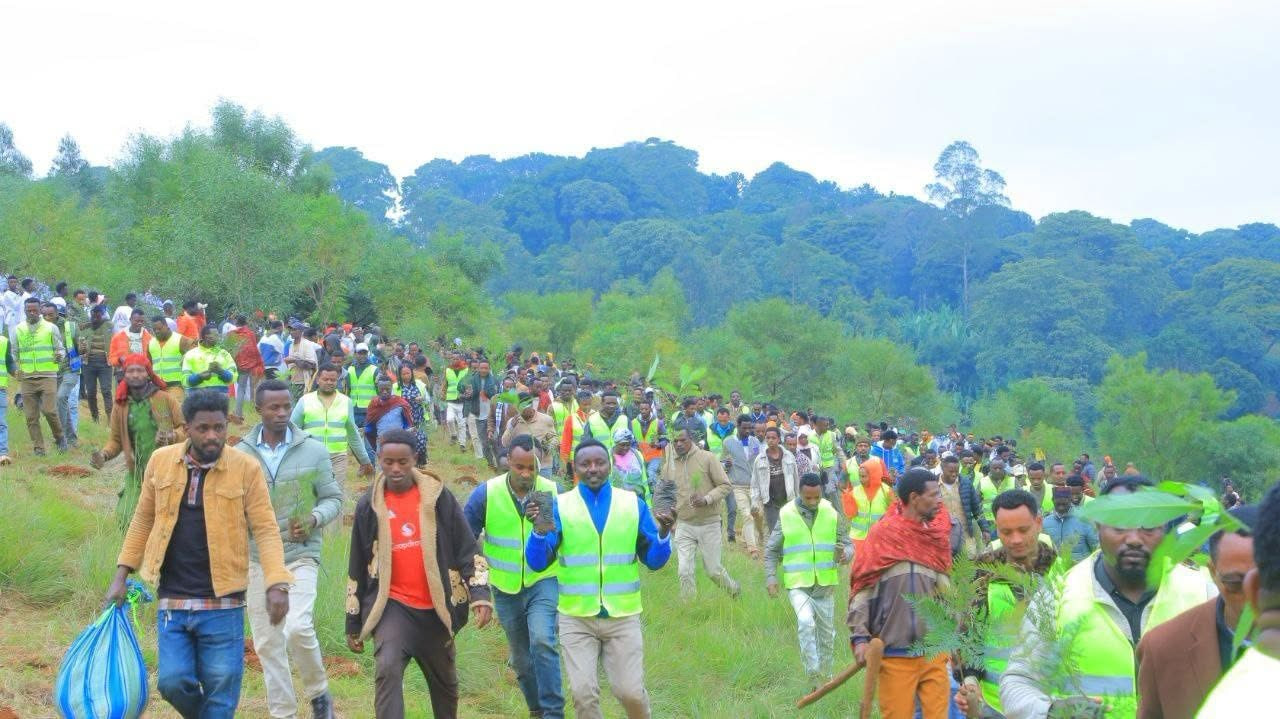
Launching the 2026 Green Legacy one day tree planting campaign, Prime Minister Abiy Ahmed called upon Ethiopians to plant 800 million tree seedlings across the country. Participating in the campaign at the Ethiopian Artificial Intelligence University in Addis Ababa, the Prime Minister described the initiative as far more than an environmental exercise, characterizing it as an investment in the country's future.
Reflecting on Ethiopia's longstanding tradition of rainy season tree planting, he said trees symbolize hope, renewal, and collective responsibility. He stressed that the Green Legacy Initiative demonstrates what a united nation can accomplish through shared commitment and collective action. "We are planting Ethiopia. We are planting hope to give our children a better tomorrow," the Prime Minister said, emphasizing that the trees planted today will continue to benefit future generations by supporting environmental sustainability, economic prosperity, and climate resilience.
Over seven consecutive rainy seasons, the initiative has expanded well beyond increasing forest cover. It has developed into a comprehensive national strategy that integrates ecosystem restoration with agricultural transformation, food security, climate resilience, biodiversity conservation, watershed rehabilitation, livelihood improvement, and green economic development.
The initiative was introduced at a time when Ethiopia faced severe environmental degradation. Decades of deforestation had accelerated soil erosion, reduced soil fertility, depleted water resources, and weakened agricultural productivity. Given that agriculture remains the backbone of Ethiopia's economy and the primary source of livelihood for the majority of the population, restoring degraded landscapes became essential not only for environmental sustainability but also for strengthening rural incomes and ensuring long term food security.
The first Green Legacy campaign, conducted during the 2019 rainy season, targeted the planting of four billion seedlings. Ethiopia exceeded that goal by planting approximately 4.7 billion seedlings. The campaign attracted worldwide attention after more than 350 million seedlings were planted in a single day, demonstrating an unprecedented level of nationwide mobilization.
Government institutions, schools, universities, farmers, youth groups, religious organizations, private businesses, civil society organizations, and members of the Ethiopian diaspora all participated, making environmental restoration a shared national responsibility.
Building on that momentum, Ethiopia expanded the campaign in 2020 despite the challenges created by the COVID 19 pandemic. The annual target increased to five billion seedlings, while approximately 5.9 billion were planted. Greater emphasis was placed on multipurpose tree species, including fruit trees, coffee seedlings, fodder crops, indigenous species, and fuelwood trees that simultaneously restore ecosystems and generate sustainable economic returns for rural households.
The upward trajectory continued in 2021 when Ethiopia planted approximately 6.8 billion seedlings against a target of six billion.
During this period, the initiative became increasingly integrated with watershed rehabilitation, soil and water conservation, agroforestry, and climate smart agriculture. Indigenous tree species were promoted for their capacity to restore soil fertility, reduce erosion, improve groundwater recharge, and create favorable microclimates that support crop production, particularly in degraded highland and semi arid areas.
In 2022, Ethiopia again exceeded its annual target by planting approximately 7.2 billion seedlings. Restoration efforts increasingly focused on degraded watersheds, river basins, hillsides, and communal grazing lands. Scientific evidence indicates that restoring vegetation cover improves rainwater infiltration, reduces soil erosion, enhances soil moisture retention, and strengthens watershed functions.
These improvements directly contribute to higher crop yields, more reliable water supplies, and greater resilience to recurring droughts. Agroforestry systems established under the initiative also provide shade for coffee production, enrich soil organic matter, reduce wind erosion, and diversify farm outputs through fruits, timber, fodder, and fuelwood.
The 2023 Green Legacy campaign further reinforced the initiative's developmental impact. Ethiopia planted more than 7.5 billion seedlings, surpassing its target of 6.5 billion. Greater emphasis was placed on integrating environmental restoration with livelihood diversification.
Farmers expanded the cultivation of fruit trees, coffee seedlings, forage species, and indigenous multipurpose trees that generate both ecological and economic value. These interventions increased household incomes, improved livestock feed availability, expanded fruit production, and reduced dependence on natural forests for fuelwood and construction materials, making the initiative an important catalyst for rural economic transformation.
The 2024 rainy season marked another significant milestone as Ethiopia planted approximately 7.5 billion seedlings, pushing the cumulative total beyond 40 billion since the initiative's inception. Restoration activities expanded to degraded agricultural landscapes, wetlands, river catchments, and urban green spaces.
These efforts have helped stabilize soils, reduce flooding, improve water quality, conserve biodiversity, and strengthen ecosystem services that directly support agricultural production.
During the 2025 campaign, Ethiopia entered a new phase by preparing more than 8.4 billion seedlings and planting approximately eight billion across the country. Greater emphasis was placed on coffee seedlings, fruit trees, fodder species, indigenous trees, and agroforestry systems that simultaneously enhance environmental sustainability and improve rural livelihoods. Ethiopia also strengthened international cooperation by sharing its experience with neighboring countries, reinforcing its position as a continental leader in landscape restoration.
One of the initiative's most significant achievements has been its contribution to agricultural transformation. Scientific studies increasingly demonstrate that landscape restoration strengthens the ecological foundation of agriculture. Reforestation reduces soil erosion, restores soil fertility, increases organic matter, conserves soil moisture, moderates local temperatures, and improves habitats for pollinators.
Agroforestry systems promoted under the initiative increase crop productivity while supplying fruits, coffee, fodder, timber, fuelwood, medicinal plants, and honey. These integrated farming systems diversify household incomes, reduce farmers' vulnerability to climate related shocks, and enhance the resilience of rural communities. Researchers have also identified Green Legacy agroforestry landscapes as having exceptionally high carbon storage while remaining productive agricultural systems.
The initiative has likewise generated substantial socioeconomic benefits. Millions of Ethiopians participate annually in seedling production, nursery management, transportation, planting, maintenance, and watershed rehabilitation. Community nurseries, youth cooperatives, and women led enterprises have created employment opportunities while improving access to quality seedlings. Multipurpose tree species provide marketable products, including fruits, coffee, timber, fuelwood, livestock feed, and other non-timber forest products that strengthen household incomes and improve food security.
Development partners increasingly recognize the initiative as an effective ecosystem based adaptation strategy that strengthens the resilience of smallholder farmers, restores degraded watersheds, and enables vulnerable communities to better withstand climate related shocks.
Scientific research has also identified lessons that can strengthen future implementation. Recent field studies report seedling survival rates of approximately 80 percent where suitable species are matched with local ecological conditions, planting is synchronized with seasonal rainfall, and communities receive adequate technical support. Researchers therefore recommend strengthening post planting management, monitoring systems, community ownership, and species selection to maximize long term environmental, economic, and social benefits.
Today, the Green Legacy Initiative represents far more than an annual tree planting campaign. It has evolved into a long term national development strategy that integrates environmental restoration with agricultural transformation, climate resilience, biodiversity conservation, watershed rehabilitation, food security, employment creation, and sustainable livelihoods.
The steady increase in annual planting, from 4.7 billion seedlings in 2019 to approximately eight billion seedlings in recent campaigns, reflects Ethiopia's growing capacity for large scale landscape restoration and its long-term commitment to building a greener, more productive, and climate resilient economy.
While continued attention to seedling survival, ecological suitability, and post planting management remains essential, the expanding body of scientific evidence demonstrates that the Green Legacy Initiative is delivering measurable environmental, agricultural, and socioeconomic benefits that extend well beyond each planting season.


