The Power of Millions: Ethiopia’s Single-Day Tree-Planting Climate Action - ENA English
The Power of Millions: Ethiopia’s Single-Day Tree-Planting Climate Action
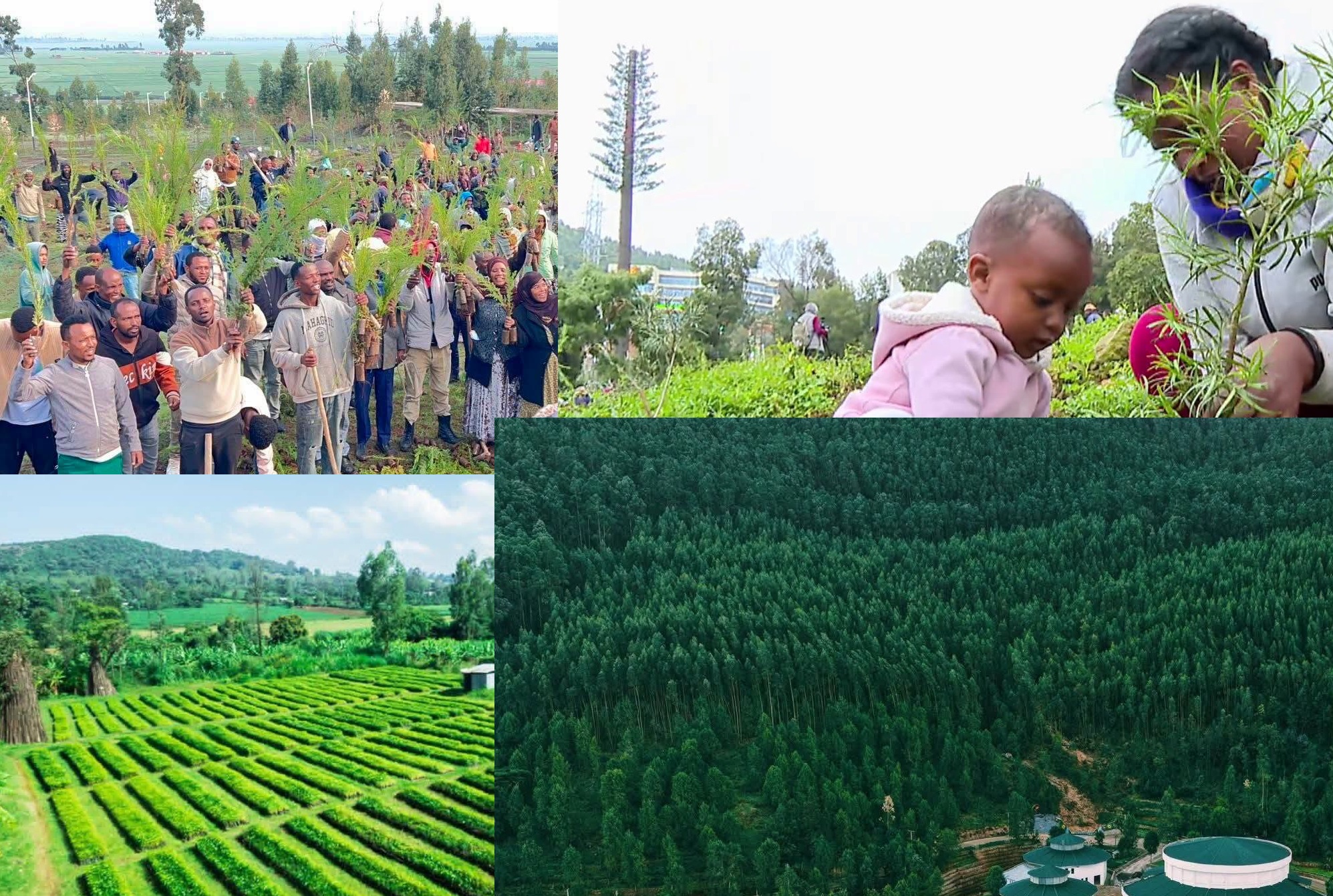
Addis Ababa, August 3, 2026 (ENA—From the early hours of Monday morning, millions of Ethiopians began gathering across cities, towns, villages, farms, schools, and public institutions with a single purpose. They unite to planting trees.
What unfolded was not merely a national campaign, but one of the largest coordinated environmental mobilizations ever attempted anywhere in the world.
Today, Ethiopia has officially kicked of a nationwide drive to plant 800 million tree seedlings in a single day, a record-breaking environmental effort that places the country at the center of global discussions on climate action, ecological restoration, and citizen-led sustainability. At a time when the world is confronting intensifying climate change, accelerating land degradation, and growing biodiversity loss, Ethiopia’s campaign offers a striking example of environmental action carried out at extraordinary scale.
The campaign forms part of the country’s broader Green Legacy Initiative, which aims to plant 8 billion seedlings during the current rainy season. More importantly, it demonstrates how a developing nation has sought to transform environmental restoration into a national movement involving government institutions, local communities, youth groups, civil society organizations, and development partners.
Hours ago, at the official launch of the nationwide campaign, Government Communication Service Minister Enatalem Melese said the initiative was driven by the urgent need to restore degraded landscapes, rehabilitate depleted ecosystems, and strengthen Ethiopia’s long-term environmental resilience.
“The overarching reason we are taking our Green Legacy initiative to the field is that we have dried, depleted, and degraded land,” she said.
Her message reflected a broader national narrative that links environmental recovery with economic resilience, food security, water conservation, and long-term development.
“Today is a special day when 800 million green seedlings touch the earth. It is a day when the land reaffirms its promise and demonstrates its ability to return more than it receives,” she added.
Beyond symbolism
Tree-planting campaigns are common around the world, but Ethiopia’s initiative differs in both scale and ambition. Since its launch in 2019 under the leadership of Prime Minister Abiy Ahmed, the Green Legacy Initiative has evolved into one of Africa’s most ambitious environmental restoration programs.
The initiative integrates reforestation, watershed rehabilitation, agroforestry expansion, biodiversity conservation, and sustainable agriculture into a single national framework. Its objective is not simply to increase tree cover, but to rebuild ecosystems that have been damaged by decades of deforestation, soil erosion, population pressure, and climate-related environmental stress.
The significance of planting 800 million seedlings in one day extends beyond the number itself. It represents a logistical and social mobilization involving millions of people acting simultaneously across one of Africa’s largest and most ecologically diverse countries.
Minister Enatalem emphasized that the campaign is built on collective action rather than individual effort.
“What we plant, we plant with unity of thought and action,” she said.
That emphasis on unity has become a defining feature of the Green Legacy Initiative, framing environmental restoration as a shared national responsibility rather than a government program alone.
A different model of climate action
International climate debates often focus on emissions targets, energy transitions, carbon markets, and multilateral negotiations. Ethiopia’s campaign highlights another dimension of climate action. It has been reinforcing a mass public participation.
And this is already bearing fruit on a significant scale.
In many countries, environmental policy remains largely institutional. Ethiopia’s approach has attempted to make ecological restoration a nationwide civic activity, where millions of citizens participate directly in restoring forests, protecting watersheds, and improving local landscapes.
This matters because environmental degradation is not only an ecological problem. Degraded land reduces agricultural productivity, increases vulnerability to drought, threatens water resources, and undermines rural livelihoods. In that context, tree planting becomes connected to economic resilience, food systems, and community adaptation.
Every seedling planted has the potential to contribute to soil restoration, groundwater recharge, erosion control, carbon sequestration, biodiversity recovery, and improved agricultural productivity.
The campaign therefore reflects a broader development strategy in which environmental restoration supports both ecological recovery and economic transformation.
Africa’s green leadership moment
Ethiopia’s environmental agenda has increasingly become part of its broader Green Diplomacy, positioning climate action as an area of regional leadership and international cooperation.
The country has shared seedlings, technical experience, and restoration practices with other African nations, arguing that environmental degradation, desertification, and climate vulnerability require continental solutions. This aligns with wider African efforts to restore degraded landscapes through initiatives such as the Great Green Wall and the African Forest Landscape Restoration Initiative (AFR100).
The Green Legacy Initiative also complements Ethiopia’s renewable energy ambitions. Investments in hydropower, renewable electricity, watershed management, and green infrastructure form part of a larger vision that links environmental protection with sustainable economic development.
In that sense, the tree-planting campaign is not an isolated environmental event. It is part of a wider strategy that connects forests, water resources, agriculture, energy, and climate resilience.
The global significance
Whether all 800 million seedlings survive and mature will depend on long-term management, monitoring, protection from grazing and deforestation, water availability, and sustained community stewardship. The ultimate measure of success will not be the number planted in a single day, but the forests, watersheds, and livelihoods that emerge over the coming years.
Yet the campaign’s international significance is already clear.
In an era often characterized by climate pessimism, political fragmentation, and slow environmental progress, Ethiopia has demonstrated the power of large-scale collective mobilization. Few countries have attempted to organize environmental action involving millions of citizens on such a scale within a single day.
As the world searches for practical pathways to ecological restoration and climate resilience, Ethiopia’s experience raises an important question: can environmental recovery become a national social movement rather than simply a policy objective?
On 3 August 2026, Ethiopia’s answer was visible across mountains, valleys, farms, schools, and public squares. Millions of people planting trees together transformed a climate campaign into something larger—a national act of restoration with global resonance.
The message reaching beyond Ethiopia’s borders is unmistakable: climate action is not only about international agreements or future targets. It is also about what people choose to do, together, on the ground, today.