Historic Push to Re-Engineering Landscapes, Cementing Resilience - ENA English
Historic Push to Re-Engineering Landscapes, Cementing Resilience
Lead line: By Yordanos D.
August 2, 2026 (ENA)
In an age marked by accelerating climate change, environmental degradation, biodiversity loss, and growing pressure on natural resources, countries around the world are searching for practical solutions that can restore ecosystems while sustaining economic growth.
For Ethiopia, where agriculture supports the livelihoods of millions and natural resources underpin food security, water availability, energy production, and economic stability, environmental restoration has evolved far beyond conservation. It has become a national development agenda.
Under the leadership of Prime Minister Abiy Ahmed, Ethiopia launched the Green Legacy Initiative (GLI) in 2019, transforming environmental stewardship into one of the country's largest citizens driven development movements.
What began as a nationwide tree planting campaign has matured into an integrated strategy that combines ecological restoration with agricultural transformation, climate resilience, watershed rehabilitation, biodiversity conservation, job creation, and sustainable economic growth.
Today, the initiative stands among the world's largest ecosystem restoration programs. Through the active participation of millions of Ethiopians and the integration of science-based landscape management, commercial agroforestry, and community ownership, Ethiopia is demonstrating that environmental recovery and economic development are mutually reinforcing objectives rather than competing priorities.
Inside Green Transformation
As dawn breaks across Ethiopia's mountains, valleys, and river basins during the rainy season, millions of citizens leave their homes carrying seedlings, farming tools, and determination. Farmers, students, teachers, civil servants, members of the National Defense Force, religious leaders, private sector employees, and community volunteers gather on degraded hillsides, riverbanks, watersheds, schools, institutions, and farmlands.
This extraordinary annual mobilization has become one of the nation’s defining national traditions.
Unlike conventional tree planting campaigns that conclude once seedlings enter the ground, the GLI follows a comprehensive landscape restoration approach. Seedling production, site selection, soil and water conservation, planting, post planting management, monitoring, and maintenance are integrated into one continuous ecological restoration cycle designed to ensure long term survival and environmental impact.
The initiative has transformed environmental protection from a government responsibility into a shared civic culture embraced by virtually every segment of society.
From campaign to national movement
The initiative gained national momentum from its first year. In 2019, approximately 20 million Ethiopians reportedly planted more than 350 million seedlings in a single day, establishing a benchmark that attracted international attention.
Prime Minister Abiy Ahmed framed the initiative in broader developmental terms, arguing that it was not merely about planting trees, but about restoring ecosystems, strengthening food security, and investing in future generations.
The campaigns have continued to expand. In July 2025, more than 27 million citizens participated in a nationwide planting effort that reportedly exceeded 714 million seedlings within twelve hours.
According to government figures, Ethiopia has produced more than 48 billion seedlings since 2019, while preparing an additional 8 billion seedlings for the 2026 planting season.
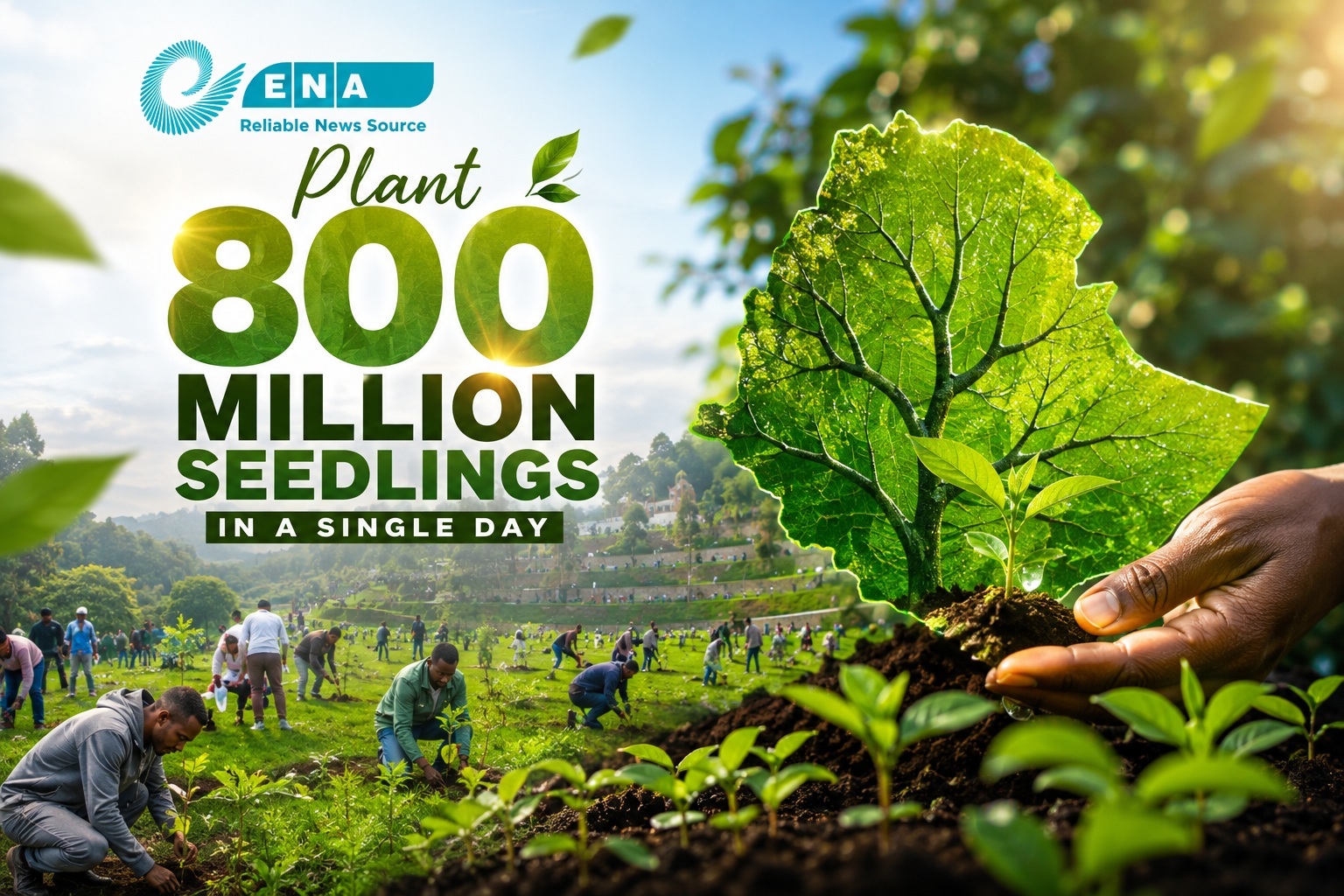
This year, Ethiopia aims to plant 800 million seedlings in a single day, an objective that, if achieved, would rank among the largest single-day environmental mobilizations ever attempted. Whether measured by participation, logistics, or geographic coverage, the campaign represents an extraordinary exercise in national coordination.
More importantly, it reflects a shift in how environmental restoration is understood. Tree planting is increasingly being treated not as a localized conservation activity, but as a national instrument for climate adaptation, watershed protection, agricultural productivity, and public participation.
Why Green Legacy?
Ethiopia possesses some of Africa's richest ecological diversity, ranging from Afro alpine ecosystems and montane forests to fertile agricultural highlands, dry lowlands, savannahs, and the Great Rift Valley. Yet decades of deforestation, expanding agricultural frontiers, unsustainable fuelwood collection, overgrazing, and climate variability placed enormous pressure on these fragile ecosystems.
Forest loss accelerated soil erosion across the country's steep landscapes. Every rainy season, millions of tons of fertile topsoil were washed into rivers, lakes, and hydroelectric reservoirs. Water infiltration declined while runoff increased, causing recurrent flooding during rainy months and water shortages during dry periods.
The degradation affected nearly every sector of the economy. Declining soil fertility reduced agricultural productivity, shrinking vegetation cover threatened biodiversity, sedimentation reduced dam efficiency, and recurring droughts increased food insecurity across vulnerable communities.
Recognizing that environmental degradation threatened Ethiopia's long term economic development, the government built upon the Climate Resilient Green Economy Strategy introduced in 2011 and launched the GLI in 2019 as a practical national response.
Government institutions adjusted work schedules to encourage participation during annual planting campaigns. Schools integrated environmental stewardship into practical education. Religious institutions promoted environmental responsibility through faith-based teachings, while local communities organized watershed rehabilitation and collective conservation activities.
Unprecedented Scale of Mobilization
The GLI immediately captured national attention. During the inaugural campaign in 2019, approximately 20 million Ethiopians planted more than 350 million seedlings in a single day, setting an unprecedented national benchmark.
Prime Minister Abiy Ahmed described the initiative by stating, “Green Legacy is not merely about planting trees. It is about planting hope, restoring our ecosystems, strengthening food security, and leaving a healthier nation for future generations."
Each successive campaign has expanded both participation and impact.
In July 2025, Ethiopia achieved another global milestone when more than 27.7 million citizens planted over 714.7 million seedlings within only twelve hours.
By 2025, cumulative seedling production had exceeded 48 billion nationwide, while 8 billion additional seedlings were prepared for the current planting season as Ethiopia steadily advances toward its ambitious target of planting billions of trees. The annual campaign has become one of the largest examples of voluntary environmental mobilization worldwide.
Beyond Planting Trees
As the initiative has evolved, Ethiopia's focus has shifted from simply counting seedlings toward ensuring ecological quality, long term survival, and measurable environmental restoration.
The GLI increasingly applies integrated watershed management principles. Tree planting is combined with extensive soil and water conservation measures including hillside terracing, contour bunds, stone bunds, check dams, water harvesting structures, gully rehabilitation, and area closures.
These interventions reduce surface runoff, increase groundwater recharge, stabilize degraded hillsides, improve river flow during dry seasons, reduce flood risks, and protect reservoirs from excessive sedimentation.
Planting strategies prioritize indigenous species suited to Ethiopia's diverse ecological zones. Native trees such as Juniperus procera (Tsid) , Hagenia abyssinica (Kosso), Cordia Africana (Wanza), Podocarpus falcatus (Zigba), and indigenous Acacia (Girar) species strengthen biodiversity while improving ecosystem resilience.
Modern technologies including Geographic Information Systems, satellite imagery, drone mapping, digital monitoring platforms, and remote sensing are increasingly employed to evaluate restoration progress, monitor canopy expansion, identify degraded landscapes, and improve seedling survival.
These coordinated efforts have contributed to increasing Ethiopia's forest cover from approximately 17.2 percent in 2019 to nearly 24 percent, marking significant progress toward restoring degraded ecosystems.
Economic Strategy
One of the initiative's defining characteristics is its integration of ecological restoration with economic development. Prime Minister Abiy Ahmed has consistently emphasized that environmental conservation should generate tangible economic benefits for rural communities. Accordingly, the GLI has significantly expanded commercial agroforestry across Ethiopia.
More than eight billion coffee seedlings have been produced under the initiative, supporting the rehabilitation of degraded farmlands while strengthening Ethiopia's globally renowned coffee industry. Coffee exports continue to generate record foreign exchange earnings while providing millions of farmers with sustainable incomes.
Fruit trees including avocado, mango, papaya, apple, citrus, and guava have been widely distributed to improve household nutrition and diversify rural income sources.
Commercial bamboo plantations have expanded across erosion prone landscapes, supplying raw materials for furniture manufacturing, construction, handicrafts, paper production, biomass energy, and emerging green industries.
The initiative has also promoted the cultivation of fodder crops that improve livestock productivity while reducing pressure on natural grazing areas.
Across the country, thousands of women and youth participate in seed collection, nursery development, seedling production, and watershed rehabilitation, creating seasonal and permanent employment opportunities while strengthening local green enterprises.
Backup Agriculture, Water Security
The environmental benefits generated by Green Legacy extend directly into Ethiopia's agricultural transformation agenda. Improved vegetation cover enhances rainfall infiltration, replenishes groundwater reserves, protects irrigation systems, and reduces soil degradation. Restored watersheds improve the sustainability of irrigation schemes supporting Ethiopia's wheat self-sufficiency program and expanding horticultural production.
Healthy forests also protect major river basins that sustain hydroelectric power generation, urban water supplies, and downstream agricultural activities. By restoring degraded catchments, the initiative strengthens resilience against increasingly frequent droughts and floods associated with climate change.
Biodiversity Recovery
As forests regenerate, wildlife habitats are gradually recovering across many regions. Expanding vegetation improves ecological connectivity, protects indigenous plant species, and creates suitable habitats for birds, mammals, insects, and pollinators essential to agricultural production.
Prime Minister Abiy recently highlighted one of the initiative's less visible achievements, noting, "The GLI, beyond its foundational role in climate action, is now delivering real gains in Ethiopia's honey production. By protecting our natural environment, forests are expanding, and with them, the habitat and food sources that sustain bee populations and boost honey harvests."
The expansion of flowering trees has strengthened Ethiopia's beekeeping sector, increased honey production while providing additional income for rural households.
Beyond Ethiopia
The GLI has also become an important pillar of Ethiopia's environmental diplomacy. The program directly supports implementation of the Paris Agreement, the United Nations Sustainable Development Goals, the African Union's Agenda 2063, the AFR100 Landscape Restoration Initiative, the Bonn Challenge, and the United Nations Decade on Ecosystem Restoration.
At a time when developing countries are often portrayed primarily as victims of climate change, Ethiopia has demonstrated that African nations can also become global leaders in delivering practical climate solutions through domestic financing, national ownership, scientific planning, and mass public participation.
Recognizing its broader significance, Ethiopia has increasingly shared seedlings, technical knowledge, and restoration experiences with neighboring countries as part of regional environmental cooperation.
In connection to this, Prime Minister Abiy once emphasized that every tree planted today will be an investment in the future. “Green Legacy is Ethiopia's contribution to the global fight against climate change and a message that sustainable development begins with protecting nature."
Aboveall, the Initiative's greatest achievement lies not only in the billions of seedlings planted but also in the transformation of public attitudes toward environmental stewardship. For millions of Ethiopian children, annual tree planting has become a normal part of civic life.
Communities increasingly view watershed protection, forest conservation, and sustainable resource management as collective responsibilities rather than isolated government programs.
This growing environmental consciousness strengthens social cohesion while creating a lasting culture of conservation that will continue benefiting future generations.
It is also become a lesson for other countries demonstrating that large scale environmental restoration succeeds when citizens become active participants rather than passive beneficiaries.
Conclusion
In a nutshell, as Ethiopia advances toward its target of planting billions seedlings, attention is increasingly focused on improving survival rates, expanding landscape restoration, strengthening biodiversity conservation, promoting climate smart agriculture, and scaling up green enterprises that generate sustainable livelihoods.
In this regard, the next phase of Green Legacy will emphasize quality as much as quantity through improved maintenance, scientific monitoring, watershed rehabilitation, indigenous species restoration, urban greening, and climate resilient agroforestry systems.
Ultimately, it represents far more than an environmental campaign. It is a comprehensive national strategy that integrates ecological restoration with economic transformation, climate resilience, food security, rural development, and sustainable growth.
By turning environmental protection into a shared national responsibility, Ethiopia has demonstrated that restoring degraded landscapes can simultaneously strengthen agriculture, create employment, expand exports, improve water security, conserve biodiversity, and build resilience against climate change.
As billions of seedlings continue taking root across the country, the country is not simply planting trees. It is restoring ecosystems, strengthening livelihoods, safeguarding future generations, and offering the world a compelling example of how environmental restoration can become a powerful engine of sustainable development.