Egypt’s Losing Game over the GERD Has Never Been About Hydro-Technical Engineering - ENA English


Egypt’s Losing Game over the GERD Has Never Been About Hydro-Technical Engineering
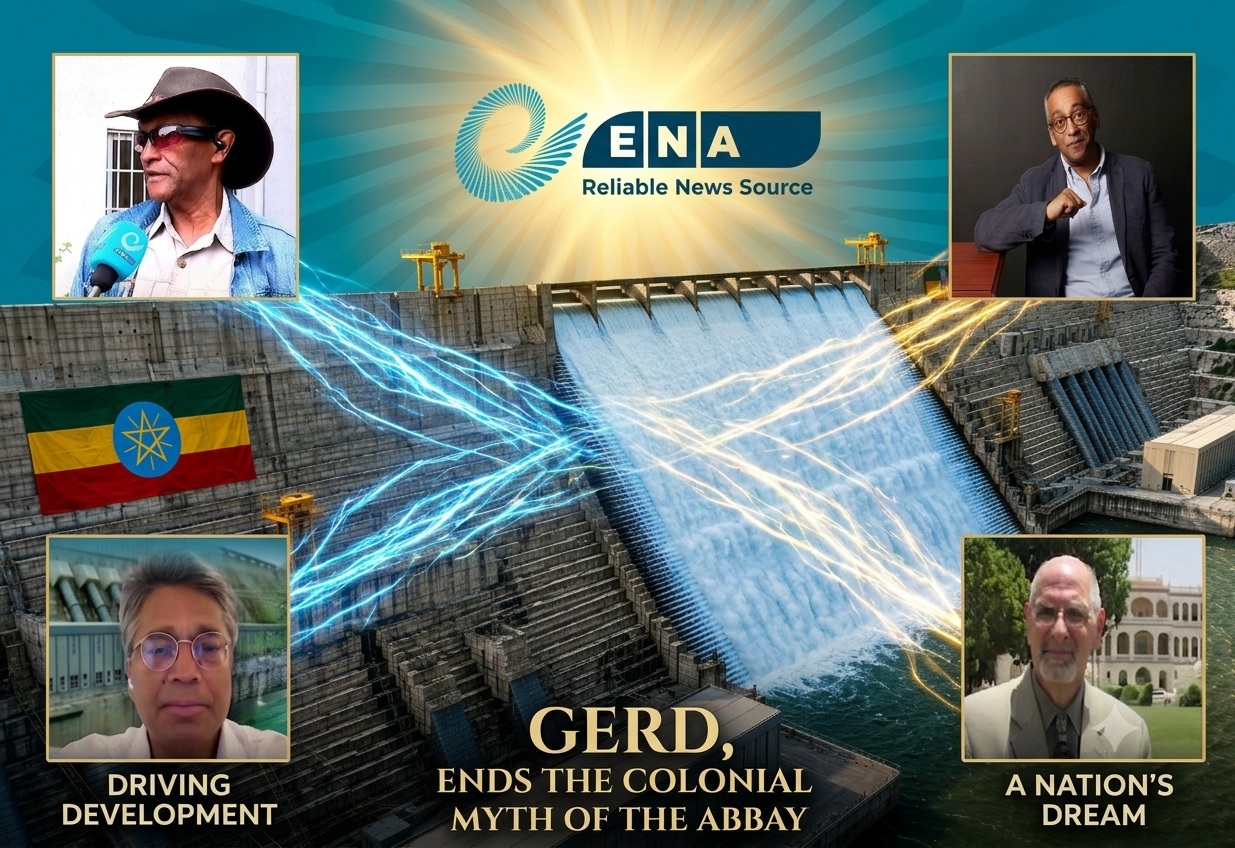
By Getnet. S Menegesha
July 23, 2026 (ENA)
Egyptian politicians have repeated the same familiar refrain for years that Ethiopia is acting unilaterally over the Grand Ethiopian Renaissance Dam (GERD) and threatening the water security of downstream countries.
The language has changed little.
From official statements and diplomatic forums to state-aligned media campaigns, the accusation of “unilateralism” has been repeatedly deployed to portray Ethiopia as a threat to the Abay (Nile) Basin and to international peace and security.
But as the GERD has moved from a construction project to an operational reality, a fundamental question has become increasingly difficult to avoid.
Is Egypt’s opposition to the dam truly about hydro-technical risks—or is it about the political consequences of Ethiopia’s emergence as an independent and influential upstream power?
For a growing number of international experts, the answer is increasingly clear.
The dispute surrounding the GERD, they argue, has long been driven less by engineering realities than by political calculations, historical assumptions and a deep-seated reluctance to accept a new balance of power in the Nile Basin.
The Abay, the source of the Blue Nile—originates in the Ethiopian highlands and contributes the overwhelming majority of the water flowing into the Nile system.
Ethiopia contributes more than 86 percent of the water flowing through the Basin.
Yet, for generations, Egypt’s political discourse has treated the river primarily through the lens of downstream control and inherited historical claims.
The GERD has fundamentally challenged that model.
Without consuming the river’s water or diverting its natural downstream flow, Ethiopia has built Africa’s largest hydroelectric dam, transforming the political and strategic realities of the Abay Basin. The project has demonstrated that an upstream country can pursue development, energy generation and economic transformation while remaining part of a shared river system.
For Professor Al Mariam, a renowned political analyst and attorney at law, Egypt’s repeated accusations of Ethiopian “unilateralism” represent the continuation of an old political narrative.
Egypt, he argues, has repeatedly used the term not only in international media but also before the United Nations Security Council, seeking to portray Ethiopia’s development project as a violation of international norms.
Yet the persistent repetition of the accusation, he suggests, reflects less a new legal reality than a lingering nostalgia for an era in which Egypt enjoyed disproportionate influence over the Abay.
The GERD has disrupted that old order.
Under international law, unilateralism generally refers to a state acting independently to pursue its interests or assert legal rights without meaningful cooperation, consultation or regard for the rights of other states. But Ethiopia has consistently maintained that the GERD is designed for electricity generation, not the permanent consumption or diversion of Abay (Nile) waters.
That distinction is central to the technical debate.
And according to energy expert Mikael Alemu, the Egyptians argument that the GERD will fundamentally reduce the flow of water to downstream countries does not withstand scientific scrutiny.
“The Grand Renaissance Dam doesn’t have engineering problems. Its claim sounds much more like political,” Mikael told the Ethiopian News Agency.
The expert argued that the repeated claim that the GERD will significantly reduce the flow of the Abay to Egypt is not technically rational.
After more than a decade of negotiations among Ethiopia, Egypt and Sudan, the three countries have still failed to reach a comprehensive agreement. Yet, Mikael said, the continuing impasse is not primarily the result of an unresolved engineering problem.
Rather, it reflects the absence of a genuine political willingness.
The negotiations have not failed because a workable agreement was beyond reach; they have failed because Egyptian negotiators have repeatedly lacked the political commitment to engage in good faith, compromise where necessary, and pursue a mutually acceptable outcome.
“I think the Grand Renaissance Dam doesn’t have engineering problems. Its claim sounds much more like political,” he said.
Mikael argued that the GERD is a complex and enormously expensive hydro-technical project, constructed at a cost of approximately 5 billion U.S. dollars, whose principal purpose is to generate electricity and support regional development.
The project, he noted, can also help regulate river flows and reduce the destructive impact of flooding, while providing major economic and energy benefits to Ethiopia and potentially to the wider region.
The idea that the GERD represents an unprecedented threat, he added, is also difficult to sustain.
Around the world, countries sharing transboundary rivers have developed dams, hydropower facilities and other infrastructure while negotiating mechanisms for cooperation and equitable utilization. Experiences from Southeast Asia, South America and the former Soviet Union demonstrate that shared rivers do not have to become permanent sources of geopolitical confrontation.
International law, he noted, recognizes the right of states to make reasonable and equitable use of shared water resources, provided they do not cause significant harm to other countries.
Ethiopia’s position, Mikael argued, is therefore fundamentally consistent with a development model based on the reasonable use of its own natural resources.
He also questioned the logic behind Egypt’s continued insistence that Ethiopia must accept restrictions on its development.
“It’s a very conveniently hot issue for Egyptians,” he said, arguing that domestic political conditions can encourage governments to maintain an external adversary.
“Frequently, the political situation of Egypt seeks an outside enemy. It’s very nice to have an outside enemy when your politics is troubled,” Mikael said.
For him, the argument that Ethiopia would deliberately seek to deprive Egypt of water is fundamentally irrational.
Ethiopia, he stressed, is not seeking to stop the Abay (Nile) from flowing to Egypt. It is seeking to develop its own economy, generate electricity and improve the lives of millions of people who have long lacked reliable access to energy.
The GERD, in this sense, is not a project designed against Egypt.
It is a project designed for Ethiopia’s development.
A Political Crisis Disguised as a Water Dispute
Professor Ashok Swain, Professor of Peace and Conflict Research at Uppsala University and UNESCO Chair on International Water Cooperation, has described the conduct of some Egyptian politicians over the GERD as a “losing game.”
According to Swain, Egypt has increasingly accepted the reality that the dam exists and will remain a permanent feature of the Nile Basin.
The continued rhetoric, he argues, is largely intended for domestic consumption.
Egyptian political and military leaders have securitized the Abay for decades, presenting the river not simply as a shared international water system but as an existential national security issue.
That political framing makes aggressive rhetoric almost inevitable, even when the underlying technical realities do not support it.
Swain argued that bringing the GERD issue repeatedly before the UN Security Council is unlikely to change the fundamental trajectory of the dispute.
The Security Council is deeply divided, he noted, while China has consistently maintained a position supportive of the rights of upstream countries to utilize transboundary water resources.
China itself is an upstream country for many major Asian rivers and has therefore maintained a longstanding policy against external intervention designed to prevent upstream states from developing their water resources.
For this reason, Swain said, attempts to internationalize the GERD dispute through the Security Council are unlikely to produce the outcome Egypt seeks.
More importantly, he argued, such efforts cannot reverse the central reality: Ethiopia has built the dam.
The GERD is no longer a proposal, a blueprint or a diplomatic bargaining chip.
It is a physical reality.
And that reality has changed the balance of power in the Nile Basin.
According to Swain, Ethiopia’s achievement represents more than an engineering milestone. It is also a diplomatic and geopolitical victory for a country that has historically faced enormous pressure whenever it attempted to develop its own water resources.
“Ethiopia’s diplomatic and regional standing is on the rise, while Egypt’s influence has waned,” he said.
The argument is not that Egypt has become irrelevant.
Rather, it is that the old model in which Egypt could define the limits of upstream development is no longer sustainable.
The GERD has made that clear.
The Red Sea and the Nile: Two Fronts of the Same Strategic Anxiety?
Swain also criticized Egypt’s opposition to Ethiopia’s efforts to secure reliable access to the sea.
Since Eritrea’s independence in the early 1990s, Ethiopia has been landlocked, despite being one of Africa’s largest countries by population and one of the continent’s most significant economies.
As Ethiopia’s population, economy and industrial ambitions continue to grow, access to maritime trade routes has become an increasingly important strategic and economic issue.
Swain argues that Egypt should recognize this reality rather than attempt to obstruct Ethiopia’s search for cooperative maritime arrangements.
He described Egypt’s efforts to prevent Ethiopia from gaining access to the sea as another example of a losing strategy.
“Egypt should have been focusing on building a cooperative arrangement over the Nile water and working in cooperation,” he said.
The logic is straightforward: Ethiopia’s development cannot be permanently halted by diplomatic pressure, political campaigns or threats.
Nor can geography be wished away.
A growing Ethiopia will require energy, trade routes and access to international markets. The question is not whether Ethiopia will pursue development, but whether its neighbors will choose cooperation or confrontation.
The End of the “Historical Rights” Narrative?
American political-economic analyst Lawrence Freeman has also argued that Egypt’s objections to the GERD lack a reasonable technical foundation.
Speaking previously to ENA, Freeman said the filling of the dam has not produced the kind of permanent reduction in Nile water flows that Egyptian officials have repeatedly warned about.
In his view, the real discussion should no longer revolve around threats, ultimatums and historical claims.
It should focus on how the countries of the Nile Basin can use their shared water resources to promote development.
“They should sit down and get that discussion, rather than being involved in these antagonistic ultimatums and getting stuck in the old mode of historical rights,” Freeman said.
“Let’s think about how the 10 nations in the Nile Basin can be developed together.”
For Freeman, the central question is not who possesses the river, but how the countries of the basin can develop infrastructure, generate electricity and improve living standards for their populations.
He also challenged the idea that Egypt possesses an unquestionable historical right to control the Nile.
The Nile’s waters, he noted, originate substantially in the Ethiopian highlands, while Ethiopia was not a party to the colonial-era agreements that Egypt frequently invokes.
Those agreements, therefore, cannot reasonably be used to permanently prevent Ethiopia from developing its own natural resources.
“There are probably sections of the Egyptian leadership who want to make sure that Ethiopia does not fully reach its potential because it will, in their view—which is a wrong view—diminish their political influence,” Freeman said.
That, he argued, is the fundamental political problem behind the dispute.
For generations, Ethiopia’s development of the Abay has faced attempts to restrict, delay or delegitimize its ambitions.
The GERD represents the most significant break with that history.
A Choice Between Cooperation and Confrontation
The most important fact about the GERD is now impossible to ignore: the dam has been built.
The political campaign against it may continue. Egyptian officials may continue to invoke “unilateralism.” State-aligned media may continue to repeat warnings about water security. Political actors may continue to seek international pressure.
But none of that changes the physical reality of the dam.
The question confronting Egypt is therefore no longer whether Ethiopia will build the GERD.
It is how Egypt will respond to a new reality in the Nile Basin.
It can continue to rely on the politics of fear, historical claims, diplomatic pressure and external confrontation.
Or it can recognize that the old order has changed.
A cooperative approach would allow the three countries to develop mechanisms for predictability, data sharing and coordination without attempting to impose permanent restrictions on Ethiopia’s development.
It would also open the door to broader cooperation in energy, trade, infrastructure and regional economic integration.
The GERD could become a source of permanent confrontation.
Or it could become the foundation for a new era of cooperation.
The choice increasingly lies not with Ethiopia, which has already completed its historic project, but with those who continue to resist the reality it represents.
The dam has demonstrated that Ethiopia can develop.
It has demonstrated that an upstream African country can pursue large-scale infrastructure without surrendering its sovereignty.
And it has demonstrated that the old assumption—that Ethiopia must remain underdeveloped in order to preserve the privileges of downstream powers—can no longer survive.
That is why the continuing Egyptian campaign against the GERD increasingly appears less like a battle over hydro-technical engineering and more like a struggle against a changing regional order.
And in that struggle, experts increasingly warn, Egypt’s continued reliance on confrontation may amount to nothing more than a losing game.


