Ethiopia's National Dialogue: Bid to End Conflict, Forge Lasting Peace - ENA English


Ethiopia's National Dialogue: Bid to End Conflict, Forge Lasting Peace
By Staff Writer
July 16, 2026 (ENA)
The opening day of Ethiopia's National Dialogue Conference on Tuesday July 15th 2026 sent two complementary messages. Domestically, it presented the dialogue as a decisive opportunity to transform Ethiopia's political culture by replacing cycles of confrontation with a tradition of consultation, compromise and consensus. Internationally, it attracted strong endorsements from leading African statesmen and regional institutions, elevating the initiative beyond a national exercise into a process with continental significance.
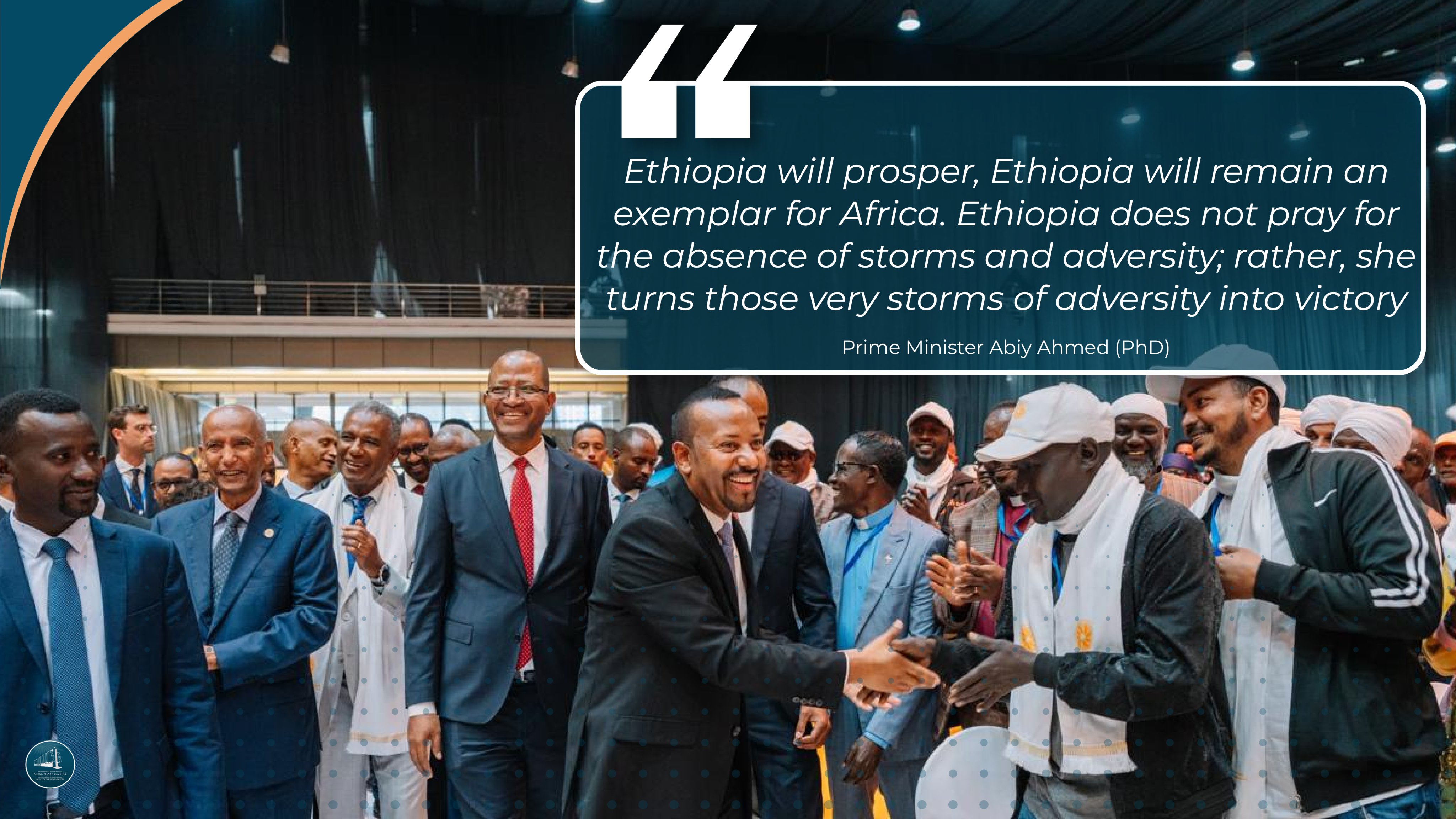
The opening ceremony brought together more than 4,000 representatives from across Ethiopia, Prime Minister Abiy Ahmed, Ethiopian National Dialogue Chief Commissioner Professor Mesfin Araya, former Nigerian President Olusegun Obasanjo, African Union Commissioner for Political Affairs, Peace and Security Ambassador Bankole Adeoye, and IGAD Executive Secretary Workneh Gebeyehu.
While each speaker approached the dialogue from a different perspective, their messages converged around several central themes: rejection of political violence, need for inclusive dialogue, Ethiopian ownership of the process, national reconciliation, institutional renewal and Africa's confidence that Ethiopia can emerge as a model for peaceful conflict resolution.
Ending Cycle of Political Violence
Prime Minister Abiy Ahmed set the tone by diagnosing what he described as Ethiopia's longstanding political dilemma. "Our politics begins with strong words and ends with strong action. This divide must be stopped once and for all."
Rather than portraying today's tensions as isolated events, the Prime Minister argued that Ethiopia has developed a political culture in which disagreements repeatedly escalate into violence because peaceful mechanisms for resolving disputes have remained weak. His central message was that Ethiopia now faces a rare opportunity to fundamentally change that tradition. "The opportunity before us today is not one that comes often. We are gathered here to write history together."
He urged the representatives to place national interests above political, ethnic and ideological divisions, arguing that future generations should remember this gathering as the moment Ethiopia deliberately chose dialogue over division.
Ethiopian National Dialogue Chief Commissioner, Professor Mesfin Araya, on his part reinforced the same diagnosis from the perspective of the National Dialogue Commission. "Our country has repeatedly attempted to settle disagreements through force, exclusion and temporary political arrangements. None of these approaches has delivered lasting peace."
For the Commission, the dialogue is not another political conference but an institutional attempt to replace force with consultation as Ethiopia's primary method of addressing disputes over governance, constitutional arrangements, identity, historical grievances, resource sharing, and national unity.
One of the strongest themes running throughout the opening day was the unanimous rejection of violence as a political instrument. Former Nigerian President Olusegun Obasanjo offered perhaps the most forceful warning, drawing on Nigeria's own painful historical experience. "War does not bring any benefits," he said, adding that "a civil war is more serious and destructive than a war with an external enemy. We must (therefore) protect ourselves from civil war and conflict."
His intervention carried particular moral authority because it reflected lessons learned from one of Africa's largest and most complex post conflict societies. Rather than offering theoretical observations, Obasanjo argued from experience that internal wars leave deeper institutional, social and psychological scars than conflicts with external enemies.
IGAD Executive Secretary Workneh Gebeyehu further expanded this argument beyond security. "No nation has ever been built or prospered through conflict."
His remarks linked peace directly with national development, suggesting that countries achieve lasting progress only when they prioritize dialogue, compromise and collective national interests over confrontation.
Together with Prime Minister Abiy and Ethiopian National Dialogue Chief Commissioner Professor Mesfin, the remarks formed a remarkably consistent message that Ethiopia's future cannot be secured through force but only through sustained political dialogue.
Listening Instead of Winning
A defining feature of the opening ceremony was the emphasis on changing not only political outcomes but political behavior itself. The Ethiopian National Dialogue Chief Commissioner argued that disagreement is a normal characteristic of democratic societies. "Having different views is natural. The problem begins when we attempt to silence differences through violence instead of resolving them through discussion."
He further emphasized that dialogue should never be viewed as a contest between winners and losers. "Dialogue is not about defeating another person. It is about finding common ground while respecting differences."
Similarly, Prime Minister Abiy repeatedly encouraged participants to listen patiently and sincerely rather than attempting to impose predetermined positions. This represents a significant conceptual shift from zero sum politics toward consensus-based governance, where political disagreement is managed institutionally rather than violently.
Continental Model
The invited African speakers consistently elevated the dialogue beyond Ethiopia's domestic political landscape. Obasanjo described the conference as being "of historic significance not only for Ethiopia but for the whole of Africa."
He positioned Ethiopia's experience within a broader continental effort to demonstrate that African countries can solve their own political challenges through dialogue rather than prolonged conflict.
African Union Commissioner for Political Affairs, Peace and Security, Ambassador Bankole Adeoye, reinforced this position from the African Union's institutional perspective. "The Ethiopian National Dialogue is a foundation for lasting peace and national reconciliation."
His statement reflects the African Union's broader policy preference for inclusive, nationally owned political processes as mechanisms for conflict prevention and post-conflict recovery.
Similarly, IGAD Executive Secretary Workneh Gebeyehu described the conference as a defining historical moment. "This historic conference is a significant event that will open a new chapter in Ethiopia's long and proud history."
Collectively, these interventions transformed the conference from a national reconciliation exercise into what many African leaders clearly view as a potential continental reference point for managing complex political diversity.
Ethiopian Ownership and African Solutions
Another major point of convergence was the insistence that Ethiopia itself must own both the dialogue and its outcomes. Ambassador Adeoye repeatedly described the process as nationally led, emphasizing that the African Union's role is to support rather than direct Ethiopia's political choices.
IGAD Executive Secretary Workneh took this argument further by highlighting Ethiopia's own historical traditions of reconciliation. "There is no need to look abroad for solutions to our problems. Ethiopia has many positive and exemplary experiences that can guide this process."
This reflects an increasingly prominent African philosophy that durable peace is most likely when countries build upon indigenous institutions, cultural traditions and locally accepted mechanisms instead of relying exclusively on externally designed political formulas.
Beyond immediate conflict resolution, the speakers presented the dialogue as a long-term state building project. Obasanjo argued that the conference should ultimately produce "a strong and united Ethiopia," capable of rallying citizens around a shared national vision while positioning the country as one of Africa's leading states.
Prime Minister Abiy similarly connected domestic unity with Ethiopia's strategic interests, suggesting that political fragmentation historically created opportunities for external actors to exploit internal divisions. National reconciliation, therefore, was presented not only as a political objective but also as an essential component of national sovereignty and regional influence.
Professor Mesfin also emphasized that the conference should be viewed as the beginning rather than the conclusion of a much longer process. "This conference is not the destination. It is the beginning of a national journey toward understanding, trust, and lasting peace."
His remarks highlighted the institutional maturity of the ENDC, which after nearly four years of nationwide consultations, agenda collection and stakeholder engagement, has now entered its substantive deliberation phase.
Regional Stability and Continental Stakes
The African Union and IGAD made clear that Ethiopia's stability has implications extending well beyond its borders. For the African Union, the country's peace is closely linked to the stability of the Horn of Africa, particularly given the country's strategic position, diplomatic influence and role as host of the AU headquarters.
Likewise, IGAD reaffirmed its commitment to accompany Ethiopia throughout the dialogue process, recognizing that developments inside Ethiopia inevitably affect regional security, trade, migration and political integration.
Their endorsements therefore represent both solidarity with Ethiopia and recognition that successful dialogue would strengthen broader regional stability.
Conclusion
The opening day of Ethiopia's National Dialogue Conference established both the political philosophy and the strategic ambitions that are expected to guide the process in the weeks ahead. The messages delivered by the speakers focused on transforming Ethiopia's political culture by replacing confrontation with consultation, acknowledging historical grievances, strengthening institutions and encouraging compromise over coercion.
These domestic messages were reinforced by a unified continental voice. Former Nigerian President Olusegun Obasanjo contributed historical perspective by warning against the devastating consequences of civil conflict and urging Ethiopians to build a united nation around shared aspiration. African Union Commissioner Ambassador Bankole Adeoye affirmed the dialogue as a nationally owned foundation for lasting peace and reconciliation, while IGAD Executive Secretary Workneh Gebeyehu emphasized Ethiopia's own traditions of consultation and called on the country to demonstrate that dialogue remains the only sustainable path to national renewal.
Taken together, the speeches reveal an emerging consensus that Ethiopia's National Dialogue is more than a political conference. It is an ambitious attempt to redefine how one of Africa's oldest states manages diversity, resolves disputes and builds national consensus. Whether it ultimately succeeds will depend not on the symbolism of its opening, but on the willingness of participants to translate dialogue into durable agreements, institutional reforms, and a shared vision capable of securing lasting peace for future generations.


