Africa Pastoral Markets Forum Seeks to Unlock Livestock Sector as Driver of Economic Growth - ENA English


Africa Pastoral Markets Forum Seeks to Unlock Livestock Sector as Driver of Economic Growth
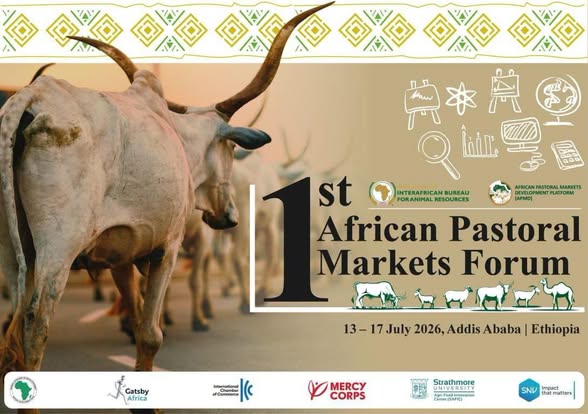
Addis Ababa, July 13, 2026 (ENA) — The First Africa Pastoral Markets Forum opened in Addis Ababa on Monday with a call to transform Africa's pastoral livestock sector into a major driver of economic growth, employment, trade, investment, and resilience across the continent.
The five-day forum, running from July 13 to 17, has brought together representatives from 15 African Union member states, along with investors, policymakers, development partners, private sector actors, and market enablers to explore ways of strengthening livestock markets and expanding investment in the pastoral economy.
The forum aims to catalyze investment, strengthen market systems, and unlock trade in Africa's pastoral livestock sector by providing a continental platform for sharing experiences, showcasing innovative and bankable business models, and identifying opportunities for greater market integration.
Opening the forum, State Minister of Agriculture Fikru Regassa said the gathering comes at a critical moment as African countries work to strengthen their agri-food systems, expand intra-African trade under the African Continental Free Trade Area, and unlock the full economic potential of livestock and pastoral production systems.
He said the forum would make a significant contribution to transforming Africa's pastoral livestock sector into a stronger source of economic growth, employment, trade, investment, and resilience.
The state minister stressed that pastoralism is far more than a traditional way of life, describing it as a productive economic system that supports millions of Africans while contributing significantly to food security, employment, exports, and rural livelihoods.
Despite its enormous potential, he noted that pastoral communities continue to face major challenges, including limited market infrastructure, inadequate financial services, animal health risks, climate variability, and weak transport networks.
Director of the African Union Inter-African Bureau for Animal Resources (AU IBAR), Huyam Salih, called for a fundamental shift in the way Africa views pastoral livestock production.
"We are here to make a deliberate continental shift from treating pastoral livestock mainly as a vulnerability issue to recognizing it as a strategic economic system capable of supporting food security, trade, jobs, investment, industrialization, and regional integration," she said.
Salih noted that the narrative surrounding pastoralism has long focused on drought, conflict, and marginal lands, overlooking its significant economic contribution.
"Livestock contributes close to a quarter of agricultural GDP in sub–Saharan Africa and between 30 and 80 percent of agricultural value added in several of our countries. Pastoral systems support more than 268 million pastoralists and agro-pastoralists, and they sustain some of the most robust, low-input, climate-adapted food production systems on earth. This is not a safety net. It is a continent-wide economic infrastructure," she said.
She added that although Africa possesses one of the world's largest livestock populations, it captures only a small share of the value generated by the sector.
"That gap is systemic inefficiency. Seen differently, it is the single largest pipeline of investible opportunity in African agriculture," Salih said.
To address this challenge, she said AU IBAR, with support from the Gates Foundation, established the African Pastoral Markets Development Platform to reposition pastoral livestock as a strategic economic asset.
The platform is generating evidence, validating business models that integrate pastoralists into formal markets, strengthening policy and institutional frameworks, facilitating trade, and mobilizing investment.
Head of Rural Development and Agriculture, Food and Security Division at the African Union Commission, Janet Edeme, said Africa must move beyond subsistence-oriented livestock production toward competitive, integrated, and climate-resilient value chains capable of creating wealth, jobs, and food security.
She said the African Union envisions pastoral livestock producers being fully integrated into regional and continental markets through improved infrastructure, harmonized trade regulations, digital technologies, financial services, and expanded investment.
"First, we must strengthen regional market integration. Livestock production systems naturally transcend national borders. Animal mobility, seasonal grazing patterns, and trade routes have existed for centuries across Africa's pastoral landscapes. Our policies and markets must therefore facilitate, not hinder, these realities," Edeme said.
She added that the African Continental Free Trade Area presents an unprecedented opportunity to expand intra-African livestock trade by reducing tariff and non-tariff barriers, harmonizing sanitary and phytosanitary standards, improving customs procedures, and strengthening regional livestock corridors.
Representing the Gates Foundation, Jom Asebe said the foundation is working closely with the African Union's Animal Resources Division to expand market access while strengthening policy and institutional capacity across the continent.
The forum also highlighted ongoing initiatives aimed at attracting investment, strengthening policy frameworks, and promoting market-driven transformation in Africa's pastoral economy.
Established by AU IBAR with funding from the Gates Foundation, the African Pastoral Markets Development Platform is facilitating inclusive livestock market development through multi-stakeholder partnerships.
The platform is currently implementing market-focused interventions in Kenya and Nigeria as lighthouse countries, with plans to expand to strategic outreach countries, including Benin, Burkina Faso, Cameroon, Chad, Ethiopia, Somalia, Niger, and Tanzania in collaboration with public, private, and civil society partners.


