Ethiopian Nat'l Dialogue: Sovereign Will of the People as Ultimate Decision Makers - ENA English
Ethiopian Nat'l Dialogue: Sovereign Will of the People as Ultimate Decision Makers
By: Tewodros Habenom
July 5, 2026 (ENA)
As Ethiopia approaches July 15, the scheduled commencement of the National Dialogue Conference, the nation stands at a historic crossroads.
Established in 2021 during a period of political turbulence, the Ethiopian National Dialogue Commission was conceived as a vital response to a fundamental question: How can a nation fractured by deeply rooted historical grievances and civil conflicts build a stable, unified future? The answer chosen by Ethiopia is both bold and democratic — allowing the people to shape their own destiny.
For decades, Ethiopia's political landscape was dominated by an elite-driven model, where peace agreements and social contracts were negotiated behind closed doors by political leaders.
History has proven that these top-down settlements are inherently fragile. They manage immediate crises but fail to resolve the structural fault lines of society because they bypass the pulse of the population.
The current national dialogue represents a decisive departure from this obsolete approach, positioning itself as the most viable alternative for sustainable peace by placing the sovereign will of ordinary citizens at the very center of the state-building process.
To appreciate why this initiative stands as the definitive path forward, one must look beyond the opening ceremony of the conference to the expansive, multi-year process that built its foundation.
Since 2021, the Commission has functioned as an independent, rigorous institution, stretching its reach across more than 1,200 administrative districts (Woredas) nationwide through extensive bottom-up consultations. This was not a superficial exercise in opinion polling, but an unprecedented effort to listen to communities that have long felt marginalized from national discourse.
This extended preparatory phase allowed for a critical transition in the national consciousness. By engaging citizens in calm, structured consultations away from the immediate pressures of political polarization, the process has gradually cultivated a sustainable culture of dialogue.
The years spent gathering agendas and conducting field investigations proved that the true ownership of this process are the Ethiopian public. The upcoming conference is therefore is the culmination of a massive, bottom-up movement where the questions to be debated were generated entirely by the people themselves.
From Elite Monopoly to National Inclusion
The core democratic strength of this dialogue lies in its success in breaking the historical monopoly of political elites over national decision-making.
By moving directly to the grassroots, the Commission has ensured that the upcoming plenary reflects the true diversity of the Ethiopian social fabric. This commitment to total inclusivity was vividly demonstrated when Ethiopian National Dialogue Commission Chief Commissioner, Professor Mesfin Araya, announced the finalized national agendas.
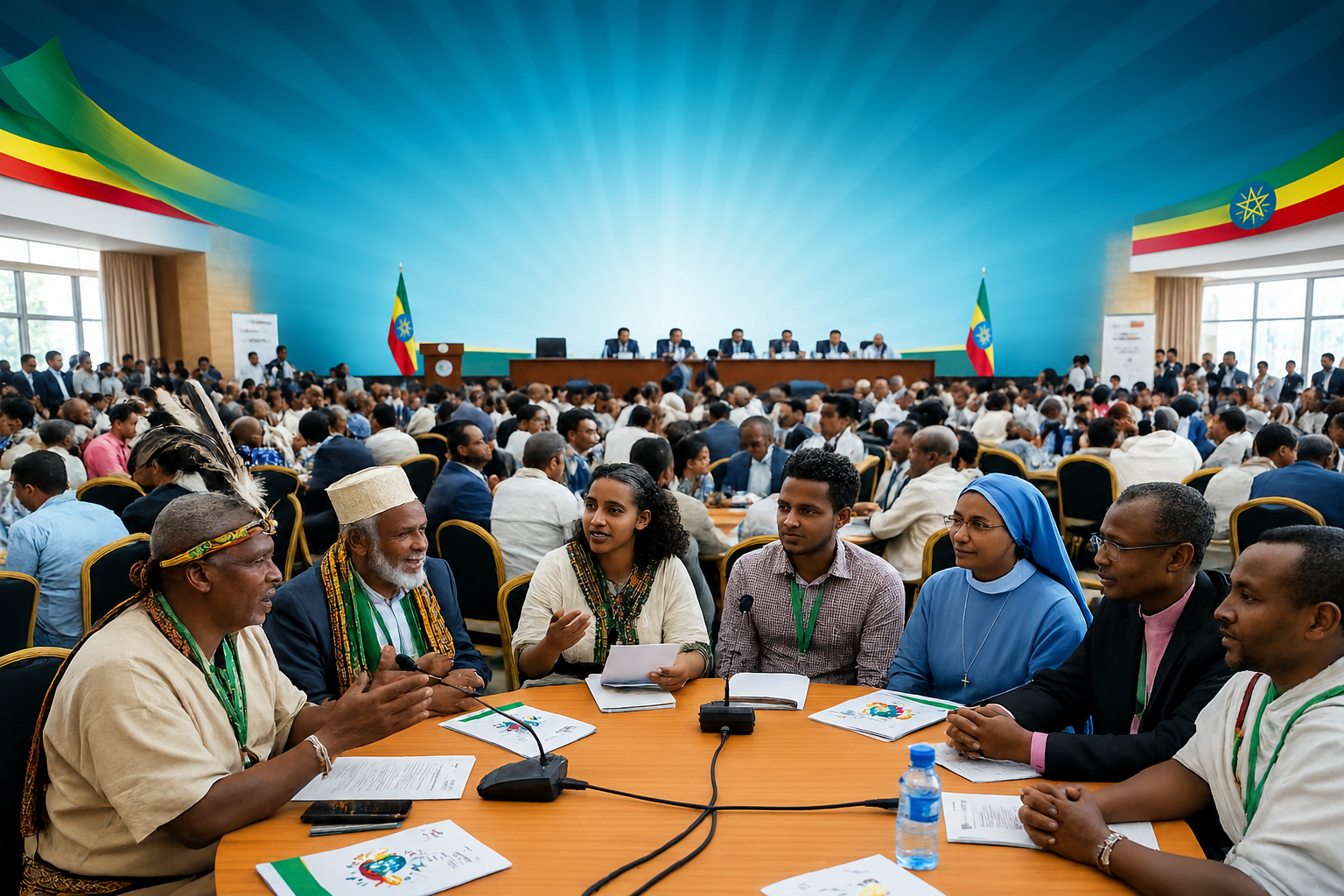
The composition of the participants shatters traditional political frameworks, bringing together influential traditional and religious leaders alongside youth advocates, women’s associations, and civil society organizations, among others.
In this arena, the voice of a farmer or a pastoralist carries the same weight and structural legitimacy of an elite. This broad representation ensures that the outcome of the dialogue will possess a collective moral authority that is difficult to challenge, transforming transparency from a political slogan into a lived reality.
Independent Management and Expert Briefings
A critical factor that solidifies this dialogue as the nation's best alternative is the clear separation of powers governing its execution. The regulatory architecture ensures that the process remains entirely autonomous, meaning the role of the Ethiopian government is strictly limited to providing logistical facilitation, financial underwriting, and securing the venues to guarantee a safe, neutral space where ideas can be exchanged without fear or institutional pressure.
To elevate the quality of the debates without manipulating the outcomes, the Commission has introduced specialized briefing sessions led by independent experts and researchers. The function of these scholars is strictly informational, aimed at equipping participants with empirical data and objective analytics regarding complex socio-economic and structural challenges.
This intellectual support is designed to strip emotional polarization from the discussions, ensuring that when the delegates make their final choices, those choices are rational, informed, and entirely their own.
The Core Pillars of New Social Contract
The comprehensive roadmap guiding the upcoming deliberations is structured around core thematic pillars synthesized directly from the thousands of submissions gathered during the nationwide grassroots consultations.
These pillars address the essential structural components required to stabilize and modernize the Ethiopian state, beginning with fundamental state-building to define shared symbols and collective identity, alongside resolving long-standing constitutional debates regarding federal structures and administrative systems.
Furthermore, the dialogue will chart the socio-political dynamics of federal cities, protect institutional religious coexistence, and strengthen judicial independence and human rights protections.
Crucially, the agenda balances these heavy constitutional questions with the daily livelihood concerns of rural and urban workers by focusing on the specific vulnerabilities of farmers and pastoralists, reforming public administration to ensure good governance, and designing comprehensive frameworks for sustainable peacebuilding and reconciliation.
By integrating these lived realities with structural politics, the agendas prove that they are grounded in the real world and driven entirely by what the population deemed urgent.
Institutionalizing Culture of Consensus
Ultimately, the true legacy of the national dialogue will be measured by its ability to permanently transform Ethiopia’s political culture. For generations, political competition in the region has been trapped in a zero-sum, exclusionary logic.
This dialogue offers a structural bridge toward a pluralistic, consensus-based model, which is a fundamental prerequisite for building a resilient state capable of navigating complex internal and external challenges.
The ongoing, open-ended invitations extended by Chief Commissioner Mesfin Araya to boycotting factions and armed actors reinforce the principle that this initiative remains an inclusive national umbrella.
It demands only one condition: a commitment to a peaceful, constructive path. Ethiopia’s future cannot be secured by force or dictated by a select few. It can only be sustained through a collective will that recognizes the nation as a shared responsibility. By entrusting the roadmap to its citizens, Ethiopia is proving that when the people are empowered to choose, they choose peace, stability, and mutual survival.