Building Ethiopia's Path to Consensus, Peace and Democratic Transformation - ENA English


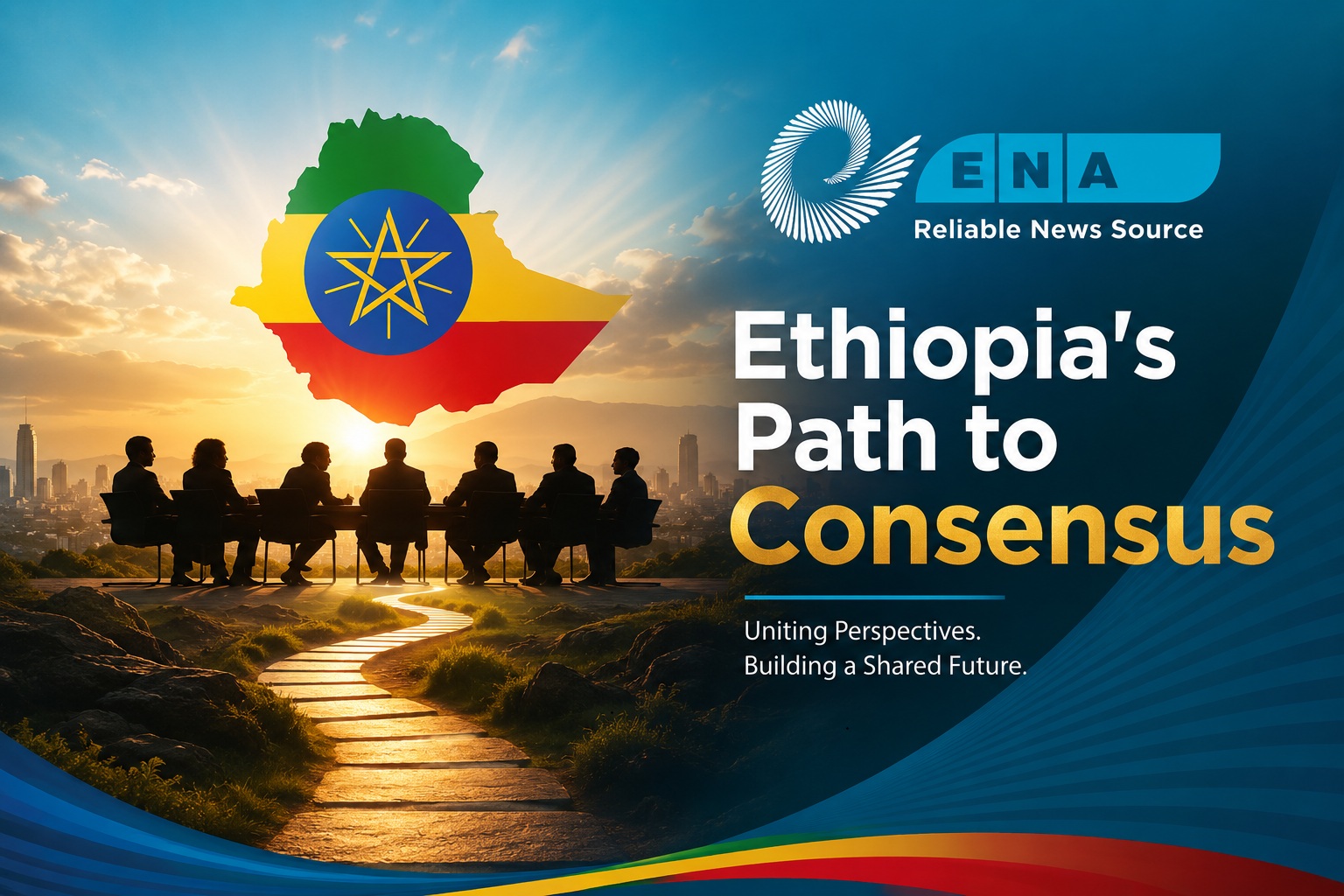
Building Ethiopia's Path to Consensus, Peace and Democratic Transformation
By Yordanos D.
June 26, 2026 (ENA)
Few nations have embarked on a national conversation as consequential as the one now taking shape in Ethiopia.
At a time when many societies are grappling with political polarization, identity disputes, and declining public trust, national dialogue has emerged as an important mechanism for addressing deep-rooted differences through peaceful engagement rather than confrontation.
Experiences from countries such as South Africa, Tunisia, Kenya, and Colombia demonstrate how inclusive dialogue can help societies navigate complex transitions, build consensus, and promote lasting peace.
Ethiopia's decision to undertake such a process reflects both the opportunities and challenges inherent in one of Africa's oldest and most diverse nations. Home to a rich mosaic of cultures, languages, religions, and historical experiences, the country has long debated issues related to governance, constitutional arrangements, national identity, political representation, and resource sharing. Recognizing that these questions require inclusive and peaceful deliberation, Ethiopia established the Ethiopian National Dialogue Commission (ENDC) as an independent platform through which citizens can discuss matters of national importance and seek common ground.
Following extensive consultations conducted across the country and Ethiopian diaspora in various countries, the Commission has identified eight major thematic agenda pillars that reflect the priorities and concerns raised by citizens. As the process moves from consultation to substantive deliberation, Ethiopia's National Dialogue enters a critical phase that could help shape the country's political future and strengthen the foundations for peace, consensus, and democratic transformation.
Independence and Credibility
The credibility of this process will depend not only on the issues under discussion but also on the independence of the institution facilitating it, the inclusiveness of participation, and the ability of the media to inform, engage, and connect citizens throughout the country. Examining these elements provides important insight into the significance of the dialogue and its potential contribution to Ethiopia's future.
The debate on its independence itself reflects the significance of the process for independence remains the most valuable asset of any national dialogue institution.
It is vivid that without public confidence in its neutrality, dialogue risks losing legitimacy before meaningful discussions begin. Conversely, when citizens trust the impartiality of the institution facilitating dialogue, they are more likely to participate constructively and accept its outcomes.
In connection to this a careful assessment of the ENDC reveals substantial legal, institutional, and operational safeguards that support its independence.
Its legal mandate, diverse leadership, nationwide consultations, bottom up agenda setting process, transparency, and commitment to inclusiveness collectively demonstrate the autonomy necessary for a credible national dialogue.
The independence of the Commission has already been rooted in law. Understanding its independence begins with its legal foundation. The ENDC, therefore, was established as an autonomous institution through legislation enacted by Ethiopia's House of Peoples' Representatives (HPR).
The proclamation explicitly recognizes the existence of differing views among political leaders, opinion makers, and various segments of society and underscores the need to address those differences through inclusive national dialogue.
The law grants the Commission authority to conduct consultations, identify agenda items, engage stakeholders, and facilitate dialogue without interference from any political actor or institution.
Recently, Commissioner Ambassador Mahmud Dirir explained the Commission's legal autonomy during a consultation forum with media representatives held in Bishoftu. "The independence of the Commission emanates from its establishing proclamation," Ambassador Mahmud stated. "The Articles in the proclamation clearly stipulates that the Commission is free from any influence and is required to work solely in accordance with the objectives for which it was established."
The ambassador further stressed that the dialogue process belongs to all Ethiopians rather than any government, political party, or interest group.
He emphasized that unless all Ethiopians handle this consultation responsibly, it could end in severe consequences. This issue is not about one government or one political party. It is about Ethiopia and the future of all Ethiopians.
Historic Opportunity
The Commission's mandate arises from Ethiopia's unique historical circumstances.
Throughout its long history, Ethiopia has achieved remarkable milestones in statehood, diplomacy, culture, and civilization. Yet the country has also experienced periods of political conflict, social tensions, and competing interpretations of history.
Questions concerning federalism, governance, constitutional arrangements, political representation, resource sharing, identity, and national unity have generated intense debate for decades. While many of these discussions have taken place through democratic processes, some have also contributed to instability and conflict.
Now the National Dialogue seeks to provide a peaceful alternative by replacing confrontation with conversation.
Chief Commissioner Mesfin Araya has repeatedly emphasized that the process represents a national opportunity to address longstanding issues through dialogue rather than division. "The National Dialogue is not designed to determine winners and losers," he stated in several public forums. "It is a platform through which Ethiopians can listen to one another, identify areas of disagreement, and build consensus on issues of national importance."
He has further stressed that the success of the process ultimately depends on citizens themselves. "No institution can build consensus alone. Sustainable peace requires the participation, ownership, and commitment of all Ethiopians."
Commissioners' Credibility
The Commission's leadership is another important factor supporting its independence.
Its commissioners come from diverse professional backgrounds, including diplomacy, academia, law, civic engagement, and public service. Their credibility was established long before their appointment to the Commission.
Rather than advocating political positions, the commissioners have consistently presented themselves as facilitators whose role is to create opportunities for Ethiopians to engage constructively and seek solutions collectively.
This diversity of expertise and experience has strengthened public confidence and contributed significantly to the institution's credibility.
Bottom Up Agenda Setting
Perhaps the clearest demonstration of the Commission's independence has been its extensive nationwide consultation process.
Over the past several years, the Commission has conducted consultations across regional states, zones, districts, and communities. It has engaged elders, religious leaders, women, youth, civic organizations, professionals, traditional institutions, political actors, and representatives of marginalized communities.
Rather than imposing agendas from above, the Commission invited citizens themselves to identify the issues they believe should be discussed during the national dialogue.
This bottom-up approach strengthens legitimacy by ensuring that agenda items reflect the concerns and aspirations of ordinary Ethiopians rather than the preferences of political elites.
It also demonstrates operational autonomy. Institutions operating under strict political direction rarely allow citizens such significant influence over agenda formation.
According to Commissioner Ambassador Mahmud Dirir, the Commission has now completed the consultation phase and is preparing for the next critical stage.
"Now the process is at its last and critical phase," he said.
In fac, the Commission has already announced the agendas for the national dialogue.
He also disclosed that consultations among selected representatives are expected to commence in July 2026.
National Responsibility
As Ethiopia prepares to enter the next phase of its National Dialogue, the responsibilities of citizens, institutions, and media organizations become even more significant.
The Commission's independence, grounded in law and demonstrated through practice, provides a foundation for public trust. Its nationwide consultations, inclusive outreach, and bottom-up agenda setting process have created an opportunity for Ethiopians to engage with difficult issues through peaceful discussion rather than confrontation.
Ultimately, the success of National Dialogue will not be determined solely by institutions or commissioners. It will depend on the willingness of Ethiopians to participate, listen, and seek common ground.
As Chief Commissioner Mesfin Araya has repeatedly emphasized, the dialogue is a national project whose success belongs to all Ethiopians.
If conducted with integrity, inclusiveness, and broad public participation, the process offers an opportunity to transform longstanding disagreements into constructive dialogue, strengthen national cohesion, and lay a foundation for lasting peace, democratic consolidation, and shared prosperity.
In that endeavor, an independent Commission and a responsible media sector stand as two indispensable pillars supporting Ethiopia's pursuit of consensus, reconciliation, and a more united future.
National Agenda Setting
The extensive consultations conducted across Ethiopia have now culminated in one of the most significant milestones of the National Dialogue process: the identification of major thematic agenda areas that reflect the concerns, aspirations, and priorities raised by citizens throughout the country.
Drawing on contributions from communities, elders, religious leaders, women, youth, political actors, civic organizations, professionals, and representatives of marginalized groups, the ENDC has consolidated thousands of public inputs into eight major thematic pillars that will guide the upcoming national deliberations.
These agenda areas encompass many of the issues that have shaped Ethiopia's political, social, and economic discourse for decades.
The first pillar, State Building, focuses on questions related to national identity, historical narratives, social cohesion, and the future direction of the Ethiopian state. Closely linked to this is the pillar on Structure and Form of Government, which addresses debates surrounding federalism, constitutional governance, power sharing arrangements, and institutional frameworks.
The agenda also includes deliberations on the Status of Federal Cities, particularly the governance, administration, and national role of Addis Ababa and Dire Dawa, issues that have long generated public discussion and differing perspectives.
Recognizing the important role of faith communities in Ethiopian society, the Commission has identified Religious Affairs as a separate thematic pillar. Discussions under this agenda are expected to focus on strengthening interfaith harmony, promoting equality among religious communities, and fostering constructive relations between the state and religious institutions.
Another major pillar centers on Institutional Building, Rule of Law, and Human Rights. This thematic area addresses concerns regarding institutional effectiveness, constitutionalism, judicial independence, accountability, and the protection of fundamental rights and freedoms.
Economic and social issues raised during consultations have also received significant attention.
The pillar on Socio Economic Affairs, Including the Concerns of Farmers and Pastoralists, seeks to address questions of economic development, equitable growth, social welfare, livelihoods, and the challenges facing agricultural and pastoral communities that form the backbone of the country's economy.
Public concerns regarding governance have been incorporated under the thematic agenda of Anti-Corruption and Good Governance, which will explore measures aimed at strengthening transparency, accountability, institutional integrity, and public trust.
Finally, the pillar on Peace Building reflects the widespread desire expressed by citizens for reconciliation, conflict resolution, healing, and sustainable mechanisms capable of ensuring long term national stability and peaceful coexistence.
Together, these eight thematic pillars provide a comprehensive framework for addressing Ethiopia's most consequential national questions.
They demonstrate the breadth of the consultation process and reflect the Commission's commitment to ensuring that the dialogue agenda emerges from citizens themselves rather than being prescribed by political elites.
Chief Commissioner Mesfin Araya has repeatedly emphasized that the purpose of the dialogue is not to impose predetermined solutions but to create a platform where Ethiopians can collectively deliberate on issues that affect their shared future.
"The National Dialogue is not designed to determine winners and losers," Mesfin has stated. "It is a platform through which Ethiopians can listen to one another, identify areas of disagreement, and build consensus on issues of national importance."
The identification of these thematic pillars therefore marks not the conclusion of the process, but the beginning of a new and more substantive phase in which representatives from across the country will engage in structured discussions aimed at building consensus on matters that have shaped Ethiopia's political and social landscape for generations.
With the consultation phase completed and deliberations scheduled to commence in July 2026, the National Dialogue is entering a historic stage that many view as an opportunity to transform longstanding disagreements into constructive engagement, strengthen national cohesion, and lay the foundation for a more peaceful and democratic future.
In conclusion the National Dialogue represents more than a political exercise. It is an attempt to create a peaceful national framework through which Ethiopians can address longstanding disagreements, strengthen mutual understanding, and build consensus on issues that have shaped the country's trajectory for generations.
The completion of nationwide consultations and the emergence of eight major thematic agenda pillars demonstrate that the process has been driven by the voices and concerns of citizens from across the country rather than by predetermined political prescriptions.
The independence of the Ethiopian National Dialogue Commission remains central to the credibility and legitimacy of this historic undertaking. Its legal foundation, diverse leadership, extensive consultations, transparent procedures, and commitment to citizen-led agenda setting provide important safeguards that can help foster public trust.
Equally important is the role of the media, whose responsibility extends beyond reporting events to facilitating informed public discourse, promoting transparency, amplifying diverse perspectives, and countering misinformation.
As representatives prepare to begin deliberations on issues ranging from state building and governance to peace building, socio-economic development, human rights, and good governance, Ethiopia stands at an important national crossroads.
The dialogue process will not eliminate differences, nor is it intended to do so. Rather, its success will be measured by its ability to transform disagreement into constructive engagement and competition into cooperation.
History shows that nations achieve lasting stability not by avoiding difficult conversations but by confronting them openly, inclusively, and peacefully.
Ethiopia's National Dialogue offers such an opportunity. If approached with sincerity, patience, and a shared commitment to the national interest, it can help lay the foundation for stronger institutions, greater social cohesion, democratic consolidation, and enduring peace.
The outcome will ultimately depend on the willingness of Ethiopians from all walks of life to participate in good faith and to embrace dialogue as a pathway toward a more stable, united, and prosperous future.


