Ethiopia’s Digital Revolution: From Connectivity to Competitiveness - ENA English


Ethiopia’s Digital Revolution: From Connectivity to Competitiveness
By Staff Writer
June 26, 2026 (ENA)
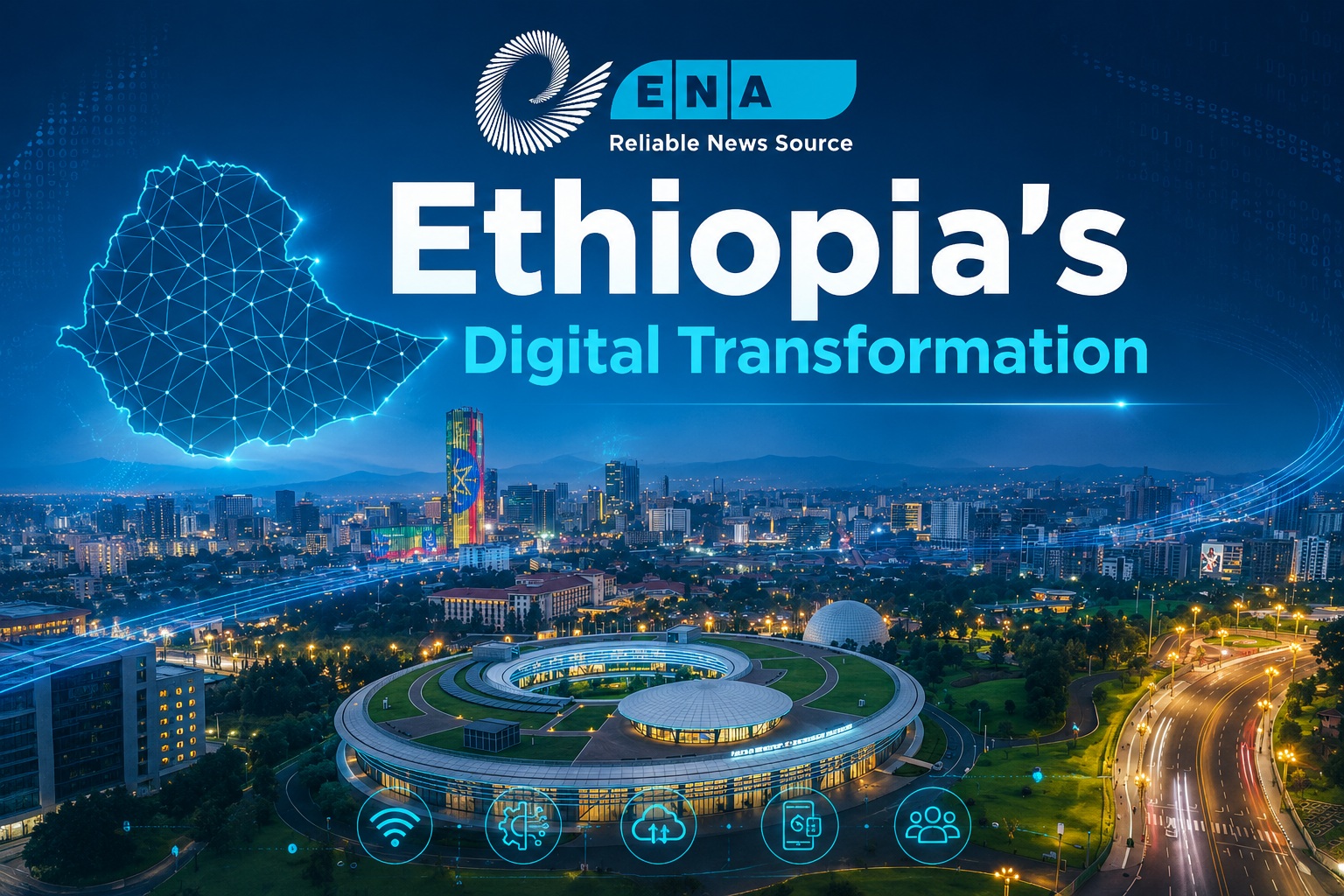
Across Africa, nations are embracing the digital revolution as a catalyst for economic growth, stronger governance, and greater global competitiveness. Among them, Ethiopia—long celebrated for its ancient civilization, rich cultural heritage, and strategic position in the Horn of Africa, is emerging as one of the continent’s most ambitious digital transformation stories.
At the heart of this transition is Prime Minister Abiy Ahmed, whose administration has elevated digital transformation from a sectoral technology initiative into a comprehensive national development agenda. Rather than viewing technology as an end in itself, the government has increasingly positioned digitalization as a powerful tool to improve governance, expand economic opportunity, modernize public services, and strengthen Ethiopia’s competitiveness in an increasingly digital world.
For a nation of more than 130 million people, around 70 percent of whom are under the age of 30—the stakes could hardly be higher. The question is no longer whether Ethiopia should embrace the digital age, but how quickly, inclusively, and effectively it can harness technology to improve the lives of its citizens.
A National Vision Beyond Technology
Since assuming office in 2018, Prime Minister Abiy Ahmed has consistently presented digital transformation as one of the central pillars of Ethiopia’s long-term economic modernization.
His administration first introduced Digital Ethiopia 2025, a national roadmap designed to establish the foundations of a modern digital economy. Building on the progress achieved under that strategy, Ethiopia has now embarked on implementing Digital Ethiopia 2030, a more ambitious blueprint intended to accelerate digital innovation while ensuring that the benefits of technological progress reach every corner of the country.
The transition represents a decisive new chapter in Ethiopia’s digital journey, shifting the focus from laying digital foundations to building an inclusive, resilient, and innovation-driven economy.
Announcing the launch of the strategy in late 2025, Prime Minister Abiy said Digital Ethiopia 2025 had achieved its objectives “to an almost full extent,” creating the momentum for an even broader national vision.
Rather than concentrating solely on expanding internet access, Digital Ethiopia 2030 seeks to build a people-centered digital society founded on accessibility, equal opportunity, institutional trust, digital sovereignty, and efficient technology-enabled public services.
Transforming Government Through Technology
One of the defining features of Ethiopia’s digital transformation has been the government’s determination to modernize public administration through technology.
Digital Ethiopia 2030 envisions a government where citizens can increasingly access public services online, institutions communicate seamlessly, and administrative processes become faster, more transparent, and more accountable.
A major milestone in this transformation is the Unified MESOB Application, described as Africa’s first integrated digital government platform that brings services from multiple public institutions together through a single digital interface. By consolidating government services onto one platform, the application is expected to simplify citizens’ interactions with public institutions, reduce bureaucracy, strengthen institutional coordination, and significantly improve service delivery.
Prime Minister Abiy Ahmed officially inaugurated the platform during the Digital for Excellence Summit, describing it as a landmark achievement in Ethiopia’s digital transformation journey and a practical demonstration of technology-driven governance.
Equally important is the continued expansion of Ethiopia’s Digital Public Infrastructure (DPI), including the nationwide rollout of the Fayda Digital ID, interoperable digital payment systems, sovereign government cloud infrastructure, and integrated online public services.
Collectively, these initiatives seek to replace fragmented administrative systems with connected digital platforms capable of supporting a modern, responsive, and citizen-focused state.
Opening Ethiopia’s Digital Economy
Digital transformation has also become an essential pillar of Ethiopia’s broader economic reform agenda.
One of the administration’s landmark reforms was the liberalization of the telecommunications sector, ending decades of monopoly and introducing competition that has stimulated investment, expanded mobile broadband coverage, and improved internet accessibility.
Alongside these reforms, the government has actively promoted digital financial services, electronic payments, fintech innovation, startup development, and entrepreneurship as key drivers of future economic growth.
Looking ahead, Digital Ethiopia 2030 aims to position Ethiopia as one of Africa’s preferred destinations for Digital Foreign Direct Investment (FDI). Through implementation of the Startup Proclamation and the Digital Ethiopia Investment Roadmap, policymakers hope to attract international technology companies, strengthen local innovation ecosystems, and create new employment opportunities for millions of young Ethiopians.
The ambition extends well beyond the ICT sector itself. Agriculture, manufacturing, healthcare, education, logistics, financial services, and public administration are all expected to benefit from deeper digital integration and improved productivity.
Building the Foundations First
Prime Minister Abiy Ahmed has repeatedly emphasized that technology alone cannot transform a nation.
Digital progress, he argues, must rest upon strong and reliable foundations.
Affordable electricity, nationwide broadband connectivity, cybersecurity, digital literacy, and resilient digital infrastructure have therefore become central pillars of Ethiopia’s long-term strategy.
Recognizing that millions of Ethiopians still live in rural communities with limited digital access, the government has placed increasing emphasis on extending infrastructure beyond major urban centers.
The objective is clear: ensuring that digital opportunities become available not only in Addis Ababa but across every region of the country.
This people-centered approach reflects a broader understanding that meaningful digital inclusion requires more than smartphones and applications—it requires reliable infrastructure that enables every citizen to participate in the digital economy.
A Young Nation with Global Potential
Ethiopia’s demographic profile represents one of its greatest strategic assets.
With one of the world’s youngest populations, the country possesses an enormous reservoir of talent capable of driving innovation, entrepreneurship, and digital productivity for decades to come.
Digital Ethiopia 2030 seeks to unlock this demographic dividend by expanding digital skills, strengthening innovation ecosystems, supporting startups, and creating an environment where technology becomes a major engine of employment, competitiveness, and economic diversification.
The strategy also aims to increase the digital economy’s contribution to the national economy while addressing persistent challenges such as digital literacy, internet penetration, and unequal access to technology.
Challenges That Still Lie Ahead
Despite remarkable progress over recent years, Ethiopia’s digital transformation remains an evolving national project rather than a finished achievement.
Infrastructure gaps, uneven connectivity, cybersecurity risks, affordability of digital services, institutional capacity, and disparities between urban and rural communities continue to present significant challenges.
Successfully implementing Digital Ethiopia 2030 will require sustained public investment, greater private-sector participation, policy consistency, stronger institutions, and continuous investment in digital skills.
Ultimately, technology alone cannot deliver transformation without resilient infrastructure, capable institutions, and widespread public participation.
Leading Ethiopia into the Digital Era
What distinguishes Prime Minister Abiy Ahmed’s approach is his effort to place digital transformation at the heart of Ethiopia’s national development strategy rather than treating it as a standalone technology policy.
Through telecommunications reform, expanded Digital Public Infrastructure, digital identity systems, electronic government services, and successive national digital strategies, his administration has sought to redefine how the Ethiopian state functions and how its economy competes in an increasingly digital world.
Digital Ethiopia 2030 represents the next chapter of that national ambition.
If successfully implemented, the strategy has the potential to position Ethiopia not only as one of Africa’s largest digital economies but also as a model for how technology can foster inclusive growth, strengthen governance, empower young people, and improve everyday life.
For Ethiopia, digital transformation is no longer simply about adopting new technologies. It is about building a future where innovation expands opportunity, institutions become more responsive, businesses become more competitive, and every citizen has a greater chance to participate in the country’s economic and social progress.
History has long remembered Ethiopia for its ancient civilization and enduring cultural legacy. Its next defining chapter, however, may well be written through digital innovation, powered by modern infrastructure and driven by one of the world’s youngest populations.
As nations compete in the digital age, Ethiopia is seeking not merely to keep pace, but to help shape Africa’s digital future.


