Ethiopia’s Leap Into the Future - ENA English


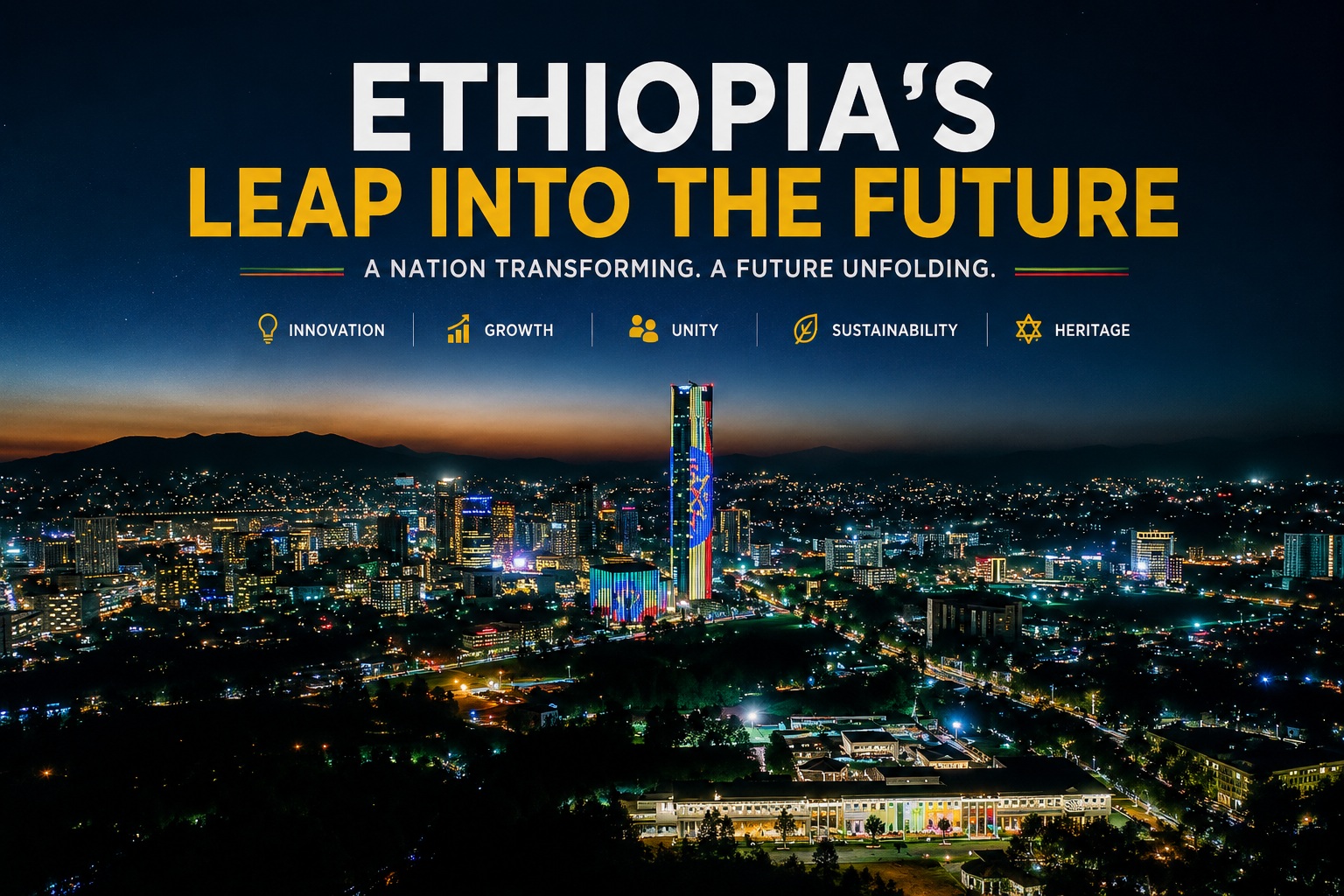
Ethiopia’s Leap Into the Future
By Staff Writer
June 25, 2026 (ENA)
There are moments in the life of a nation when history demands more than endurance. It demands clarity about where a country stands and courage about where it must go next.
Ethiopia is living through such a moment.
Standing before policymakers, development partners, investors, and national stakeholders, Prime Minister Abiy Ahmed framed a question that lies at the heart of Ethiopia’s current transformation:
What does it mean for Ethiopia not merely to catch up with the future, but to leap into it?
For a nation of more than 130 million people and one of the world's oldest civilizations, the question is neither rhetorical nor symbolic. It is a challenge rooted in Ethiopia’s history and increasingly reflected in its ambitions.
For generations, Ethiopia has defied expectations. It preserved its sovereignty when much of Africa was colonized. It built the Grand Ethiopian Renaissance Dam (GERD) on the Abay River through the determination and contributions of its citizens. Time and again, the country has demonstrated an ability to rise above limitations imposed by circumstance.
Today, Ethiopia seeks to do so again.
A New Story Emerging
For years, international narratives about Ethiopia were often dominated by conflict, poverty, inflation, and humanitarian challenges. While those realities cannot be ignored, they no longer tell the full story.
Across the country, signs of transformation are becoming increasingly visible.
Inflation, which once exceeded 30 percent, has fallen dramatically and even reached single-digit levels earlier this year. Exports are approaching historic highs. Economic growth is projected to reach 10.2 percent this fiscal year—one of the fastest growth rates not only in Africa but in the world.
These achievements did not emerge by chance.
They are the result of difficult reforms, what Prime Minister Abiy on Ethiopia Delivers Summit described it: “It is a result of deliberate policy choices, and a willingness to confront long-standing structural challenges.
The path has not been easy, nor has it been without sacrifice. Yet the emerging results suggest that Ethiopia is beginning to turn economic stabilization into a foundation for sustained national renewal.”
Still, numbers alone cannot capture the significance of transformation.
Behind every statistic are millions of lives being reshaped by opportunity.
The Human Face of Reform
Again Prime Minister Abiy cited a story of a woman who spent years running a small business in a local market.
She operated outside the formal economy. She had no bank account, no credit history, and no officially registered business. For years, the financial system simply did not recognize her existence.
Then came Fayda, Ethiopia’s national digital identification program.
After enrolling in the system and beginning to use digital financial services, she started building a formal financial record. That record created trust. Trust opened access to finance. Finance created opportunity.
Her talents had not changed. What changed was access.
Her story mirrors that of millions of Ethiopians who are now gaining entry into systems and opportunities that were previously beyond their reach. It is a reminder that the true measure of progress is not merely the institutions a country builds, but the lives those institutions improve.
Reforming While Building
Unlike many nations that can address challenges sequentially, Ethiopia has had to confront multiple crises simultaneously.
It has been required to stabilize while building, reform while delivering services, and correct long-standing weaknesses while preparing for future opportunities.
This approach reflects the philosophy behind Ethiopia’s broader development framework, often described as a model of interconnected transformation.
Economic reform, social protection, digital innovation, human development, local empowerment, and national cohesion are not viewed as competing priorities. Rather, they are seen as mutually reinforcing pillars of progress.
The goal is not simply economic growth. It is resilient and inclusive development.
Nation-Building as a Shared Responsibility
A central message emerging from Ethiopia’s reform journey is that transformation cannot be achieved by government alone.
Neither markets nor communities acting independently can deliver lasting change.
Nation-building requires collective effort.
It requires governments that create enabling environments, businesses that invest and innovate, communities that participate actively, and international partners willing to engage with mutual respect and shared purpose.
This spirit of partnership is increasingly shaping Ethiopia’s approach to development.
From macroeconomic reforms and productive urban development to digital systems, agricultural modernization, mining expansion, and infrastructure investment, Ethiopia is pursuing a comprehensive agenda aimed at unlocking long-term growth.
Yet leaders acknowledge that transformation remains a process rather than a destination.
The Challenges That Remain
The optimism surrounding Ethiopia’s progress is accompanied by a clear recognition of unfinished work.
Years of high inflation reduced household purchasing power and placed significant pressure on families. The benefits of economic reforms have not yet reached every citizen equally. Many communities continue to face economic hardship.
Acknowledging these realities is essential.
Successful nations do not advance by ignoring their challenges; they advance by confronting them honestly.
Perhaps the most critical challenge lies in preparing the next generation.
As technology reshapes economies and global competition intensifies, Ethiopia must ensure that its education systems, institutions, and opportunities allow young people to thrive.
The ultimate test of reform will not be measured solely by growth figures or investment flows.
It will be measured by whether Ethiopia can create competitive industries, generate meaningful employment, expand prosperity across regions, and build opportunities that endure across generations.
Ethiopia: A Leap Into Tomorrow
As Prime Minister Abiy revealed that at the heart of Ethiopia’s vision is a concept expressed in Amharic as "Ethiopia Manserarat (Ethiopia’s leap forward.”
It represents more than an economic strategy. It is a national aspiration.
A belief that the country can move beyond managing crises and begin shaping its future with confidence.
A belief that development must be inclusive, institutions must be strong, and progress must be sustainable.
A belief that every generation has a responsibility to preserve what is valuable, correct what is not working, and leave stronger foundations for those who follow.
The world is watching Ethiopia’s transformation.
Some observers do so with encouragement. Others with skepticism.
But Ethiopia’s responsibility remains unchanged: to serve the aspirations of its people, broaden opportunity, strengthen institutions, and build a future worthy of its immense potential.
The direction, Ethiopia says, is clear.
The commitment is firm.
And if the nation continues to build with discipline, courage, and a shared sense of purpose, this generation may well be remembered as the one that transformed possibility into reality—and left Ethiopia stronger than it found it.


