The Convergence of Terrorist Forces in the Horn: TPLF's Route to Al-Shabaab - ENA English


The Convergence of Terrorist Forces in the Horn: TPLF's Route to Al-Shabaab
Op-ed by Neway Tamiru
Addis Ababa, June 14, 2026
The Horn of Africa is entering a new and increasingly volatile chapter in its security history. Long characterized by political rivalries, armed conflicts, and geopolitical competition, the region now faces a more complex and dangerous challenge: the convergence of actors whose interests increasingly align around destabilizing Ethiopia and reshaping the regional balance of power.
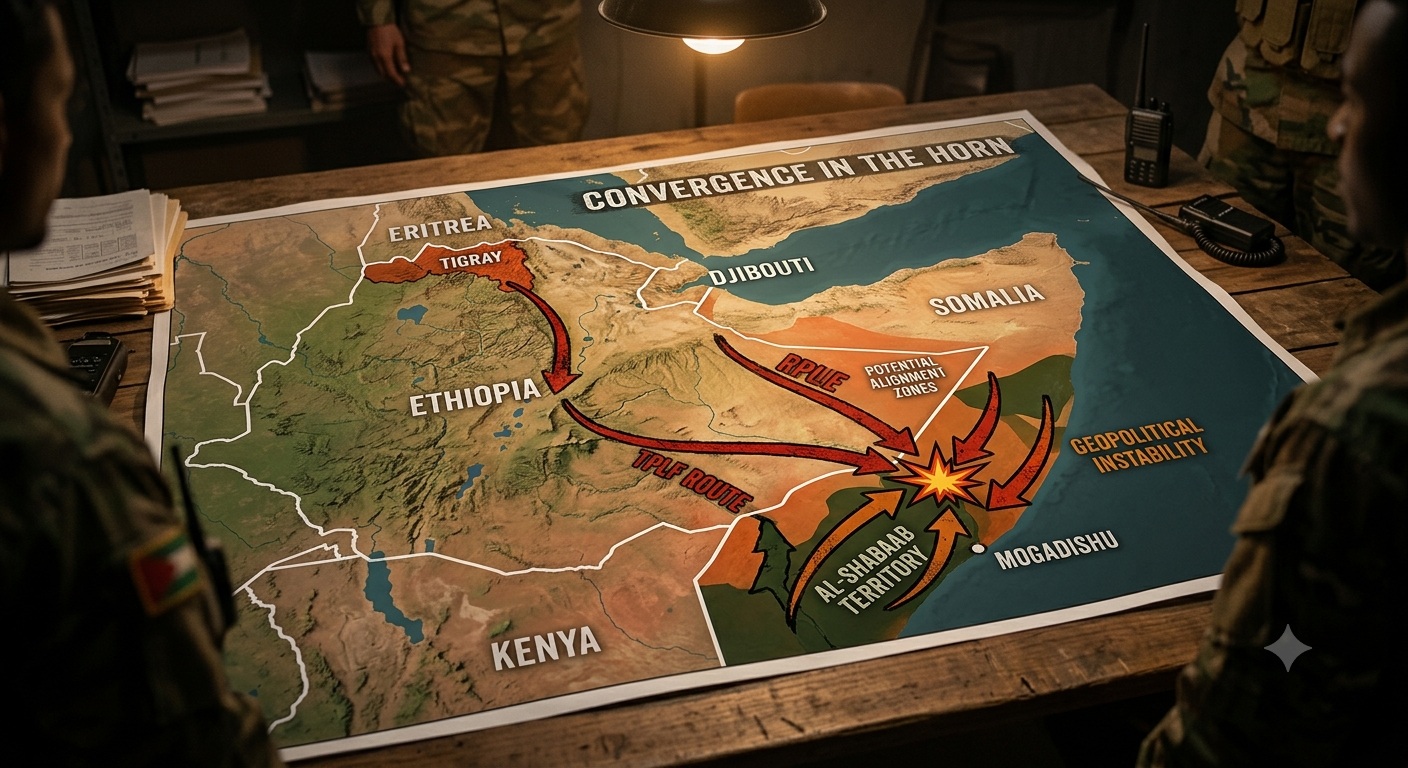
What were once separate conflicts and isolated security threats are gradually merging into a broader network of interconnected actors, agendas, and strategic calculations. At the center of growing concern is the emerging nexus linking the Tigray People's Liberation Front (TPLF), the Eritrean regime, and the Somalia-based terrorist organization Al-Shabaab. While these actors differ in ideology, structure, and objectives, mounting reports and intelligence assessments suggest that their interests are increasingly intersecting in ways that threaten regional stability.
Compounding these concerns is the role of external powers seeking to advance their evil interests in the Horn. Among them, Egypt has been always viewed through the lens of its longstanding dispute with Ethiopia over the Grand Ethiopian Renaissance Dam (GERD) and broader geopolitical competition in the Red Sea basin.
The implications extend far beyond Ethiopia. The Horn of Africa sits at the crossroads of Africa, the Middle East, and major global trade routes. Any sustained destabilization of the region risks undermining economic integration, disrupting maritime security, fueling displacement, and weakening already fragile state institutions.
Understanding the evolving relationships among these actors is therefore not merely a matter of Ethiopian national security. It is a regional imperative. As geopolitical competition intensifies and non-state armed groups forge new alliances, the future stability of the Horn may depend on the ability of governments and regional organizations to confront these interconnected threats before they become entrenched.
The Horn's Evolving Security Landscape
The security environment across the Horn of Africa has become increasingly interconnected. Conflicts that once remained confined within national borders now generate ripple effects across the region, influencing migration flows, trade corridors, diplomatic relations, and security cooperation.
Sudan's ongoing conflict, political transitions in neighboring countries, unresolved security concerns in northern Ethiopia, and growing competition for influence along the Red Sea have collectively created a highly sensitive geopolitical environment.
In such circumstances, instability in one state rapidly becomes a concern for all.
For Ethiopia, these developments are viewed not as isolated challenges but as components of a broader strategic contest. Policymakers increasingly perceive coordinated efforts by hostile actors to exploit regional vulnerabilities and obstruct Ethiopia's ambitions regarding the Abay River, Red Sea access, and regional economic integration.
Many analysts argue that sustainable peace in the Horn will require more than military responses. It will demand enhanced regional cooperation, stronger diplomatic engagement, and collective mechanisms capable of addressing shared security and development challenges.
TPLF: From Political Movement to Armed Destabilizing Force
Critics argue that the Tigray People's Liberation Front has undergone a profound transformation from a conventional political organization into an armed actor increasingly dependent on coercion, militarization, and intimidation to pursue its objectives.
Among the most serious allegations are reports of forced recruitment campaigns targeting young people across parts of the Tigray region. Families have reportedly faced pressure to surrender their children for military training and deployment. If verified, such practices would represent grave violations of human rights and reflect tactics commonly associated with extremist and insurgent organizations.
The organization has also been accused of undermining public institutions, disrupting governance structures, and weaponizing civilian infrastructure to preserve its influence. Rather than contributing to post-conflict reconstruction, critics contend that the TPLF continues to foster instability and maintain a climate of insecurity.
Security assessments have further linked TPLF networks to illicit activities, including contraband trafficking, illegal arms transfers, and underground financial operations. Such activities enable armed structures to function outside legitimate state authority while contributing to wider regional insecurity.
Particularly alarming are reports regarding the emergence of the so-called "Tsimdo Alliance," involving elements associated with the TPLF, Eritrean actors, and factions linked to the Sudanese conflict. Critics argue that such cooperation demonstrates a willingness to align with external forces whose interests run counter to Ethiopia's sovereignty and national security.
Concerns have also intensified over what many view as violations of the Pretoria Peace Agreement. These include alleged remobilization efforts, attempts to dismantle the federally recognized Interim Administration, military activities in disputed areas, and the preservation of parallel political and military structures.
Taken together, critics argue that these developments indicate that the TPLF has moved beyond the realm of conventional political opposition and now represents a significant threat to Ethiopia's constitutional order, national unity, and regional stability.
Rising Alarm Over Defunct TPLF’s Destabilizing Role in Northern Ethiopia
The resurgence of tensions in northern Ethiopia has drawn growing concern from prominent political commentators, former TPLF leaders, and regional analysts. Many of whom warn that actions by hardline elements within the divided and defunct TPLF risk jeopardizing the hard-won peace established through the Pretoria Agreement.
Their assessments converge on a common theme: while the federal government of Ethiopia has made significant strides toward post-conflict recovery and reconciliation. But a faction within the former TPLF leadership appears determined to undermine these efforts, threatening not only the stability of Tigray region but also the broader peace and security of the Horn of Africa.
Among the most outspoken voices is founding member and former TPLF Chairman, Aregawi Berhe.
In a recent interview, Aregawi argued that the Federal Government demonstrated considerable commitment to implementing the Pretoria Peace Agreement by facilitating humanitarian assistance, restoring budgetary support, and establishing the Tigray Interim Administration to guide the region's transition toward peace and recovery.
According to Aregawi, these initiatives represented a genuine effort to move beyond conflict and rebuild trust. However, he contended that such efforts were not reciprocated by hardline elements within the defunct TPLF leadership. Instead, he alleged that certain factions exploited the peace process as an opportunity to regroup, recruit new fighters, and rebuild military capabilities rather than fully embrace the spirit and objectives of the agreement.
Aregawi also expressed concern over what he described as the international community's limited response to reports of recruitment and rearmament activities. He warned that continued silence could weaken the foundations of the Pretoria Agreement and create conditions for renewed instability in northern Ethiopia. Such a development, he noted, would carry implications far beyond Ethiopia's borders, potentially affecting the security and stability of the wider Horn of Africa.
Particularly troubling, he said, are allegations of child recruitment and growing efforts to mobilize young people for another round of conflict. Aregawi emphasized that many residents of Tigray have already endured immense suffering during the devastating two-year war and are increasingly resistant to calls for renewed confrontation. He urged Tigrayan youth and members of the diaspora to reject narratives of war and instead champion peace, stability, reconstruction, and economic development.
A similar warning Professor Kindeya Gebrehiwot, Head of the Cabinet Secretariat of the first Tigray Interim Regional Administration, views the recent developments as a direct threat to the region's fragile recovery process.
Speaking to ENA, Professor Kindeya argued that a belligerent faction within the divided TPLF is actively pursuing actions that could drag northern Ethiopia back into conflict. He described the group behind the recent instability as a "criminal faction" that unlawfully displaced the Interim Regional Administration and continues to obstruct efforts aimed at implementing peace and restoring constitutional order.
The professor maintained that the faction has consistently worked against the implementation of the Pretoria Agreement and sought to undermine successive interim administrations established to guide Tigray's post-war recovery and political normalization.
In contrast, he commended the Federal Government for exercising restraint and demonstrating a continued commitment to preserving peace despite mounting provocations.
For Kindeya, the stakes extend well beyond regional politics. He warned that Tigray, still grappling with the economic and social consequences of the recent war, cannot afford another round of violence. Renewed conflict, he argued, would reverse reconstruction efforts, deepen humanitarian challenges, and threaten the broader stability of the Horn of Africa.
He also voiced concern over reports of forced military recruitment and alleged attempts by the faction to cultivate alliances with actors opposed to the peace process. Such actions, he cautioned, could further destabilize the region and undermine ongoing efforts toward national reconciliation and recovery.
Eritrea: The Persistent Driver of Regional Tensions
Since its independence in 1993, Eritrea has pursued a foreign policy heavily shaped by security considerations and recurring confrontations with neighboring states.
Disputes with Yemen over the Hanish Islands, tensions with Sudan, the devastating 1998–2000 border war with Ethiopia, and later clashes with Djibouti all contributed to a regional reputation defined by militarized statecraft and strategic competition.
During the 2000s and early 2010s, Eritrea faced international sanctions over allegations of support for armed groups operating in Somalia. Although those sanctions were eventually lifted, debates regarding Eritrea's role in regional instability have persisted.
Recent reports suggesting closer engagement between Eritrea and various political and armed actors inside Ethiopia have renewed concern. Such relationships risk undermining peacebuilding efforts and fueling further instability.
Many international scholars have characterized Eritrea's regional approach as one driven more by security competition than by economic integration or collective development. According to these assessments, persistent confrontation has frequently taken precedence over opportunities for regional cooperation.
Whether viewed through the prism of geopolitics or national security, Eritrea remains a central variable in any assessment of the Horn's future stability.
Egypt's Strategic Campaign Against Ethiopia's Rise
The relationship between Ethiopia and Egypt is no longer merely a dispute over the waters of the Abay River or the Grand Ethiopian Renaissance Dam (GERD). It has evolved into a broader geopolitical contest centered on influence, power, and the future balance of power in the Horn of Africa and the Red Sea region.
For decades, successive Egyptian governments have viewed any effort by Ethiopia to harness the waters originating from its own territory as a challenge to Cairo's longstanding dominance over Abay affairs. The GERD fundamentally altered that equation. For the first time in modern history, Ethiopia demonstrated both the political will and national capacity to pursue a transformative project despite sustained external pressure and opposition.
Unable to halt the dam through diplomatic campaigns, international lobbying, or political pressure, Egypt has increasingly expanded its strategic engagement across the Horn of Africa. Its growing military, diplomatic, and security partnerships with Somalia, Eritrea, and other regional actors have been widely interpreted as part of a broader effort to contain Ethiopia's emergence as a major regional power.
Many analysts argue that the objective extends beyond the GERD itself. They contend that Cairo seeks to undermine Ethiopia's strategic ambitions, limit its influence in regional affairs, obstruct its pursuit of reliable access to the Red Sea, and prevent the consolidation of its growing economic and geopolitical weight.
What is particularly striking is that despite years of opposition, Ethiopia not only completed the GERD but successfully began generating power from a project once portrayed by its critics as unattainable. The dam now stands as a powerful symbol of African self-reliance, national determination, and Ethiopia's refusal to surrender its developmental aspirations to external pressure.
From this perspective, Egypt's intensified engagement with Somalia, Eritrea, and other forces is viewed not as a series of isolated diplomatic initiatives but as part of a wider strategy aimed at creating strategic pressure around Ethiopia's borders and complicating its regional objectives. Critics argue that such policies risk deepening divisions and fueling instability in a region that urgently requires cooperation and economic integration.
Yet the central reality remains unchanged: despite decades of resistance, Ethiopia has continued to advance its national interests, complete its flagship development project, and strengthen its position as one of Africa's most influential states. The failure to stop the GERD has become a defining illustration of the limits of coercive diplomacy in the face of determined national resolve.
The Red Sea Factor
The Red Sea has emerged as one of the world's most strategically significant waterways.
Global powers, Gulf states, and international investors are increasingly competing for influence through investments in ports, logistics corridors, maritime infrastructure, and coastal development projects. This competition has transformed the Red Sea into a critical arena of geopolitical contestation.
For Ethiopia, a nation of more than 130 million people without direct maritime access, developments along the Red Sea carry profound strategic implications. Access to trade routes, port infrastructure, and regional connectivity is viewed not simply as an economic necessity but as a fundamental component of national security and long-term development.
Consequently, any effort to limit Ethiopia's strategic options in the Red Sea is increasingly viewed in Addis Ababa as part of a broader attempt to constrain the country's regional influence.
Ethiopia's Enduring Resilience
Despite formidable internal and external pressures, Ethiopia has continued to pursue an ambitious agenda of economic transformation, institutional reform, and infrastructure development.
Recent reforms have focused on attracting investment, improving productivity, expanding exports, and strengthening foreign exchange generation. Progress in agriculture, manufacturing, services, and infrastructure continues to support the country's long-term development aspirations.
At the same time, Ethiopia has accelerated defense modernization efforts aimed at enhancing technological capability, intelligence integration, domestic production capacity, and strategic autonomy. These initiatives are designed to strengthen national security while reducing dependence on external actors.
Regional connectivity remains equally central to Ethiopia's vision. Investments in transportation corridors, energy integration, and cross-border trade reflect a broader strategy focused on economic interdependence and regional prosperity.
The Grand Ethiopian Renaissance Dam stands as perhaps the clearest symbol of this determination. Despite years of diplomatic pressure and political opposition, Ethiopia has remained committed to completing the project, viewing it as essential to its energy security and developmental future.
Drawing upon a long history of preserving sovereignty against external pressure, Ethiopia continues to frame its national strategy around resilience, unity, and self-reliance.
The Anchor Prevails
The Horn of Africa stands at a critical geopolitical crossroads. The convergence of armed groups, regional rivalries, and competing strategic interests has created one of the most complex security environments in the region's modern history.
The growing alignment of actors hostile to Ethiopia's interests presents serious challenges. Yet history suggests that Ethiopia has repeatedly demonstrated an extraordinary capacity to withstand adversity, adapt to changing circumstances, and emerge stronger from periods of crisis.
Today, the country's demographic weight, economic potential, strategic location, and expanding institutional capabilities continue to position it as one of Africa's most influential states and a central pillar of stability in the Horn.
The path ahead will require vigilance, diplomatic agility, and sustained national unity. But as geopolitical competition intensifies and new security threats emerge, Ethiopia's commitment to economic transformation, technological advancement, and regional integration suggests that it intends not merely to endure these challenges, but to overcome them.
In a region often defined by uncertainty, Ethiopia remains the anchor around which the future stability and prosperity of the Horn of Africa may ultimately be secured.


