Ethiopia's Unprecedented Urban Metamorphosis - ENA English
Ethiopia's Unprecedented Urban Metamorphosis
By Yordanos D.
For generations, Ethiopia's story was shaped by its fertile highlands, vast pastoral landscapes, and rural communities whose livelihoods depended on agriculture. The smallholder farmer was not merely an economic actor but the foundation of social organization, cultural identity, and local governance. Throughout much of the twentieth century and into the early years of the twenty first century, the countryside defined the nation's economy, while cities primarily served as administrative centers and regional marketplaces.
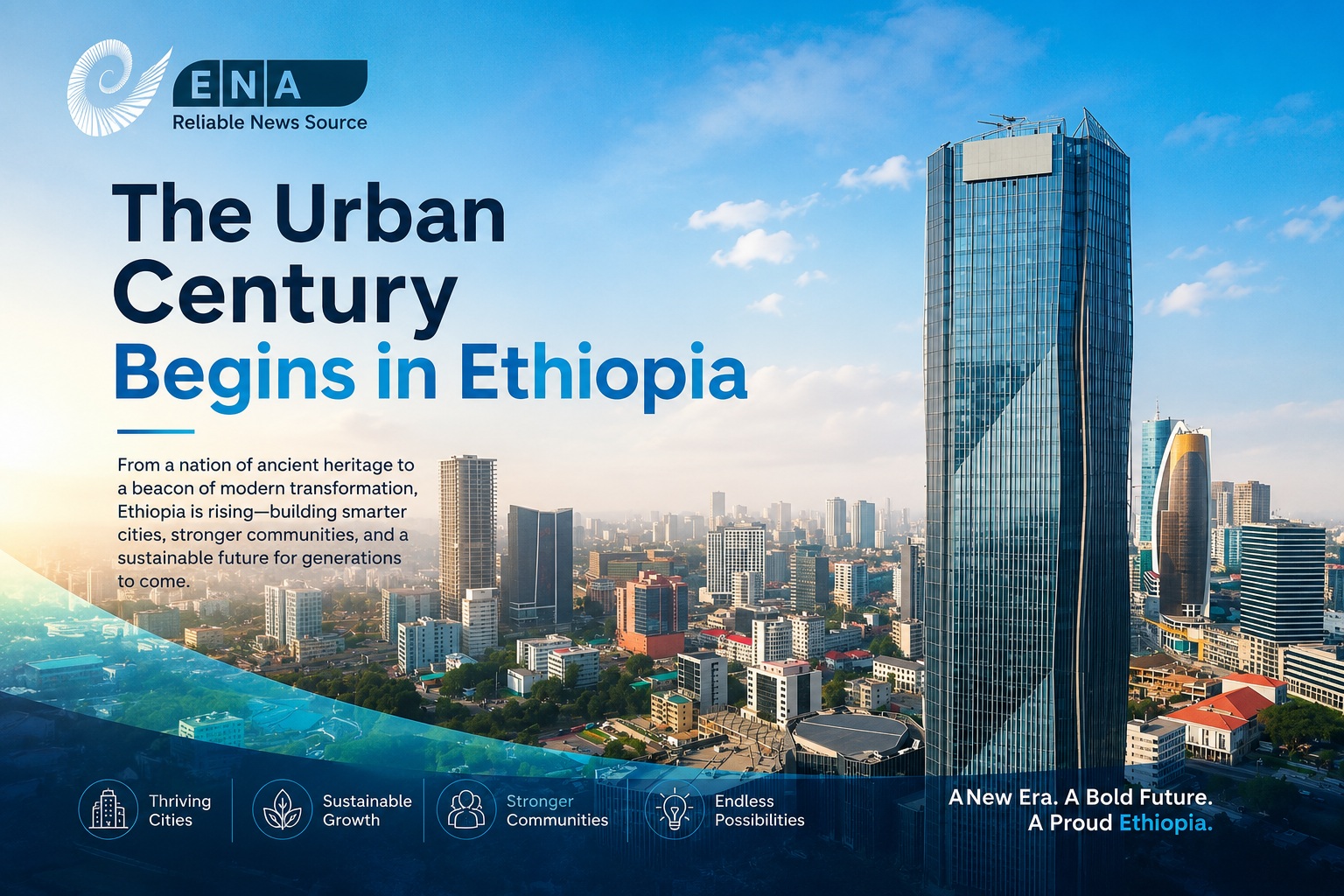
Today, however, Ethiopia is undergoing a profound urban transformation. Across the country, expanding road networks, industrial parks, modern housing developments, commercial centers, and large-scale corridor development projects are reshaping both the physical landscape and the economic foundations of society. Cities that once played a limited role in national development have emerged as powerful engines of industrialization, innovation, investment, and economic growth.
This transformation is evident not only in Addis Ababa but also in rapidly expanding urban centers such as Hawassa, Adama, Bahir Dar, Dire Dawa, Jimma, Mekelle, and many others. A nation that was once overwhelmingly rural is becoming increasingly urban, driven by demographic change, infrastructure investment, industrial development, and ambitious urban renewal initiatives.
According to the World Bank, Ethiopia was among the least urbanized countries in Africa at the turn of the century. In 2000, only about 14 percent of the population lived in urban areas. By 2010, the urbanization rate remained below 18 percent, significantly lower than the Sub-Saharan African average.
This was largely because the country's economy depended heavily on agriculture, which accounted for nearly half of economic output and employed the vast majority of the labor force. For most Ethiopians, agriculture was not simply an economic activity but the foundation of daily life, social structures, and community identity.
The Ethiopia of the early 2000s was vastly different from the country that exists today. Urban centers were relatively small, infrastructure was limited, and municipal governments often struggled with inadequate resources and planning capacity.
The 2007 Population and Housing Census showed that Addis Ababa had approximately 2.7 million residents. Although it was already the country's largest city, its skyline bore little resemblance to what is seen today. High rise buildings were concentrated in a few commercial districts, while much of the capital consisted of traditional residential compounds, aging public housing, and informal settlements.
Secondary cities were even smaller. Hawassa had a population of around 188,000, while Bahir Dar was home to approximately 180,000 residents. Cities such as Adama, Jimma, Dire Dawa, Mekelle, and Jigjiga functioned primarily as administrative centers and agricultural trading hubs. Industrial activity was limited, and urban expansion proceeded gradually.
Beneath this seemingly stable landscape, however, powerful demographic and economic forces were beginning to reshape the country. Urbanization accelerated significantly after 2010 as Ethiopia increasingly embraced development as a central pillar of its economic transformation strategy. Policymakers came to view cities as engines of industrialization, job creation, investment attraction, and structural economic change.
Large scale investments were directed toward transportation infrastructure, industrial parks, housing programs, electricity generation, telecommunications, and logistics networks. These investments created the conditions for sustained urban growth and economic diversification.
The impact has been substantial. Ethiopia's urban population more than doubled between 2010 and the mid 2020s, rising from about 13 million people to more than 26 million. During much of this period, urban population growth exceeded four percent annually, making Ethiopia one of Africa's fastest urbanizing countries.
Today, urban centers play an increasingly important role in national economic development. Manufacturing, construction, trade, logistics, financial services, tourism, and technology related activities are becoming increasingly concentrated in cities, generating employment opportunities and attracting investment.
No city better illustrates this transformation than Addis Ababa. Studies examining land use changes in the capital reveal dramatic urban expansion over the past three decades. Areas once characterized by farmland, open spaces, and low-density settlements have gradually been transformed into residential neighborhoods, commercial districts, industrial zones, and transportation corridors.
The eastern and northeastern parts of the city, including Bole, Yeka, Ayat, Summit, and Lemi Kura, have experienced particularly rapid growth. New housing developments, commercial centers, public infrastructure projects, and transportation networks have expanded the city's footprint well beyond its historical boundaries.
At the same time, secondary cities have undergone remarkable transformation. Hawassa has emerged as a major industrial and investment destination, supported by one of the country's most successful industrial parks. Adama has strengthened its position as a logistics and commercial hub, while Dire Dawa has expanded its role as a gateway for trade and transportation. Bahir Dar, meanwhile, has leveraged tourism, education, and commerce to drive urban growth and attract investment.
The nationwide Corridor Development Program provides perhaps the clearest illustration of Ethiopia's urban transformation. While urbanization has been driven by population growth, industrialization, and infrastructure investment, corridor development has become the framework through which these changes are reshaping cities.
Over the past few years, Ethiopia has increasingly embraced corridor based development as a strategic tool to modernize urban centers, improve transportation networks, stimulate economic activity, and enhance the quality of life of urban residents. What began as an urban renewal initiative in Addis Ababa has evolved into one of Africa's most extensive city transformation programs, expanding to more than 120 cities and towns across the country.
The concept operates at two levels. The first involves transport and trade corridors that connect Ethiopia to regional and global markets. The second encompasses urban transformation corridors designed to modernize cities, improve mobility, create green public spaces, and stimulate local economic activity.
As one of the world's largest landlocked nations, Ethiopia has prioritized the development of strategic transport corridors to strengthen access to international markets. The Ethio Djibouti Corridor remains the backbone of the country's trade, supported by the Addis Ababa Djibouti Railway and an extensive highway network linking Ethiopia's economic centers to the Port of Djibouti.
At the same time, Ethiopia has pursued alternative trade routes through the Berbera Corridor and the Lamu Port South Sudan Ethiopia Transport Corridor. These initiatives are intended to diversify market access, strengthen resilience, improve regional integration, and reduce dependence on a single maritime outlet.
Within Ethiopia's cities, however, corridor development has become one of the most visible symbols of modernization and urban renewal.
Addis Ababa serves as the flagship of the program. Major corridors, including Torhayloch Mexico, Piassa, Arat Kilo, Megenagna, Kazanchis, Bole, Sar Bet, and Merkato, have undergone extensive redevelopment. Roads have been widened, intersections redesigned, utility infrastructure upgraded, and pedestrian facilities significantly improved.
The transformation extends far beyond transportation. Public plazas, landscaped green spaces, cycling lanes, recreational facilities, riverfront developments, and modern lighting systems have created more attractive, accessible, and functional urban environments. The integration of green spaces into urban planning has also strengthened environmental sustainability while enhancing the city's overall livability.
The initiative has expanded beyond the capital. Major regional cities, including Adama, Bishoftu, Hawassa, Dire Dawa, Bahir Dar, Gondar, Jimma, Dessie, Kombolcha, Jigjiga, Harar, Mekelle, Semera, Assosa, Nekemte, Shashemene, Arba Minch, Wolaita Sodo, Debre Birhan, Debre Markos, Dilla, and Hosaena, have launched corridor development projects.
These projects are improving mobility, modernizing public infrastructure, enhancing tourism destinations, strengthening industrial zones, and creating new opportunities for investment and employment. In many cities, corridor development is transforming previously congested urban centers into vibrant economic and social spaces.
Beyond their aesthetic appeal, these corridors are increasingly serving as engines of economic growth. The Addis Ababa Bishoftu Corridor, stretching through key industrial centers such as Dukem and Gelan, has attracted substantial domestic and foreign investment. Manufacturing facilities, logistics centers, industrial parks, and residential developments have emerged along the corridor, transforming formerly rural areas into dynamic economic zones.
Similar development patterns are emerging around Hawassa Industrial Park, Dire Dawa Industrial Park, Kombolcha Industrial Park, and other manufacturing centers across the country. Improved infrastructure and connectivity have enhanced productivity, attracted investors, and created thousands of jobs.
In many respects, corridor development represents the physical manifestation of Ethiopia's broader urban transformation. It brings together transportation, housing, commerce, industry, environmental sustainability, and public services within a comprehensive development framework. More importantly, it demonstrates how strategic urban planning can transform cities from congested administrative centers into dynamic hubs of economic activity and improved quality of life.
In conclusion, Ethiopia's urban transformation represents one of the most significant socioeconomic shifts in the country's modern history. A nation once defined primarily by its rural character is steadily evolving into an increasingly urbanized and interconnected economy, driven by infrastructure investment, industrialization, and strategic urban planning.
The nationwide Corridor Development Program has become a defining feature of this transition, modernizing cities, improving connectivity, and creating new opportunities for economic growth and social development. As cities continue to expand and new urban centers emerge, the challenge will be to ensure that this growth remains inclusive, sustainable, and responsive to the needs of a rapidly changing population.
If successfully managed, Ethiopia's ongoing urban transformation has the potential to create competitive cities, stronger regional economies, and a more prosperous future, positioning the country as one of Africa's leading examples of urban led development in the twenty first century.