Ethiopia Votes: A Choice, Not a Coronation - ENA English


Ethiopia Votes: A Choice, Not a Coronation
By Henok Tadele
There is a familiar pattern in the way many Western media organizations report on Africa.
When African nations collapse, they are headlines. When African nations rebuild, they are footnotes. When African states conduct elections amid challenges, the challenges become the story. When Western democracies face similar conditions, resilience becomes the story.
A growing number of Western media narratives covering Ethiopia’s election—from CNN to The Economist and other international outlets, reflect this broader and familiar framing.
At first glance, these reports appear to be straightforward election coverage. Yet beneath the polished language lies a recurring assumption: that Ethiopia’s seventh general election is not a democratic exercise but a “coronation.”
The problem is not criticism. Democracies need criticism. The problem is selective storytelling and externally defined standards of legitimacy.
A nation of more than 130 million people, preparing one of Africa’s largest electoral exercises, deserves to be examined through facts—not through a narrative written before the first ballot is cast.
The Missing Ethiopia
Readers of these reports may come away believing Ethiopia is a nation defined solely by conflict. Yet another Ethiopia exists.
It is the Ethiopia that has spent the last several years rebuilding itself while simultaneously confronting war, drought, global economic turbulence, and the lingering effects of a pandemic. It is the Ethiopia constructing industrial parks, expanding digital infrastructure, liberalizing key sectors of its economy, launching a securities exchange, modernizing financial systems, planting billions of trees through the Green Legacy Initiative, and transforming major urban centers through ambitious corridor development projects.
It is also the Ethiopia preparing one of the largest democratic exercises in Africa.
This raises a legitimate question. Why now? Why is Ethiopia once again being portrayed primarily through the lens of crisis precisely at a moment when it is taking off in multiple directions—economic reform, infrastructure expansion, institutional modernization, and democratic participation?
No serious observer would suggest that Ethiopia has solved all its problems. It has not. But neither can a nation of more than 135 million people be reduced to a single narrative of conflict and instability. Constructive criticism is essential. Selective criticism is something different.
The real Ethiopia contains both challenges and achievements. Yet too often, international audiences are shown only one side of that story.
Development Is Not a Social Media Filter
Perhaps the most revealing phrase in these reports is the description of Addis Ababa’s transformation as a “social media-friendly narrative of progress.”
The choice of words is telling. A narrative is a story. Infrastructure is a reality. Roads are not narratives. Parks are not narratives. Expanded airports, digital payment systems, industrial parks, and a stock exchange are not narratives. Neither are the billions of trees planted through the Green Legacy Initiative. These are measurable developments visible to citizens, investors, and visitors alike.
The transformation taking place in Addis Ababa is not occurring on social media. It is occurring on the ground. Millions of residents use newly built roads, public spaces, and digital services every day. Major economic reforms, airport expansion projects, capital market development, and investment reforms are not public relations campaigns; they are policy decisions with real economic consequences.
One may debate whether these reforms are sufficient or whether they benefit everyone equally. But questioning their existence is another matter entirely.
Ethiopia’s development story is not complete, and serious challenges remain. Yet it is difficult to dismiss visible infrastructure, measurable economic reforms, and urban transformation as mere optics. These are not Instagram filters. They are realities experienced by millions of Ethiopians every day.
Nor is Addis Ababa an exception; corridor development projects are reshaping major cities and towns across Ethiopia, improving urban mobility, public spaces, and infrastructure on a scale unprecedented in the country’s modern history.
The Election They Forgot to Describe
For all its skepticism, much of this coverage spends remarkably little time discussing the election itself.
The scale of Ethiopia’s seventh general election is extraordinary by any standard. More than 54 million Ethiopians have registered to vote, up significantly from the approximately 38 million registered in the previous election. The addition of over 16 million new voters within a single electoral cycle reflects expanding political participation and makes this one of the largest electoral exercises ever conducted on the African continent.
The election is being conducted with participation from 42 political parties and dozens of independent candidates. Altogether, more than 10,000 candidates are competing for seats in federal and regional institutions, giving voters a wide range of political choices.
Equally significant is the role of civil society. More than 169 accredited civic organizations are engaged in voter education, while 55 domestic observer organizations have deployed over 64,000 observers nationwide. International observation missions from the African Union and IGAD are also present, adding further transparency to the process.
These are not the characteristics of a political coronation. They are the characteristics of a large-scale democratic exercise involving millions of voters, thousands of candidates, and extensive observation mechanisms operating at national scale.
Comparing the Seventh Election with the Past
Democracy is not measured against perfection. It is measured against progress.
A fair question is therefore not whether Ethiopia’s seventh general election is flawless, but whether it is improving compared to previous cycles. The answer is clearly yes.
For decades, Ethiopian elections were criticized for limited competition, restricted civic participation, and weak institutional capacity. Today, political participation is broader, observation mechanisms are stronger, and electoral administration is more institutionalized. Even opposition voices quoted in these reports acknowledge increased competitiveness compared to earlier elections.
If competition is expanding and participation is increasing, then Ethiopia is not moving backward. It is moving forward—unevenly, imperfectly, but forward nonetheless.
The War They Discuss Without Context
CNN repeatedly associates Prime Minister Abiy Ahmed with the Tigray conflict while devoting little attention to how the war began. History cannot be selectively edited. The conflict erupted following attacks on the Northern Command of the Ethiopian National Defense Force in November 2020. No serious discussion of the war can omit that reality. One may debate the government's response. One may criticize military decisions. One may question political choices. But journalism becomes advocacy when it removes the event that triggered the conflict itself.
Complex wars require complex explanations. Simplistic villains may satisfy headlines, but they rarely satisfy history.
Equally absent from the article is adequate recognition of the peace process that followed. The Pretoria Peace Agreement, brokered under African leadership, demonstrated that Africans could resolve African conflicts through dialogue and negotiation. Despite inevitable challenges in implementation, the agreement ended one of the deadliest conflicts in recent history and opened a pathway toward national reconciliation.
That achievement deserves acknowledgment as well.
A Curious Double Standard
When countries such as India, Nigeria, Colombia, or Pakistan conduct elections while confronting security challenges, Western media often celebrate democratic resilience. When Ethiopia does the same, the election itself becomes suspect. Why?
No country suspends democracy simply because security problems exist. In fact, democratic processes often become more important during periods of national difficulty.
Ethiopia's decision to proceed with elections despite significant challenges should be viewed as an affirmation of constitutional governance, not evidence against it.
The exclusion of some constituencies due to security concerns is not proof of electoral illegitimacy. It reflects the practical reality that elections require minimum conditions of safety and accessibility. Similar decisions have been made in democracies across the world when extraordinary circumstances prevent voting from taking place in specific locations.
The Voices Missing from the Story
The CNN article quotes opposition figures, exiled analysts, and former officials. Their perspectives deserve to be heard. But where are the ordinary Ethiopians? Where is the farmer voting for the first time? Where is the young woman serving as an election official? Where is the university graduate contesting local office? Where is the entrepreneur who believes economic reforms are creating new opportunities? Where are the millions of citizens who continue to engage with the democratic process despite the challenges facing their country?
A democracy cannot be understood solely through the opinions of political elites. The ultimate judges of Ethiopia's future are not foreign commentators. They are Ethiopian citizens.
Beyond the Narrative
No serious observer would claim Ethiopia has solved all its problems. Conflict remains.
Political disagreements remain. Economic pressures remain. Democratic institutions remain a work in progress. But none of these realities erase another reality.
More than 54 million Ethiopians have registered to vote. Thousands of candidates are competing for office. Tens of thousands of domestic observers are monitoring the process. International observer missions are present. Civil society organizations are engaged. Electoral institutions are stronger than they were in previous decades. Political competition is broader than it was in previous eras.
These are not signs of democratic collapse. They are signs of democratic evolution.
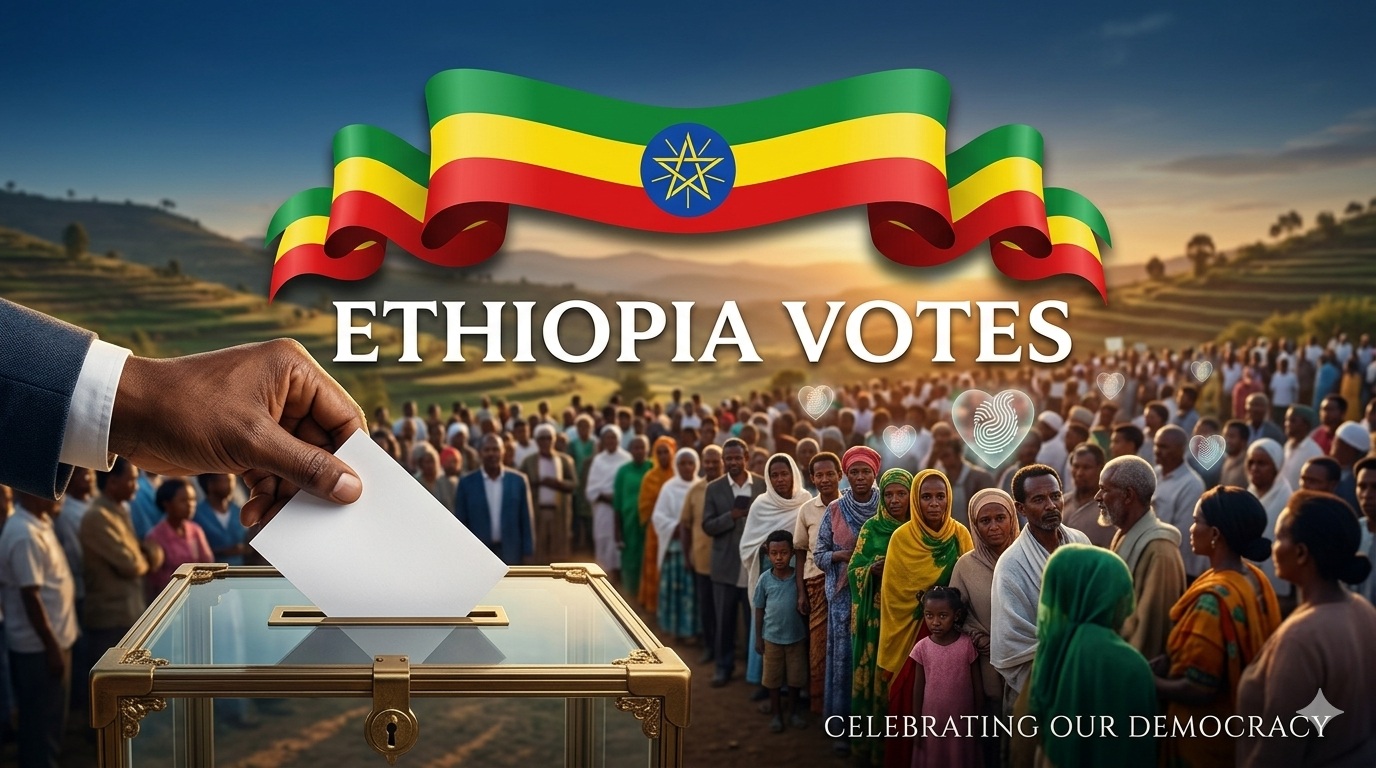
Tomorrow, tens of millions of Ethiopians will participate in one of the largest elections on the African continent. They will cast their ballots not because their democracy is perfect, but because they believe their future should be decided through ballots rather than bullets.
That is not a coronation. That is a choice. The tragedy of the CNN article is not that it criticizes Ethiopia. The tragedy is that it sees only Ethiopia's wounds and refuses to acknowledge its recovery.
History will not judge this election by headlines written in distant newsrooms.
History will judge it by whether Ethiopians continue expanding political participation, strengthening institutions, modernizing their economy, and resolving differences through constitutional means.
That journey is far from complete. But it is underway. And that story deserves to be told too.


