Ethiopia’s 7th Election Marks Shift Toward Democratic Maturity - ENA English
Ethiopia’s 7th Election Marks Shift Toward Democratic Maturity
Addis Ababa, May 29, 2026 —As dawn breaks over Ethiopia, the country moves to a quieter political rhythm. Campaign slogans fade from the streets, broadcasters soften their tone, and political parties fall silent as the nation officially enters the mandatory electoral silence period ahead of the June 1 general election.
The silence itself carries significance. It is not merely the absence of campaigning, but a national pause before millions of citizens speak through the ballot box.
Across Ethiopia’s vast geography, from bustling cities to remote rural communities — preparations for the country’s 7th General Election have reached their final stage. What is unfolding is more than a routine electoral exercise; it is a defining institutional moment for one of Africa’s largest and most strategically significant nations.
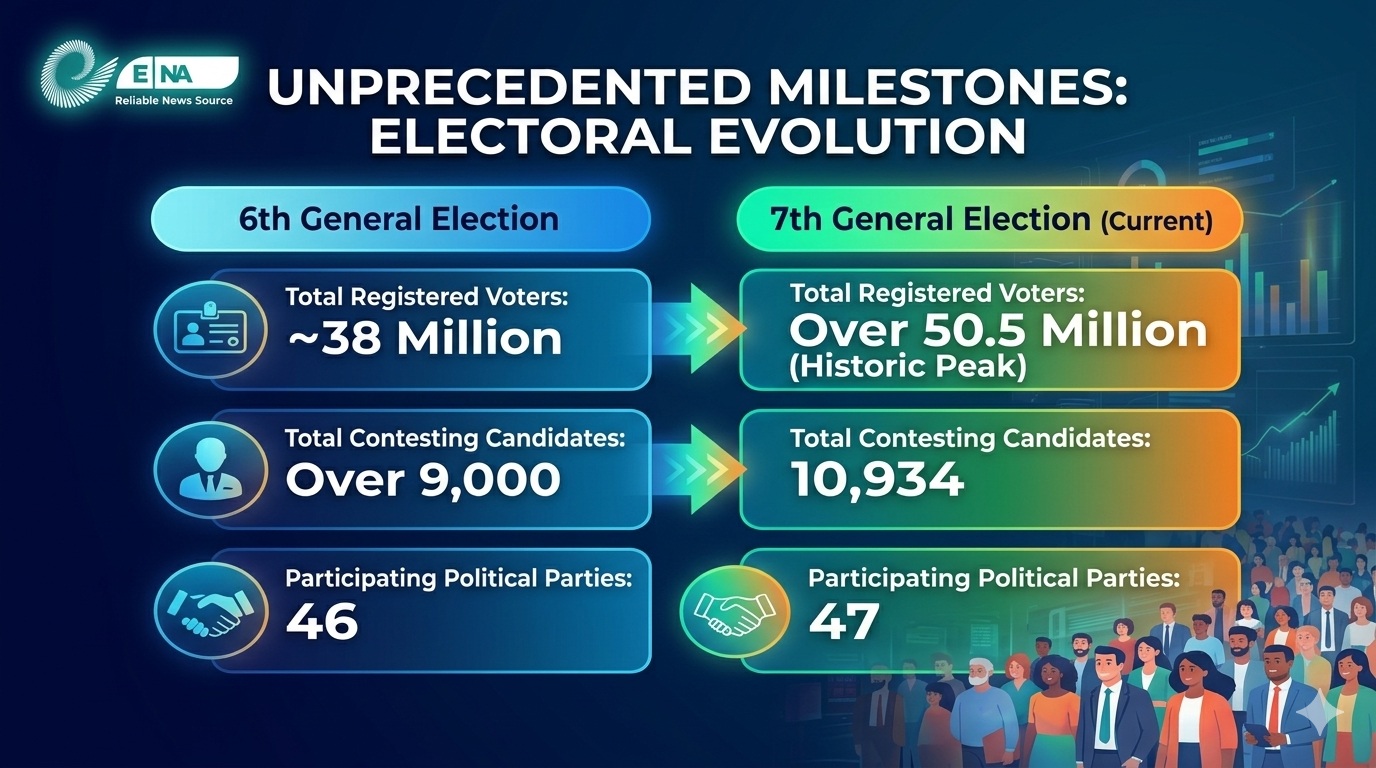
With more than 50 million registered voters expected to participate, the election is emerging as one of the continent’s most consequential democratic processes in recent years. It also reflects not only political competition but also the growing operational maturity of Ethiopia’s electoral institutions.
Ahead of the polls, the National Election Board of Ethiopia (NEBE) announced the successful completion of all logistical and operational preparations for the historic vote. NEBE Chairperson Melatwork Hailu stated that the Board has finalized every major phase of the electoral process, officially transitioning into the final implementation stage.
According to the Board, Monday’s vote represents a substantial institutional advancement compared to previous electoral cycles, marked by broader political inclusion, improved technological systems, stronger administrative coordination, and expanded public participation.
How the 7th Election Differs from the 6th
A closer examination of the electoral framework reveals a striking trajectory of institutional progress.
Unlike previous elections, the 7th General Election has demonstrated higher levels of logistical readiness, digital modernization, media inclusivity, and regulatory sophistication. The process reflects a state institution that has evolved significantly in both organizational capacity and democratic administration.
Digital Innovation and Operational Readiness
One of the most notable transformations has been NEBE’s introduction of digital voter and candidate registration systems for the first time in Ethiopia’s electoral history.
Through the “Mirchaye” (“My Election”) mobile application, citizens were able to register digitally using smartphones, while tablets distributed to polling officials enabled in-person registration nationwide in partnership with Ethio Telecom. The transition from paper-based systems to digital infrastructure significantly reduced bureaucratic delays, minimized logistical inefficiencies, and improved transparency.
Election materials, including sensitive ballots printed abroad under secure arrangements, have already been distributed across constituencies nationwide. Candidate registration, voter registration, and the establishment of special polling stations were all completed within the planned operational timeline.
Civic organizations and election observers have described the digital transition as a major qualitative leap for Ethiopia’s electoral administration, helping modernize election management while expanding accessibility across geographically challenging regions.
Expanding Political and Media Space
Another defining feature of the 7th General Election has been the unprecedented expansion of political participation and public debate.
For the first time in Ethiopia’s history, NEBE directly organized and supervised nationwide political debates in collaboration with the Ethiopian News Agency (ENA), rather than leaving the process entirely to third-party media institutions.
Under the initiative, 19 nationally broadcast debate forums were conducted in five languages across public and private media platforms. The debates brought together political parties, civil society representatives, academics, and university students to deliberate on key national issues.
A total of 33 political parties participated in discussions covering 19 major policy areas, presenting competing visions and programs before the electorate.
To ensure equitable political competition, NEBE also allocated free campaign airtime to political parties, including 782.5 hours of radio broadcasting, 520 hours of television airtime, and 576 newspaper columns.
In parallel, more than 220,000 party representatives, 64 media institutions, and 1,814 journalists received accreditation to monitor and report on the election process.
Strengthening Voter Sovereignty and Institutional Neutrality
As Ethiopia approaches election day, NEBE has introduced additional safeguards aimed at protecting voter independence and reinforcing public trust in the process.
Following the conclusion of the nationwide debates, the Board officially declared the beginning of the electoral silence period — a mechanism designed to allow voters adequate time for reflection free from political pressure or last-minute campaigning.
The Board has also strengthened its complaint-handling procedures by assigning independent, politically unaffiliated professionals to oversee electoral grievances and disputes.
Domestic civic participation has similarly expanded. NEBE granted voter education licenses to 169 civil society organizations, with 114 receiving financial support from the Board. Observer accreditation was also issued to 55 domestic civil society organizations to enhance transparency and public oversight.
These measures collectively indicate a broader institutional effort to reinforce electoral neutrality, accountability, and citizen confidence.
Pan-African Partnership and Continental Confidence
Beyond domestic preparations, the election has also attracted significant continental engagement, underscoring growing African ownership of democratic processes across the region.
The African Union Election Observation Mission (AUEOM), led by former Kenyan President Uhuru Kenyatta, deployed 73 short-term observers drawn from 37 African countries, with women comprising 61 percent of the mission.
Similarly, the Intergovernmental Authority on Development (IGAD) Election Observation Mission — led by former Ugandan Vice President Speciosa Wandira-Kazibwe and former Speaker of Djibouti’s National Assembly Mohamed Ali Houmed — deployed regional experts to observe polling-day procedures and assess electoral compliance.
Guided by continental democratic frameworks, including the African Charter on Democracy, Elections and Governance, these missions reflect a broader continental commitment to supporting credible African-led democratic institutions.
Their presence also signals growing regional confidence in Ethiopia’s electoral process and institutional capacity.
A Defining Democratic Moment
As Ethiopians prepare to vote on June 1, the country’s 7th General Election stands as more than a political contest. It represents a test of institutional endurance, democratic administration, and national coordination on a massive scale.
The combination of expanded voter participation, digital modernization, broader political engagement, strengthened oversight mechanisms, and continental observation reflects a significant evolution in Ethiopia’s democratic architecture.
With more than 50.5 million citizens registered to vote, the election is increasingly being viewed as a major indicator of the country’s institutional trajectory and a demonstration of how electoral systems in Africa can evolve through domestic reform, technological adaptation, and growing continental partnership.