Africa Watches Ethiopia - ENA English
Africa Watches Ethiopia
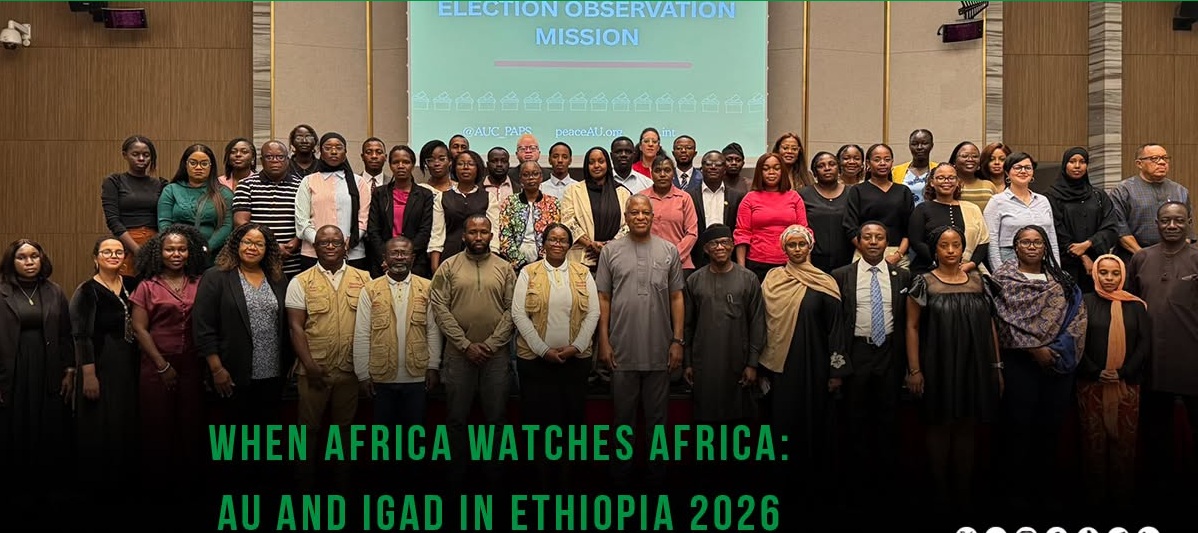
Continental Institutions, Democratic Ownership, and the Significance of Ethiopia’s 7th General Election
But this attention is not accidental.
It reflects Ethiopia’s unique political, diplomatic, and symbolic role within Africa — and more importantly, it reflects the growing determination of African institutions to increasingly take ownership of Africa’s democratic development.
The recent deployment of election observation missions by both the African Union (AU) and the Intergovernmental Authority on Development (IGAD) represents more than a technical electoral exercise. It represents a broader continental statement about African democratic agency, institutional confidence, and the evolution of Pan-African political responsibility.
Ethiopia as a Continental Democratic Arena
Few African countries carry the continental weight that Ethiopia does.
As the diplomatic capital of Africa and host of the African Union headquarters, Ethiopia has long occupied a central place in African political imagination. From the anti-colonial symbolism of Adwa to the founding of the Organization of African Unity, Ethiopia has historically represented sovereignty, African unity, and political independence.
Today, that continental role increasingly extends into democratic development.
When Ethiopia organizes a nationwide election involving tens of millions of voters, dozens of political parties, and one of Africa’s most complex societies, the implications naturally extend beyond Ethiopia itself.
This is why Africa is watching.
And significantly, Africa is increasingly watching through African institutions.
IGAD’s Observation Mission and Regional Democratic Responsibility
The arrival of the IGAD Election Observation Mission (IGAD EOM) in Addis Ababa marks an important example of regional democratic engagement within the Horn of Africa.
The mission is led by Dr. Speciosa Wandira-Kazibwe, former Vice President of Uganda, and deputized by Mohamed Ali Houmed, former President of the National Assembly of Djibouti. The mission includes 26 Short-Term Observers drawn from IGAD Member States, representing election management bodies, civil society organizations, women’s groups, and youth organizations.
This composition is politically significant.
It demonstrates that election observation in Africa is increasingly becoming a multidimensional civic and institutional undertaking rather than a narrowly diplomatic exercise. The inclusion of women, youth groups, and civil society representatives reflects a broader understanding that democratic legitimacy emerges not only from state institutions, but also from societal participation.
The IGAD observers are expected to deploy across multiple Ethiopian regional states, including Addis Ababa and Dire Dawa, where they will observe polling procedures, voting processes, counting mechanisms, and the closing of polls.
Importantly, IGAD has indicated that its assessment will be based on multiple frameworks, including:
- Ethiopia’s domestic electoral laws,
- the IGAD Draft Protocol on Democracy, Governance and Elections,
- the African Charter on Democracy, Elections and Governance (ACDEG),
- and international principles for democratic election observation.
This demonstrates the increasing institutionalization of African democratic standards within regional governance structures.
The African Union and Continental Democratic Legitimacy
Alongside IGAD, the African Union has also deployed a major Election Observation Mission (AUEOM) to Ethiopia.
The AU mission is led by former Kenyan President Uhuru Kenyatta and includes 73 Short-Term Observers drawn from 37 African countries. Notably, 61 percent of the observers are women — a remarkable indicator of the AU’s emphasis on inclusivity and gender representation in democratic governance.
The mission includes:
- ambassadors accredited to the African Union,
- election management officials,
- civil society representatives,
- election experts,
- human rights specialists,
- gender and media experts,
- and youth representatives.
This diversity reflects the AU’s evolving approach to democratic observation — one that increasingly views elections not simply as political contests, but as broad civic processes tied to governance, inclusion, constitutionalism, media freedom, and citizen participation.
The observers will monitor:
- the opening of polling stations,
- voting procedures,
- ballot counting,
- tabulation processes,
- and the overall conduct of the election.
The AU mission will assess the election based on:
- the OAU/AU Declaration on the Principles Governing Democratic Elections in Africa,
- the African Charter on Democracy, Elections and Governance,
- and other regional and international democratic instruments.
-
This is highly important because it demonstrates Africa’s growing ability to define, monitor, and defend democratic standards through its own continental institutions.
Africa Increasingly Observing Africa
For decades, African elections were frequently interpreted and validated primarily through external actors and foreign observer missions.
Today, however, a major transformation is taking place.
Africa is increasingly developing institutional confidence in its own democratic oversight mechanisms.
The simultaneous deployment of AU and IGAD observer missions to Ethiopia symbolizes this transition.
African institutions are no longer passive spectators in democratic processes occurring within member states. They are becoming active democratic stakeholders capable of:
- monitoring elections,
- producing assessments,
- promoting constitutional governance,
- encouraging peaceful political participation,
- and strengthening electoral accountability.
This evolution matters profoundly for the future of Pan-African governance.
No continent can fully consolidate democratic sovereignty while relying exclusively on external validation of its political processes. Sustainable democratic culture requires regional ownership, institutional maturity, and locally rooted accountability systems.
That is precisely what AU and IGAD participation increasingly represents.
Ethiopia’s Election as a Continental Democratic Moment
Ethiopia’s 7th General Election is therefore more than a national constitutional exercise.
It is:
- one of Africa’s largest electoral processes,
- one of the continent’s most institutionally demanding democratic undertakings,
- and one of the clearest contemporary examples of African institutions observing African democracy in action.
The scale alone is extraordinary:
- over 50 million registered voters,
- approximately 45 political parties,
- thousands of polling stations,
- and a nationwide electoral infrastructure stretching across one of Africa’s largest and most diverse countries.
Yet beyond the numbers lies a deeper continental significance.
The election reflects Africa’s growing democratic confidence.
It demonstrates that African institutions increasingly possess:
- the expertise,
- the organizational structures,
- the political legitimacy,
- and the institutional mechanisms necessary to engage seriously with democratic governance on African terms.
Democracy Beyond External Certification
Neither the AU nor IGAD missions represent hostility toward international engagement. Rather, they represent the normalization of African democratic ownership.
Africa’s democratic future will ultimately become stronger when African institutions themselves become the primary custodians of:
- electoral credibility,
- democratic norms,
- constitutional governance,
- and political accountability.
That process is now visibly unfolding.
When AU and IGAD observers monitor Ethiopia’s election, they are not merely observing ballots.
They are participating in the construction of an African democratic architecture increasingly rooted in continental institutions rather than external dependence.
A Continental Message
Ultimately, the significance of the AU and IGAD missions in Ethiopia extends beyond election-day procedures.
They send a larger message:
That Africa is increasingly capable of observing itself, evaluating itself, and strengthening its own democratic systems through African institutions, African expertise, and African political ownership.
As millions of Ethiopians prepare to vote, Africa is not simply watching another national election.
Africa is watching the continued emergence of a more institutionally confident and politically self-aware continent.
And perhaps that is one of the most important democratic developments taking place in Africa today.