Nation at Ballot Box: Ethiopia’s Defining Democratic Moment - ENA English


Nation at Ballot Box: Ethiopia’s Defining Democratic Moment
By Henok Tadle H.
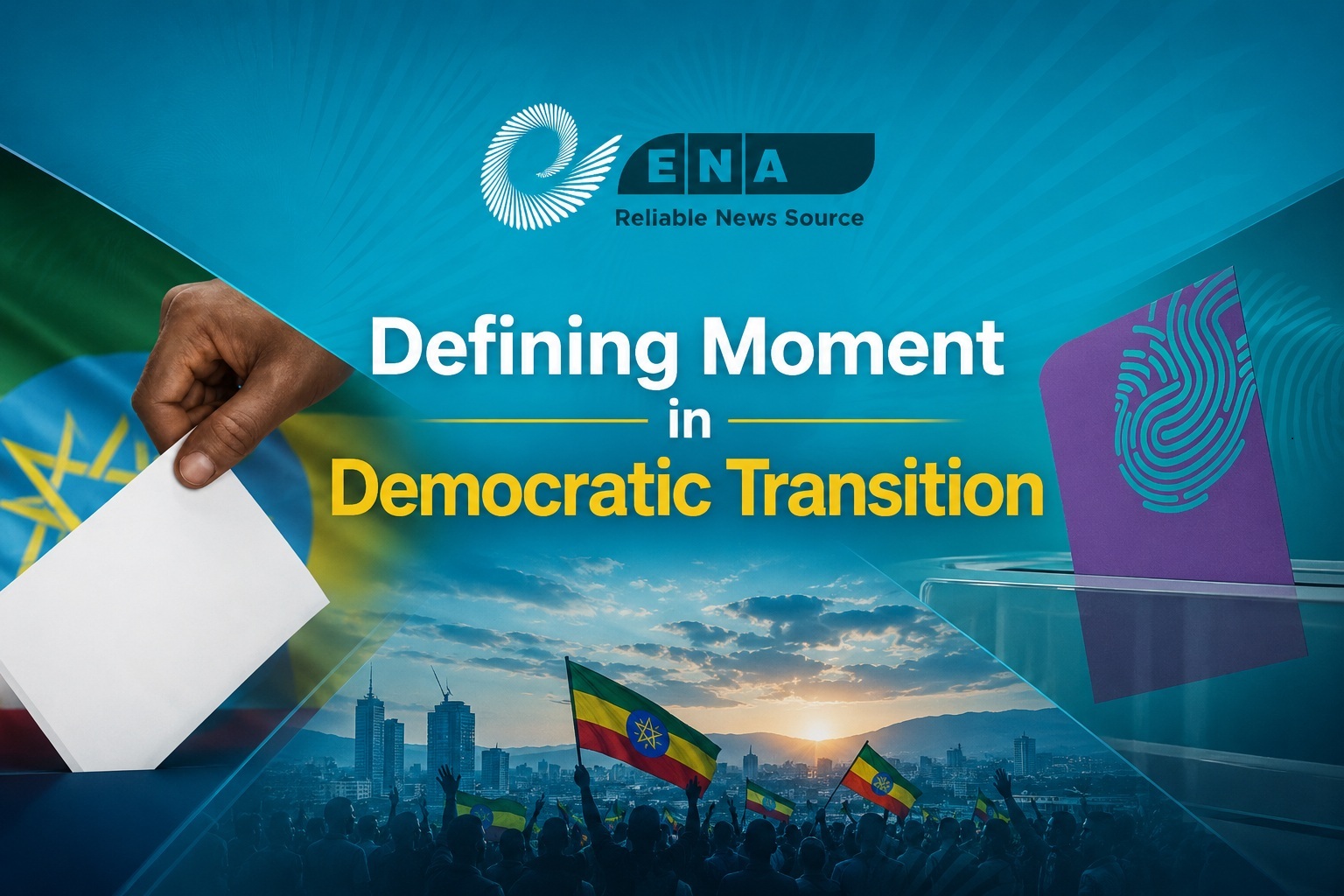
Addis Ababa, May 26, 2026 —With only days remaining before Ethiopians head to the polls on June 1, 2026, the country is preparing for what many observers consider one of the most important elections in its modern history.
With more than 50 million registered voters expected to participate, the election is emerging not simply as a national political exercise, but as one of Africa’s most consequential democratic tests in recent years.
And this is a vote that carries significance far beyond the ballot box. For many Ethiopians, the election represents a broader test of the country’s democratic transition, institutional reforms, and political future.
At the center of this process is the National Election Board of Ethiopia (NEBE), an institution that has undergone major transformation in recent years. Once criticized for administrative weakness and limited independence, the Board is now attempting to build a more transparent, modern, and nationally trusted electoral system.
The changes are already visible.
According to official figures, over 50.5 million Ethiopians have registered to vote, making this the largest voter registration exercise in the nation’s history. What makes the process especially notable is the introduction of Ethiopia’s first large-scale digital voter registration system.
Through the “Mirchaye” mobile and online platform, millions of citizens registered electronically — a major shift for a country where elections have traditionally relied almost entirely on manual systems. NEBE says the digital registration platform was designed to reduce duplication, improve accuracy, and strengthen public confidence in voter records.
Still, the Board has emphasized that voting itself will remain physical and paper-based, a decision intended to preserve transparency while the country gradually adapts to technological modernization.
The registration process also revealed another important trend: growing political participation among women. NEBE data shows that women make up nearly 46 percent of registered voters nationwide, reflecting a steady expansion of civic engagement across different segments of society.
Beyond voter registration, the scale of the election itself is enormous.
NEBE says more than 187,000 election officials have been deployed across the country to facilitate the process. The Board also reports that these officials were recruited competitively and screened for political neutrality in consultation with political parties — an effort aimed at improving public trust in election administration.
Political competition appears broader than in previous elections as well. Forty-seven political parties have registered candidates, with more than 10,900 individuals competing for federal and regional seats. Independent candidates are also participating, further widening the political landscape.
Transparency measures have expanded significantly compared to earlier electoral cycles. More than 169 civic organizations have been accredited to observe the election, while over 1,100 journalists from 37 media institutions are expected to cover the process nationwide.
For many analysts, these developments point to an evolving democratic culture in Ethiopia, one that is increasingly shaped by institutional reforms, public participation, and greater scrutiny from civil society and the media.
The growing role of media institutions and civic observers represents an important democratic development, increasing public scrutiny and strengthening electoral accountability.
Another visible shift is the increasing use of dialogue and consultation mechanisms between NEBE and political actors. The Board has conducted consultations regarding campaign codes of conduct, airtime allocation, debate arrangements and election-related procedures.
These mechanisms are particularly important in politically diverse societies where electoral legitimacy depends not only on voting day itself, but also on whether political actors perceive the process as fair and inclusive.
Beyond the technical reforms, the broader significance of the current electoral preparations lies in the gradual institutionalization of democratic practices in Ethiopia.
Historically, Ethiopian elections were often criticized for weak institutional independence, limited competition, logistical shortcomings and insufficient transparency. Although challenges remain, the current reforms suggest that the country is attempting to move toward a more rules-based and institutionally managed democratic framework.
Naturally, Ethiopia’s democratization process is still a work in progress. Security concerns, political tensions and logistical challenges continue to affect parts of the country. NEBE itself has acknowledged reports of irregularities and repeatedly emphasized that electoral violations will not be tolerated. Yet the willingness of the institution to publicly discuss challenges while simultaneously introducing reforms also reflects growing institutional confidence and administrative maturity.
The ongoing electoral process therefore represents more than a preparation for voting day. It reflects Ethiopia’s broader effort to modernize governance institutions, expand political participation and build a democratic culture rooted in transparency, inclusion and technological modernization.
The emergence of digital voter registration, the expansion of women’s participation, the increased role of civic observers, the deployment of large-scale election personnel and the emphasis on preventing duplicate voting collectively indicate that Ethiopia’s electoral administration is evolving beyond its previous limitations.
In many ways, the 7th General Election is becoming a defining moment in Ethiopia’s democratic transition, one that could shape not only the country’s political future, but also the credibility and institutional strength of its democratic institutions for years to come.


