AU, UN Reaffirm Strategic Partnership for Peace and Dev’t and Global Reform - ENA English


AU, UN Reaffirm Strategic Partnership for Peace and Dev’t and Global Reform
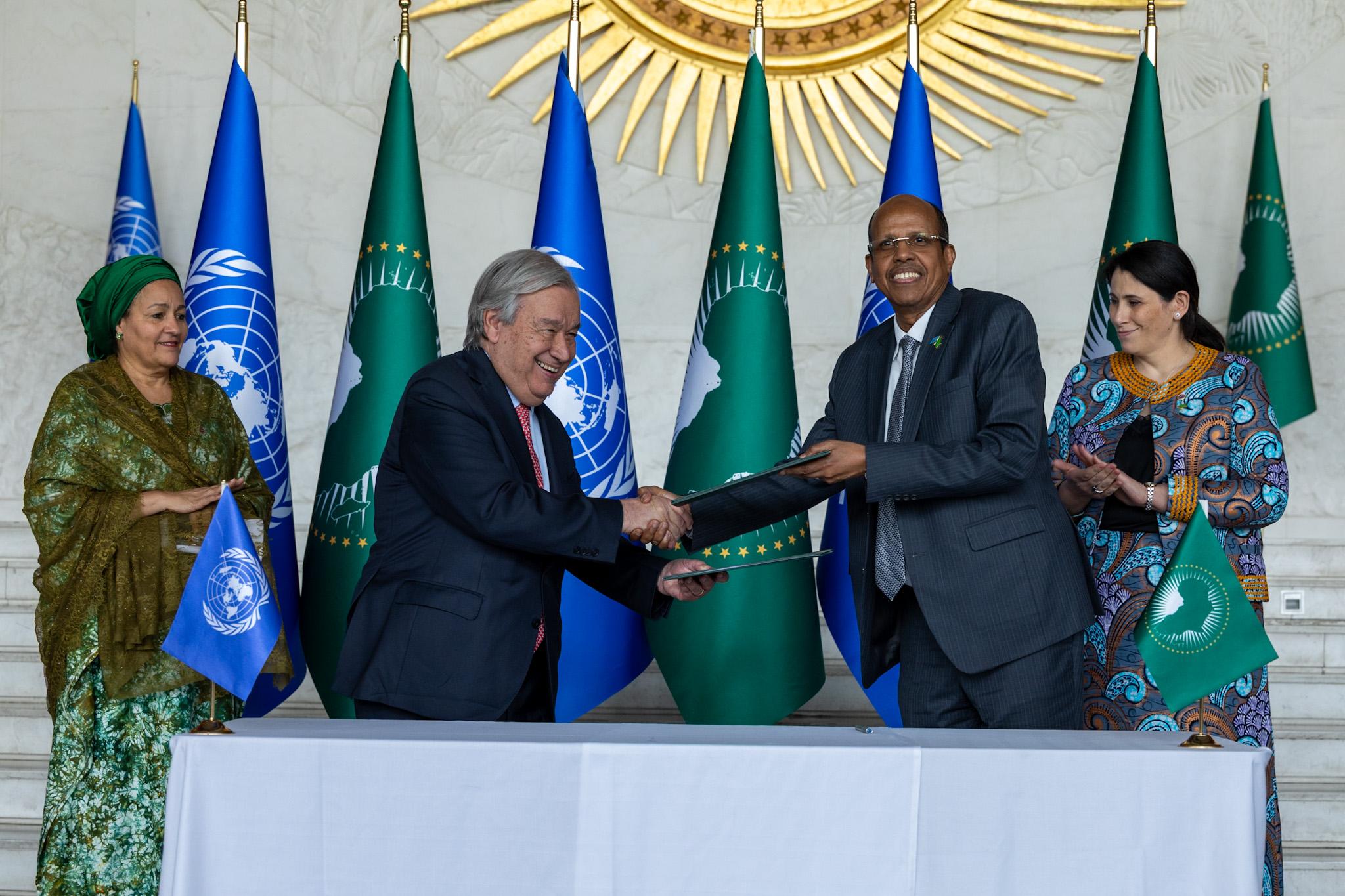
Addis Ababa, May 13, 2026 —The African Union and the United Nations have reaffirmed their strategic partnership as a cornerstone for advancing peace and security, human rights, and sustainable development.
The two bodies also vowed to accelerate progress on the African Union’s Agenda 2063 and the UN 2030 Agenda.
The commitment was made at the 10th African Union–United Nations Annual Conference held at the AU Headquarters in Addis Ababa, co-chaired by AU Commission Chairperson Mahmoud Ali Youssouf and UN Secretary-General António Guterres.
The two leaders expressed concern over rising global and continental challenges, including armed conflicts, humanitarian crises, poverty and inequality, climate change, and weakening respect for international law.
Strengthening AU–UN Cooperation
Both sides reviewed progress under key joint frameworks on peace and security, sustainable development, and human rights, welcoming stronger institutional coordination and accountability mechanisms. They also highlighted the importance of the High-Level Strategic Dialogue and College-to-College platforms in deepening cooperation.
The adoption of UN General Assembly Resolution 79/329 was welcomed as a boost to reinforcing Africa’s central role within the UN system.
Peace and Security: Focus on Conflict Zones
The conference underscored the importance of political solutions and sustainable financing for AU-led peace support operations, including implementation of UN Security Council Resolution 2719.
Leaders discussed ongoing crises in the Great Lakes region, Horn of Africa, Sahel, and Sudan, calling for intensified diplomatic efforts and respect for sovereignty and territorial integrity.
On eastern Democratic Republic of Congo, both institutions emphasized the urgency of a lasting ceasefire and pledged support for AU-led mediation efforts, alongside regional and international initiatives in Doha and Washington.
Regarding Sudan, the communiqué called for an inclusive inter-Sudanese dialogue and coordinated international action to end the conflict and prevent regional spillover.
In the Horn of Africa, they stressed full implementation of peace agreements and warned against rising interstate tensions. For the Sahel, they reiterated support for counterterrorism efforts and condemned recent attacks in Mali.
Economic Stability and Global Pressures
The AU and UN also warned that global instability, including conflicts in the Middle East, is worsening food insecurity, fuel prices, inflation, and debt pressures across Africa.
They agreed to raise these concerns in global forums such as the G20 and G7, stressing the need for coordinated international responses.
Sustainable Development and Financial Reform
Both institutions welcomed progress in aligning Agenda 2063 with the 2030 Agenda, including new digital tools to track implementation and strengthen cooperation.
They called for urgent reform of the international financial system to address Africa’s development needs, including high borrowing costs, debt vulnerabilities, and illicit financial flows.
The communiqué also emphasized key drivers of growth such as infrastructure development, energy transition, digital transformation, youth employment, gender equality, and the African Continental Free Trade Area (AfCFTA).
Human Rights and Governance
The leaders reaffirmed the centrality of human rights in peacebuilding and development, welcoming recent progress on AU human rights instruments, including efforts to end violence against women and girls.
They also strengthened cooperation on human rights compliance in peace operations and accountability frameworks.
Water, Climate and Africa’s 2026 Theme
The conference highlighted Africa’s 2026 theme on water security and sanitation, linking it with global priorities ahead of the UN Water Conference in 2026.
They agreed to scale up investment in water infrastructure, climate resilience, and early warning systems, while recognizing water as a strategic resource for development.
They also welcomed the UN General Assembly’s adoption of a landmark declaration recognizing slavery and racial enslavement as crimes against humanity.
Migration, Health and Humanitarian Cooperation
The communiqué emphasized stronger cooperation on migration governance, refugee protection, and combating trafficking in persons.
They also committed to operationalizing the African Humanitarian Agency and strengthening responses to forced displacement and humanitarian crises.
Joint efforts on public health, drug trafficking, and access to essential medicines were also reinforced.
A Stronger Multilateral Partnership
Both sides reaffirmed the AU–UN partnership as a model of effective multilateralism, grounded in shared responsibility, solidarity, and global cooperation.
They committed to deepening coordination beyond 2026 through a joint roadmap aligning continental and global priorities.
The Chairperson of the AU Commission paid tribute to UN Secretary-General António Guterres for his leadership and longstanding commitment to Africa and multilateralism.
The next AU–UN Annual Conference will be held in 2027 in New York at a date to be confirmed.


