Summer Wheat Cultivation Delivers Remarkable Gains: PM Abiy - ENA English
Summer Wheat Cultivation Delivers Remarkable Gains: PM Abiy
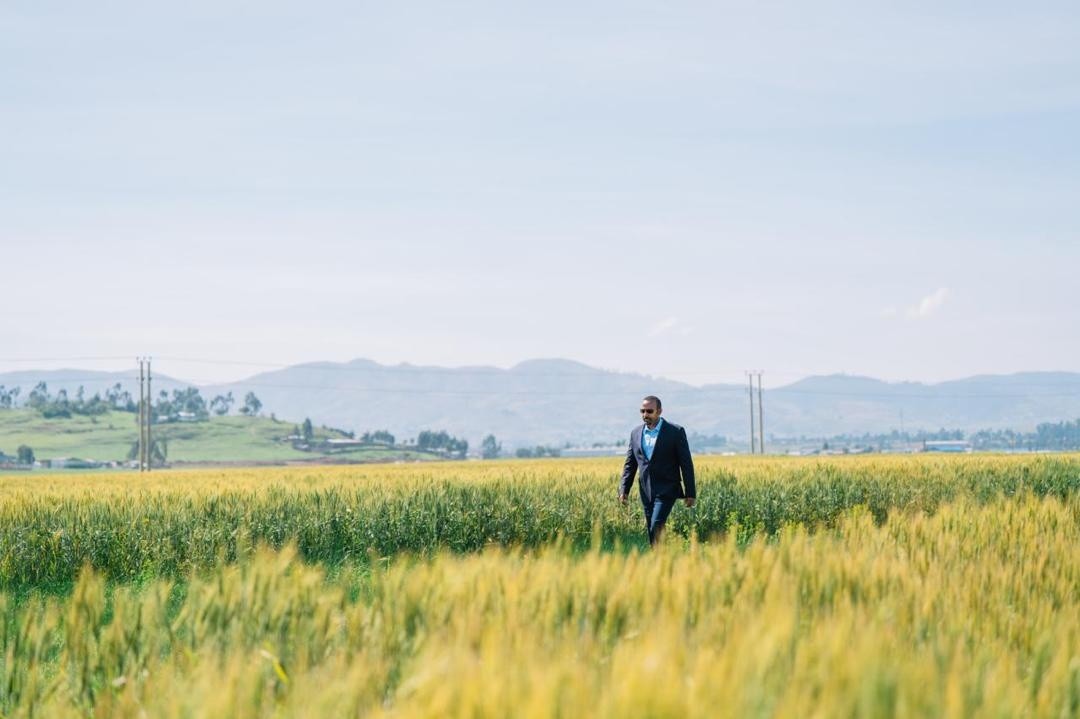
Addis Ababa, May 6, 2026 (ENA) — Prime Minister Abiy Ahmed said Ethiopia’s summer wheat cultivation is yielding remarkable gains, signaling a major shift in agricultural performance and strengthening the country’s food security outlook.
The Prime Minister made the remarks after inspecting wheat grown on 2,150 hectares of farmland in Sululta Woreda of North Shewa Zone in the Oromia Region.
Speaking during the field visit, PM Abiy highlighted the transformation driven by expanding cultivation into previously unused land.
“Land should not be left fallow, we must free ourselves from dependency,” he said, noting that summer wheat farming, once uncommon in Ethiopia, has now become a central pillar of agricultural transformation.
He indicated that wheat was cultivated on 4.4 million hectares during the previous summer season and on 3.8 million hectares this year, bringing the combined total to more than 8 million hectares.
Production has surpassed 330 million quintals, placing Ethiopia among Africa’s leading wheat producers, he added.
Referring to output trends, the Prime Minister said last year’s combined summer and winter harvest reached 280 million quintals.
“This year’s production has increased by 50 million quintals,” he stated.
PM Abiy attributed the growth to expanded farmland and improved productivity.
He pointed to North Shewa Zone as one of the areas registering notable yield improvements, due to the use of previously uncultivated land and more efficient resource utilization.
Irrigation development, including river diversion and the use of seasonal rains, has also contributed to increased output, he noted.
Highlighting the economic impact, the Prime Minister further said rising productivity is translating into better livelihoods for farmers.
“Increased productivity has enhanced income and improved livelihoods,” he said.
He stressed that the experience in the area demonstrates how focused effort and effective resource use can deliver tangible results, while underlining the importance of scaling up agricultural innovation to further boost productivity nationwide.
Calling for sustained momentum, the prime minister urged farmers, extension workers and officials to build on the current progress.
“The progress we are seeing shows that Ethiopia has strong potential for growth,” he said. “We must use every day and every season to produce, not only to feed ourselves but to support others.”
He acknowledged that challenges remain but emphasized they can be overcome through continued commitment. “We will overcome the obstacles in our development journey,” he said.
In a social media post following the visit, the Prime Minister reaffirmed that efforts to strengthen national food self-sufficiency are advancing steadily.
He noted that the country’s push for food sovereignty continues to deliver encouraging results through expanded wheat cultivation across Ethiopia.