ENA Global Weekly: Mounting Instability and the Escalating Tech Race - ENA English


ENA Global Weekly: Mounting Instability and the Escalating Tech Race
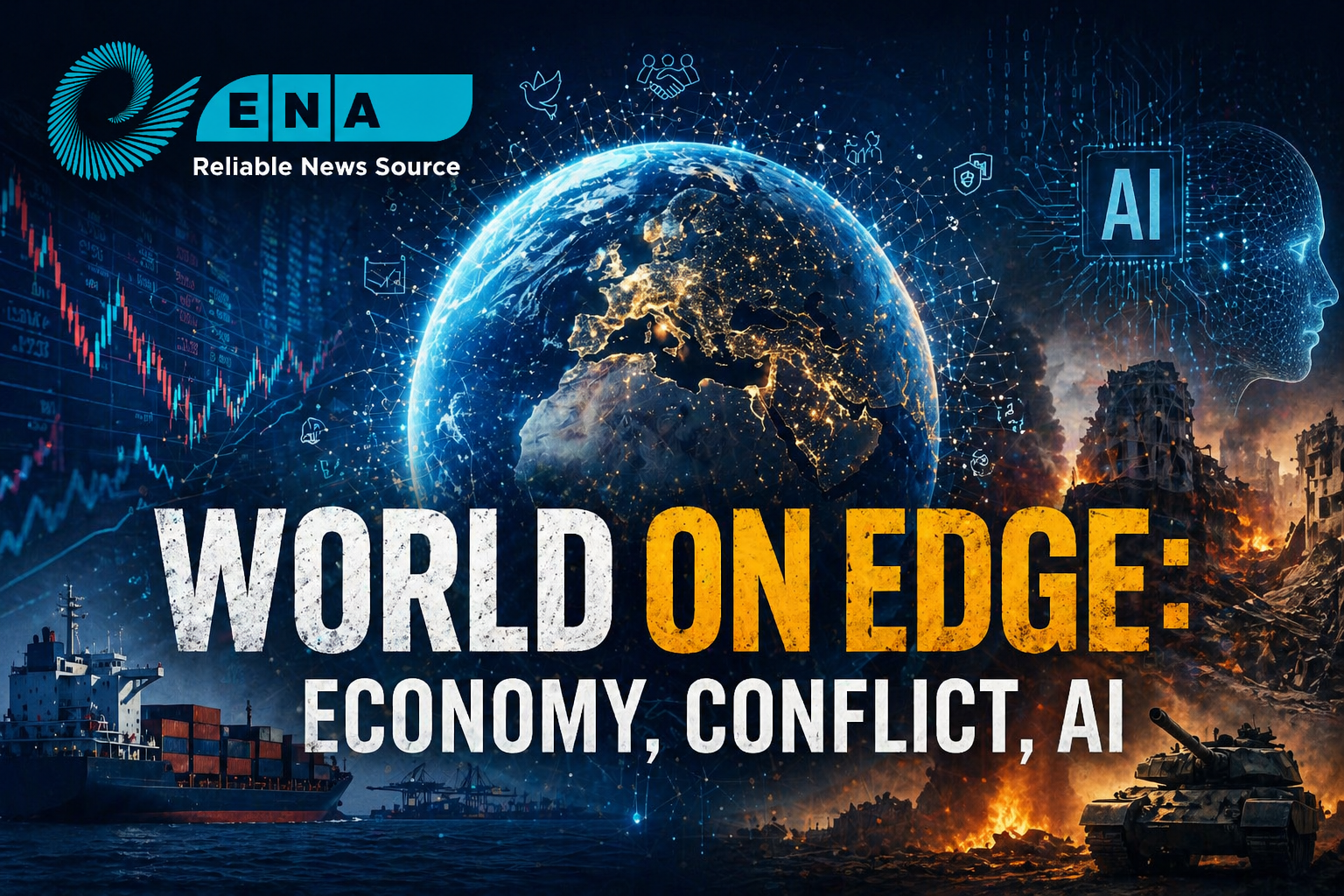
Addis Ababa, April 26, 2026 (ENA) —The third week of April 2026 closed with a world defined less by a single crisis than by a convergence of many. Across regions, geopolitical tensions persisted, economic uncertainty deepened, and technological rivalry accelerated. Together, these forces are shaping what analysts increasingly describe as a “polycrisis”—a condition in which overlapping disruptions amplify one another across an interconnected global system.
What distinguishes this moment is not only the scale of instability, but its structure. Security tensions are driving energy volatility, economic stress is influencing political cohesion, and competition over technology is redefining alliances. Power is more diffuse, risks more interconnected, and shocks more difficult to contain.
Middle East: Persistent Volatility with Global Reach
The Middle East remained a central of instability. Tensions around the Strait of Hormuz continued to disrupt maritime traffic, reinforcing volatility in global oil markets and adding pressure to inflation worldwide.
The conflict between Israel and Hizballah persisted in cycles of escalation and temporary de-escalation, with humanitarian conditions in Gaza deteriorating further. Aid agencies warned of severe shortages of food, medical supplies, and electricity, underscoring the widening gap between military dynamics and civilian needs.
Diplomatically, actors such as Pakistan have taken on a more prominent mediating role, reflecting a shift toward “middle power” diplomacy amid limited consensus among major global players. At the same time, Iran’s indirect influence continues to shape proxy dynamics, complicating pathways toward broader de-escalation.
Even limited disruptions in the region are having outsized global consequences. Energy markets remain highly sensitive to geopolitical signals, reinforcing the tight linkage between regional conflict and global economic stability. Developments such as local elections in conflict-affected Palestinian areas and continued Israeli strikes in Lebanon highlight how political processes and military actions are unfolding simultaneously, often reinforcing uncertainty rather than reducing it.
Africa: Between Fragility and Strategic Importance
Africa’s trajectory reflects a dual reality. On one hand, conflicts such as the war in Sudan and persistent insecurity in the Sahel continue to drive humanitarian crises and weaken state authority. On the other, the continent is becoming increasingly central to global economic competition.
Africa’s reserves of critical minerals, essential for renewable energy and advanced technologies—are elevating its strategic importance in global supply chains. This growing relevance is reshaping external engagement from major powers.
However, structural constraints remain significant. High debt burdens, inflationary pressures, and limited fiscal capacity continue to restrict development options, while climate vulnerability intensifies existing risks.
Ethiopia has emerged as a notable example of policy innovation through its Green Legacy Initiative, which integrates environmental restoration with broader economic and agricultural development goals. In parallel, Prime Minister Abiy Ahmed’s designation as the African Union Champion for Artificial Intelligence and Digital Health signals growing continental recognition of Ethiopia’s expanding role in shaping Africa’s digital transformation agenda. Far from being merely symbolic, the appointment reflects a wider shift in which Ethiopia is increasingly positioning itself at the intersection of climate action, technological adoption, and development strategy. More broadly, it underscores a continental trend in which climate policy is no longer treated in isolation, but is being integrated into national resilience, economic planning, and long-term growth frameworks.
Yet institutional limitations persist. Regional mechanisms, including those led by the African Union, continue to face challenges in translating political intent into effective conflict resolution and coordinated action.
Europe: Strategic Adjustment Under Strain
The war in Ukraine remains unresolved, settling into a prolonged phase of military and political stalemate. Its impact on Europe, however, continues to evolve.
Energy diversification away from Russia is no longer a temporary adjustment but a structural transformation. This shift is reshaping supply chains, pricing systems, and long-term policy across the continent.
At the same time, public sentiment is becoming more complex. Signs of “war fatigue” are emerging in parts of Europe, creating tension between sustained political commitments and domestic pressures. This divergence is beginning to influence electoral dynamics and policy debates.
Institutionally, NATO’s expanding role signals a longer-term shift toward deeper military integration and collective defense planning. The consequences of the war are therefore extending far beyond the battlefield, redefining Europe’s strategic posture.
Asia: The Center of Strategic Competition
Asia remains the focal point of global power competition, particularly between the United States and China. Rivalry is intensifying across military, economic, and technological domains.
Taiwan continues to represent the most sensitive geopolitical flashpoint, with increased military activity and signaling reflecting broader strategic competition. Meanwhile, North Korea remains an ongoing security concern, contributing to regional instability.
India’s continued economic expansion is reinforcing its position as a potential balancing power, while Southeast Asian states are pursuing diversification strategies to avoid overdependence on any single major actor.
The region is also central to the restructuring of global supply chains, as companies adjust production networks in response to geopolitical risk. This makes Asia not only a theater of competition, but also a key arena of economic adaptation.
America: Domestic Tensions with Global Implications
A security incident in Washington, D.C. disrupted a high-profile political gathering, renewing concerns about domestic security conditions in the United States after gunfire was reported at the event.
According to preliminary assessments cited by Acting U.S. Attorney General Todd Blanche, President Donald Trump was a “likely” target of the attack. Officials also indicated that early findings suggest the suspected gunman may have been aiming at members of the Trump administration, although authorities have stressed that the investigation is ongoing and the motive has not yet been confirmed.
U.S. media outlets have identified the suspect as 31-year-old Cole Tomas Allen of Torrance, California. Authorities say he is not currently cooperating with investigators. Law enforcement officials have not established a definitive motive.
In his first public comments following the incident, President Donald Trump described the attack as a “religious thing” and claimed it was “strongly anti-Christian,” though these assertions have not been independently verified by investigators.
While no senior leaders were reported injured, the episode has raised renewed questions about vulnerabilities in the domestic security environment and the risks surrounding politically sensitive events.
More broadly, the incident comes against the backdrop of deepening political polarization in the United States, which continues to shape governance dynamics and influence perceptions of institutional stability both domestically and abroad.
In Latin America, economic conditions remain mixed. Brazil has maintained relative macroeconomic stability, while Argentina continues to face financial volatility and inflationary pressure. Across the region, migration flows remain a persistent challenge, driven by structural inequality, economic uncertainty, and the growing impact of climate-related disruptions.
Global Economy: Fragmentation and Uneven Growth
Global markets presented a mixed picture. Strong performance in the technology sector, particularly in artificial intelligence—provided momentum, while geopolitical tensions and energy volatility weighed on broader sentiment.
Global growth remains uneven, with inflation control continuing to challenge policymakers. Central banks are maintaining cautious, restrictive monetary policies amid persistent uncertainty.
A deeper structural shift is also underway: trade fragmentation. Increasingly, countries are prioritizing resilience and security over efficiency, leading to more selective forms of economic integration. This marks a significant departure from previous globalization trends.
Meanwhile, worsening drought conditions in the Horn of Africa highlight the growing intersection of climate stress and economic vulnerability, with rising humanitarian needs and limited response capacity.
Technology and Climate: The New Axes of Power
Artificial intelligence is rapidly reshaping the global landscape. Major firms are restructuring operations as automation expands, while competition intensifies over data, computing power, and innovation leadership.
AI is no longer just an economic driver. It is increasingly a geopolitical asset, influencing productivity, military capability, and global influence.
At the same time, climate change continues to act as a systemic risk multiplier. The frequency of extreme weather events is increasing, with direct implications for food security, migration, and economic stability.
A critical emerging trend is the convergence of climate and geopolitics. Competition over resources such as lithium and cobalt is reshaping alliances, echoing the strategic importance of oil in earlier decades.
Countries like Ethiopia illustrate how climate policy is being integrated into development strategy, particularly through investments in reforestation and renewable energy. This reflects a broader shift toward viewing sustainability as an engine of growth rather than a constraint.
Outlook: Managing Interlinked Instability
The defining feature of this moment is interdependence under strain. Geopolitical, economic, technological, and environmental pressures are no longer isolated—they reinforce one another.
The central challenge ahead is whether global actors can sustain cooperation while managing intensifying competition. Rivalry may be structural, but shared risks—from climate change to financial instability—require coordinated responses.
The world is moving toward a model that prioritizes resilience, security, and adaptability over efficiency alone. Whether this transition leads to greater stability or deeper fragmentation will depend on the ability of states and institutions to maintain functional cooperation in an increasingly complex system.


