Djibouti Prioritizes Ethiopian Cargo at Ports, Says Ports Authority Chairman - ENA English


Djibouti Prioritizes Ethiopian Cargo at Ports, Says Ports Authority Chairman
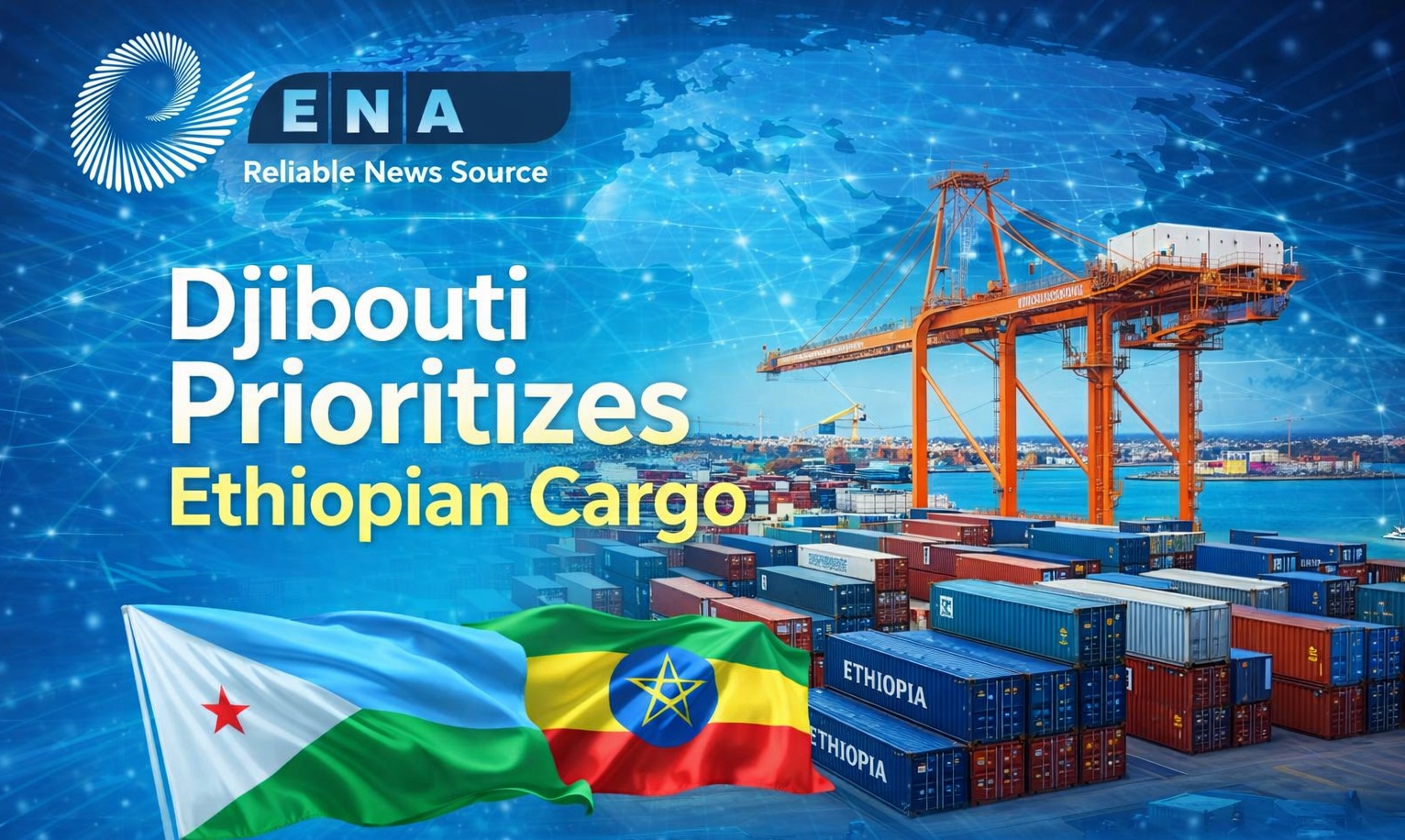
Addis Ababa, April 8, 2026 (ENA) —Djibouti will continue to give priority handling to cargo destined for Ethiopia, according to Aboubaker Omar Hadi, Chairman of the Djibouti Ports and Free Zones Authority (DPFZA).
Speaking to the Ethiopian News Agency, Hadi emphasized that Djibouti’s deep-sea ports have sufficient capacity to manage rising cargo volumes without experiencing congestion.
“For Ethiopia, we are going to give priority to all Ethiopian cargo destined to Ethiopia, especially fertilizer,” Hadi said, describing the growing demand as an opportunity for Djibouti to strengthen its role in global logistics and transshipment.
For decades, Djibouti has served as Ethiopia’s primary maritime gateway, handling more than 90 percent of its import and export trade due to Ethiopia’s landlocked status.
The strategic Addis Ababa–Djibouti Corridor, anchored by modern highways and the electrified Addis Ababa–Djibouti Railway, has significantly improved logistics efficiency, reducing transit times and enhancing trade connectivity between the two countries.
As a result, Djibouti has evolved into a critical logistics hub, with much of its port activity dependent on Ethiopian cargo volumes.
Addressing ambitions of becoming the region’s largest logistics hub, Hadi noted that Djibouti is already sufficiently prominent.
“We are enough visible. We don't want to be more visible. It's very dangerous to be more visible,” he said, while underscoring the country’s strategic position at the southern entrance of the Red Sea.
Ethiopia’s continued economic expansion, driven by industrialization, infrastructure development, and increasing trade, has led to higher demand for port services. Rising imports such as fuel, machinery, and consumer goods, along with growing exports of agricultural and manufactured products, are placing additional pressure on logistics systems.
Hadi stressed, however, that Djibouti’s ports can handle the increased traffic.
He acknowledged that minor delays of one to two days may occur due to vessel scheduling, particularly during simultaneous arrivals of ships carrying bulk commodities like fertilizer, but noted that such delays are typical in global port operations.
Reaffirming the strong bilateral relationship, Hadi said Djibouti continues to provide Ethiopia with the facilities required to support its trade needs.
He also revealed that Djibouti has proposed shareholding arrangements for Ethiopia in certain port assets.
With the upcoming Kiremt (rainy) season approaching, Djibouti is prioritizing timely fertilizer shipments to Ethiopia.
“We are going to give priority particularly for fertilizers to Ethiopia before the rainy season,” Hadi said, adding that discussions are underway regarding investments in additional storage facilities.
While port congestion is unlikely, Hadi noted that delays are more likely to occur inland, particularly within rail and road transport systems.
To ease pressure, Djibouti plans to expand transshipment operations, including ship-to-ship transfers, as part of efforts to enhance efficiency and strengthen its position in global logistics.


