Ethiopia Presses Red Sea Access as ‘Win–Win’ Solution at Strategic Maritime Dialogue - ENA English
Ethiopia Presses Red Sea Access as ‘Win–Win’ Solution at Strategic Maritime Dialogue
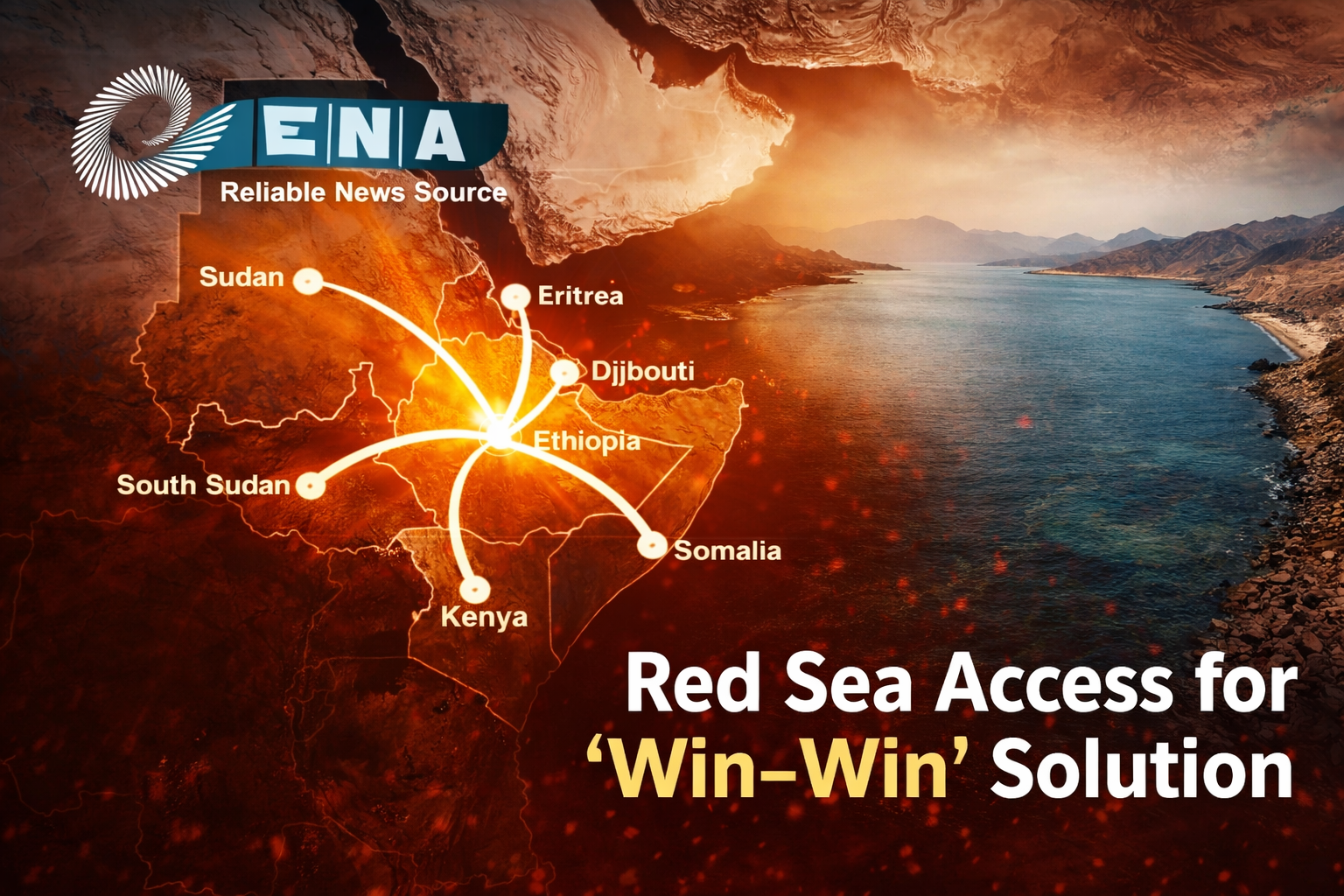
Addis Ababa, April 7, 2026 (ENA) —Ethiopia’s pursuit of sovereign access to the Red Sea is not solely a national ambition but a strategic vision aligned with regional integration and the African Union’s Agenda 2063, Vice Admiral Kindu Gezu, Commander-in-Chief of the Ethiopian Navy, said.
He made the remarks at the 4th Annual Red Sea and Gulf of Aden Dialogue (RESGA Dialogue–IV), held in Addis Ababa under the theme: “Maritime Governance in the Red Sea and Gulf of Aden Region: Inclusivity and Connectivity for Shared Interests.”
The forum, organized by the Institute of Foreign Affairs, brought together high-level policymakers, diplomats, and experts to discuss strengthening cooperation across the Horn of Africa and Gulf regions while enhancing Ethiopia’s role in regional connectivity.
Vice Admiral Kindu emphasized the historic and strategic importance of the Red Sea and the Gulf of Aden as vital corridors of global trade and civilization.
The two major global strategic waterways remain central to energy transport and international commerce today, he noted.
Kindu warned, however, that the region is increasingly affected by complex and overlapping challenges, including maritime crime, arms trafficking, irregular migration, insurgent networks, and intensifying geopolitical competition, all of which threaten stability across the Horn of Africa–Gulf nexus.
He stressed that no single country can address these challenges alone, calling instead for sustained regional and international cooperation.
Effective maritime governance, the Vice Admiral said, must be inclusive, bringing together coastal states, landlocked countries, local communities, and other stakeholders.
Such an approach, he argued, strengthens legitimacy and fosters collective action in addressing shared security and economic interests.
According to him, Ethiopia’s historical connection to the Red Sea and its strategic role in regional security make the question of coastal access a matter of broader regional benefit, not narrow national interest.
Kindu stated that Ethiopia’s landlocked status has limited its economic potential and reduced its regional influence, and argued that restoring access to the sea would serve not only Ethiopia but also its neighbors and wider international partners.
He added that Ethiopia’s quest for sovereign sea access aligns with the African Union’s Agenda 2063 and supports broader regional and global interests.
“Ethiopia’s landlockedness has not only led to the loss of vital economic opportunities but has also diminished its regional role. Ethiopia has a historical right and strategic importance in the Red Sea. Its quest for sovereign sea access is beyond a national goal; it is for the common benefits of the region. It aligns with the African Union Agenda 2063. It will strengthen Ethiopia’s maritime role in tackling common security threats such as piracy, terrorism, irregular migration, and human trafficking,” he said.
He further emphasized that strengthening Ethiopia’s maritime capacity would enhance regional security cooperation and improve collective responses to piracy, arms trafficking, organized crime, and terrorism.
In the context of shifting global geopolitics, he called for a more inclusive model of maritime governance based on regional integration and international partnership, where connectivity, access, and economic growth are treated as shared priorities.
“Effective maritime governance must involve a broad range of actors, including both littoral and landlocked states. This inclusivity strengthens legitimacy and fosters shared interests in security and connectivity,” he said.
He also noted that advancing Ethiopia’s access to the sea could unlock significant economic opportunities, not only for Ethiopia but for the wider region.
Improved port access and infrastructure development, he said, would reduce trade costs, expand export markets, attract international investment, and strengthen regional economic integration. Direct sea access would also allow Ethiopia to better align its industrial development with neighboring economies, fostering deeper cooperation and shared growth.
Executive Director of the Institute of Foreign Affairs, Jafar Bedru, said Ethiopia’s position is not aimed at undermining any country’s sovereignty but at strengthening collective regional capacity.
“We seek to add to regional capacity, more patrols, more trade, more predictable rules of engagement,” he said.
He stressed that shared waters require shared stewardship, adding that the RESGA Dialogue is intended to build cooperation through sustained engagement rather than confrontation.
He reaffirmed the Institute’s commitment to continuing the annual forum, noting that consistency itself is a major achievement in a region often marked by instability.
“Hosting the Red Sea and Gulf of Aden Conference for four consecutive years is, in itself, a small victory. Continuity, in a region too often defined by disruption, is no minor achievement,” he said.