From the Horn to the World: Ethiopia’s Diplomatic Awakening - ENA English


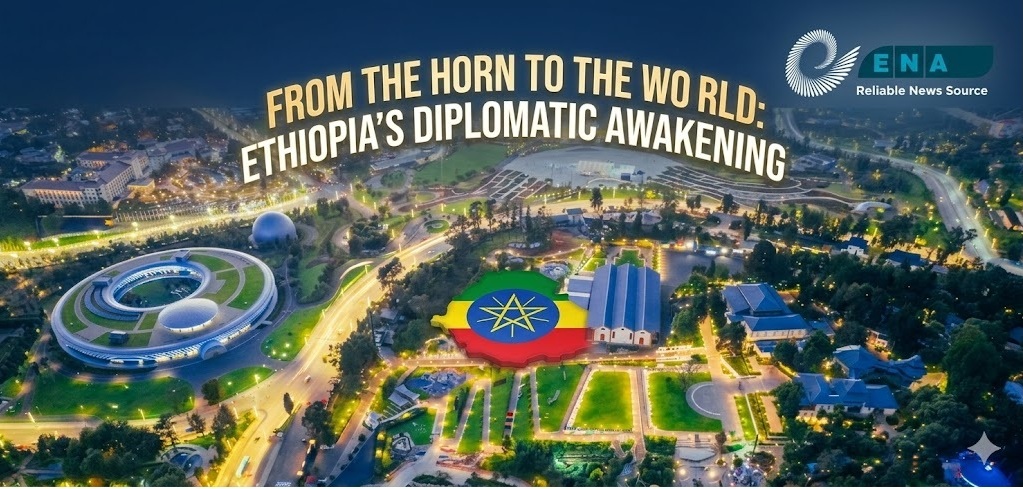
From the Horn to the World: Ethiopia’s Diplomatic Awakening
By Yordanos D.
Ethiopia’s Rising Diplomatic Influence: From Regional Engagement to Global Leadership
Addis Ababa, April 5, 2026 (ENA) —Over the past eight years, Ethiopia has redefined its diplomatic posture, evolving from a cautious regional actor into an assertive and adaptive player on both continental and global stages. This transformation has been guided by a combination of pragmatic decision-making, economic ambition, and the cultivation of diversified partnerships, reflecting a deliberate effort to secure influence within an increasingly multipolar world.
Under the leadership of Prime Minister Abiy Ahmed, Ethiopia’s foreign policy has prioritized cooperation, mutual benefit, and proactive engagement in international affairs. The country has pursued strategic relationships across Africa, Europe, Asia, and the Middle East while participating actively in multilateral forums. This approach has enabled Ethiopia to not only respond effectively to global developments but also to shape regional initiatives, promote economic integration, and advance peacebuilding efforts, signaling its emergence as a confident and independent actor on the world stage.
High-Level Engagements and Global Visibility
Ethiopia’s diplomatic resurgence has been defined by sustained high-level engagements with world leaders and international institutions, gesturing its growing influence on both regional and global stages. Prime Minister Abiy Ahmed has conducted strategic dialogues with prominent figures, including former United Kingdom Prime Minister Tony Blair, where discussions focused on governance reforms, international cooperation, and support for Ethiopia’s development agenda.
In Addis Ababa, Prime Minister Abiy met with United Nations Secretary-General António Guterres during the annual UN-African Union consultations. Their talks addressed pressing regional and multilateral issues, and together they inaugurated the newly renovated Africa Hall, a symbolic milestone in Ethiopia’s commitment to continental and global diplomacy.
Ethiopia’s stature as a diplomatic hub has been further reinforced by its hosting of major international gatherings. These events, ranging from multilateral summits to sector-specific conferences, underscore Addis Ababa’s role as a platform for dialogue, negotiation, and cooperative initiatives. By convening global leaders on its soil, Ethiopia has enhanced its visibility, strengthened its networks, and demonstrated its capacity to facilitate solutions to regional and international challenges.
Addis Ababa as a Diplomatic Hub
As the seat of the African Union, Addis Ababa has solidified its position as a central hub for both continental and global diplomacy. The city regularly hosts high-level meetings that bring together heads of state, government officials, and international representatives, providing a platform for dialogue, negotiation, and policy coordination. A landmark example was the 38th African Union Summit, where leaders from across the continent convened to address pressing political, economic, and security challenges. In his opening address, Prime Minister Abiy Ahmed emphasized that lasting justice, peace, and prosperity require rising above inherited divisions and working toward shared progress, underscoring Ethiopia’s vision for continental cooperation.
Beyond formal summits, Addis Ababa has expanded its profile as a venue for international conferences and high-profile events. The city hosted the Confederation of African Football General Assembly, attracting top sports officials and enhancing Africa’s sporting diplomacy. It also co-hosted the United Nations Food Systems Summit, providing a forum for global leaders to discuss sustainable development and food security.
Through these initiatives, Addis Ababa has not only strengthened Ethiopia’s diplomatic visibility but also positioned itself as a dynamic center for international engagement. By hosting major gatherings across political, economic, and social spheres, the city exemplifies Ethiopia’s broader strategy of leveraging its continental role to advance regional integration, multilateral cooperation, and global influence.
Expanding Bilateral Relations
Ethiopia has actively expanded its bilateral relations, cultivating strategic partnerships with both regional and global actors. Relations with France have been particularly notable, strengthened through reciprocal visits between Prime Minister Abiy Ahmed and President Emmanuel Macron. These engagements have fostered cooperation in areas such as cultural preservation and heritage restoration, including the ongoing renovation of Ethiopia’s National Palace and the restoration of the rock-hewn churches of Lalibela. Such initiatives highlight Ethiopia’s commitment to preserving its historical legacy while deepening diplomatic and development ties.
Beyond France, Ethiopia has intensified engagement with countries across Europe, Asia, and the Middle East. High-level official visits to nations including Italy, France, and Vietnam have led to the signing of agreements spanning trade, education, and civil aviation. Notably, these discussions have advanced plans for direct air connectivity between Addis Ababa and Hanoi, strengthening commercial and people-to-people links.
These bilateral efforts reflect Ethiopia’s broader diplomatic strategy: leveraging partnerships to support economic growth, cultural exchange, and infrastructure development. By combining strategic diplomacy with tangible projects, Ethiopia has transformed formal relationships into practical avenues for investment, collaboration, and mutual benefit.
Regional Integration and the Horn of Africa
At the regional level, Ethiopia has assumed a central role in promoting stability, cooperation, and integration across the Horn of Africa. Ethiopia has pursued closer cooperation with neighboring countries, including Somalia, Djibouti, Kenya, and Sudan. These partnerships extend beyond traditional security concerns, encompassing economic integration, joint infrastructure projects, energy interconnectivity, and regional development initiatives. In Somalia, for example, Ethiopia has supported stabilization efforts and governance reforms, reinforced peacebuilding while fostering trade and investment links. Djibouti continues to serve as a critical maritime gateway, with Ethiopia investing in port and railway infrastructure to enhance connectivity and regional trade. Relations with Kenya and Sudan have similarly evolved into dynamic collaborations that combine security, energy, and cross-border economic projects.
This broader approach reflects a vision of regional integration anchored in shared prosperity and collective security. As a regional official observed, "Our partnership is no longer limited to borders, it is about building a shared future." By leveraging its geographic position, economic potential and diplomatic influence, Ethiopia has positioned itself as a linchpin in the Horn of Africa, shaping the region’s political and economic architecture while promoting African-led solutions to shared challenges.
Multilateral Engagement and BRICS Membership
Ethiopia’s role in multilateral diplomacy has grown substantially, reflecting a strategic commitment to diversify partnerships and engage with emerging global actors. A defining moment in this trajectory was Ethiopia’s accession to BRICS in 2024, marking a decisive pivot toward South-South cooperation and signaling a more autonomous approach to global alignment. Membership in BRICS has provided Ethiopia with a platform to engage directly with leading emerging economies, including Brazil, Russia, India, China, and South Africa, on issues ranging from economic development and infrastructure investment to trade facilitation and technological collaboration. This alignment has strengthened Ethiopia’s bargaining power in international forums while expanding opportunities for investment and knowledge exchange.
Beyond BRICS, Ethiopia has sustained robust engagement with the United Nations, the African Union, and other international organizations. The country has consistently contributed to UN peacekeeping missions, participated in climate and sustainable development dialogues, and supported multilateral initiatives aimed at conflict resolution and regional stability. These efforts underscore Ethiopia’s commitment to being a responsible global actor, capable of advancing both regional and international priorities.
Through multilateral engagement, Ethiopia has not only broadened its diplomatic reach but also leveraged collective platforms to address domestic and regional development challenges. The combination of BRICS membership and active participation in global institutions reflects a dual strategy: strengthening ties with emerging powers while maintaining influence in established international frameworks, positioning Ethiopia as a versatile and proactive player on the world stage.
Economic Diplomacy and Investment Promotion
Economic diplomacy has emerged as a central pillar of Ethiopia’s foreign policy, reflecting a strategic shift toward linking external engagement with domestic economic transformation. Diplomatic missions are increasingly tasked with advancing investment promotion, facilitating business partnerships, and opening new avenues for trade across priority sectors such as manufacturing, agriculture, energy, and technology.
This proactive approach has yielded tangible outcomes. Ethiopia has witnessed the expansion of industrial parks, a steady inflow of foreign direct investment, and gradual improvements in export performance. Embassies and consulates now serve not only as political outposts but also as economic platforms, actively engaging investors, organizing business forums, and promoting the country’s competitive advantages, including its large labor force, strategic location, and growing infrastructure base.
A key feature of this strategy is the emphasis on trade diversification. By broadening its commercial partnerships beyond traditional markets, Ethiopia is reducing vulnerability to external shocks and enhancing economic resilience. New trade linkages across Asia, the Middle East, and Africa are helping to expand export destinations while encouraging the development of value-added industries.
In parallel, the government has intensified efforts to improve the investment climate through policy reforms, regulatory adjustments, and targeted incentives. These measures are designed to attract long term capital, stimulate industrial growth, and support job creation. Many analysts emphasized that diplomacy is no longer confined to politics, it has become a frontline instrument for economic transformation.
Looking ahead, economic diplomacy is expected to deepen further, with a stronger focus on technology transfer, digital economy partnerships, and sustainable investment. By aligning foreign relations with development priorities, Ethiopia is positioning itself to harness global opportunities while building a more diversified and resilient economy.
Strategic Projects and Resource Diplomacy
Ethiopia has increasingly anchored its diplomacy in national development priorities, placing strategic infrastructure and natural resources at the center of its foreign policy. This approach reflects a calculated effort to convert domestic assets into tools of regional influence, economic cooperation, and long-term growth.
At the core of this strategy is the Grand Ethiopian Renaissance Dam (#GERD), which has gradually shifted from a point of contention into a pillar of energy diplomacy. Initially marked by tensions with downstream countries, the project is now redefining regional engagement through electricity generation and cross border power trade. By exporting energy to neighboring states, Ethiopia is fostering economic interdependence, supporting industrial expansion, and reinforcing its position as an emerging energy hub in East Africa. Different regional analysts noted that energy is no longer just a domestic asset, it has become a tool for integration and influence."
Beyond hydropower, Ethiopia has elevated its diplomatic efforts to address the structural constraints of being landlocked. Engagements across the #RedSea corridor, including negotiations aimed at securing port access, reflect a more assertive and forward-looking posture. These initiatives are grounded in the understanding that dependable maritime access is critical for lowering trade costs, improving competitiveness, and sustaining economic transformation.
This combined emphasis on energy and maritime access signals a broader shift toward resource driven diplomacy, where infrastructure, geography, and strategic location are actively leveraged to advance national interests. It illustrates a move away from reactive engagement toward a more deliberate and goal oriented foreign policy.
Taken together, these efforts underscore a recalibrated diplomatic approach that places development at its center. By linking strategic projects with international partnerships, Ethiopia is not only addressing its internal economic needs but also shaping regional dynamics and building a more resilient and interconnected future.
Cultural, Environmental, and Diaspora Diplomacy
Cultural diplomacy has emerged as a vital pillar in Ethiopia’s international engagement, serving as a bridge between its rich historical legacy and contemporary global outreach. Through cultural festivals, artistic exchanges, and targeted tourism campaigns, the country has showcased its unique heritage, from ancient civilizations to living traditions. These efforts have not only enhanced Ethiopia’s global image but also fostered people to people connections that complement formal diplomatic relations. The promotion of historic sites and cultural landmarks has increasingly positioned the country as a compelling destination, reinforcing the role of soft power in advancing national interests.
Environmental diplomacy has gained significant momentum, with Ethiopia leveraging its domestic initiatives to actively engage on global climate platforms. The Green Legacy Initiative (#GLI), in particular, has attracted international recognition as a landmark reforestation and environmental restoration effort, with more than 48 billion trees planted over the past five to six years. By aligning national priorities with global climate goals, Ethiopia has strengthened its voice in international discussions on sustainability, climate resilience, and environmental protection. This approach underscores a broader strategy of linking development with environmental stewardship, positioning the country as a proactive contributor to global climate action.
Diaspora diplomacy has further expanded Ethiopia’s reach beyond its borders. Ethiopians living abroad have become key partners in promoting investment, innovation, and knowledge transfer. Through structured engagement and policy incentives, the government has encouraged diaspora communities to participate in national development initiatives, ranging from business ventures to infrastructure projects. Beyond economic contributions, the diaspora has also played an important role in shaping international perceptions, advocating for national interests, and strengthening bilateral ties in host countries.
Together, cultural, environmental, and diaspora diplomacy reflect a multidimensional approach that extends beyond traditional state to state relations. They highlight Ethiopia’s ability to harness its heritage, natural resources, and global community as strategic assets in building influence, fostering cooperation, and supporting sustainable development.
Asserting Sovereignty
Ethiopia also reinforced its commitment to African led solutions, aligning its stance with broader continental principles of resolving conflicts through regional mechanisms. This approach helped preserve a degree of diplomatic space, allowing the country to navigate a complex and often polarized international environment.
A decisive turning point came with the signing of the Pretoria Peace Agreement in 2022, which brought an end to active hostilities and opened a pathway toward stabilization. The agreement not only eased internal tensions but also created an opportunity for diplomatic recalibration. It enabled Ethiopia to re-engage more constructively with international partners, rebuild trust, and shift focus toward recovery and reconstruction.
In the aftermath, diplomatic momentum gradually returned, supported by renewed cooperation with global institutions and bilateral partners. The experience of navigating this turbulent period has reinforced Ethiopia’s preference for a foreign policy grounded in resilience, strategic patience, and an unwavering commitment to sovereignty, while remaining open to engagement and collaboration on mutually beneficial terms.
Ethiopia has shifted toward strategic realignment, expanding its partnerships beyond traditional allies and embracing a diversified foreign policy orientation. Engagement with emerging global blocs, renewed regional initiatives, and a stronger focus on economic diplomacy reflect a deliberate effort to align international relations with national development priorities. This period is characterized by assertiveness balanced with calculated cooperation, as the country positions itself within an increasingly multipolar global order.
Conclusion
Ethiopia is poised to consolidate its diplomatic gains by deepening regional integration, expanding global partnerships, and aligning foreign policy with national development priorities. In the Horn of Africa, strengthened ties with neighbors, economic corridors, and energy interconnectivity are expected to enhance trade, stability, and shared prosperity. At the continental level, Ethiopia will continue leveraging its role as host of the African Union to facilitate dialogue, mediation, and African-led solutions.
Globally, engagement with emerging economies through platforms like BRICS, alongside balanced relations with traditional partners, reflects a pursuit of strategic autonomy. Economic diplomacy, focused on investment, exports, and key sectors such as manufacturing, energy, agriculture, and digital innovation, will remain central, with infrastructure and industrial projects serving as anchors for international cooperation.
Ethiopia’s diplomacy will also emphasize climate action, cultural outreach, and diaspora engagement, enhance its soft power and mobilize global support for sustainable development. Overall, the country is positioned not only to respond to global changes but to actively shape them, using diplomacy as a tool for economic transformation, regional stability, and international influence


