Recasting the Foundations of Ethiopia’s Economy - ENA English
Recasting the Foundations of Ethiopia’s Economy
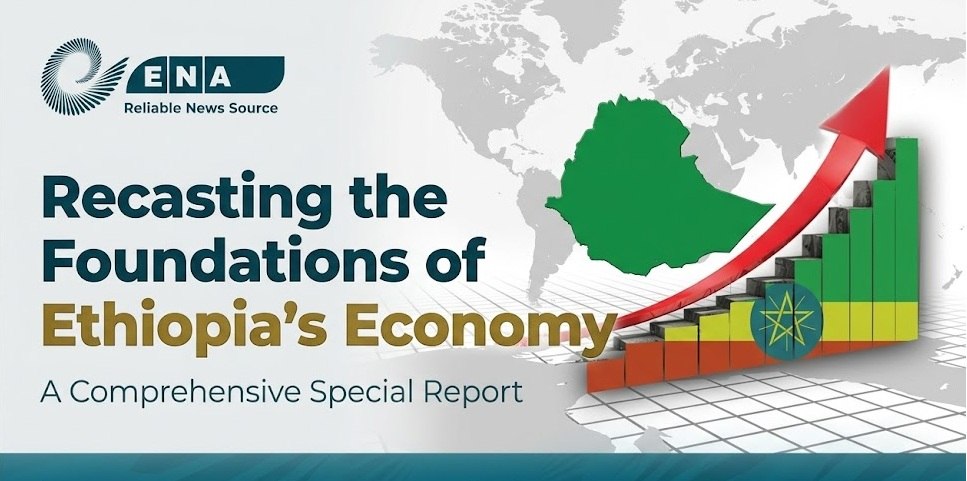
By Gezmu Edicha
How Ethiopia’s Economic Reform Charts a New Course of Growth?
There are defining moments in a nation’s history when continuity yields to recalibration, when accumulated pressures demand not incremental adjustment, but a fundamental rethinking of direction.
For Ethiopia, April 2, 2018, marks such a turning point.
The ascent of Prime Minister Abiy Ahmed was more than a political transition. It signaled the beginning of a profound reassessment of the country’s economic foundations. It was a moment that challenged long-standing assumptions and opened the door to a new vision of growth.
For years, Ethiopia’s economic story was one of both achievement and constraint. Rapid expansion, driven largely by public investment and anchored in an agriculture-led model, delivered impressive gains in infrastructure and overall output.
Yet beneath this progress, structural imbalances quietly intensified. Foreign exchange shortages became chronic, debt vulnerabilities deepened, and the limitations of a narrow production base grew increasingly evident.
It was within this context that the Homegrown Economic Reform Agenda emerged; not merely as a set of policy measures, but as a strategic pivot. Its objective was twofold: to restore macroeconomic stability while laying the groundwork for a more diversified, competitive, and resilient economy.
Upon taking office in 2018, the reform-oriented leadership moved swiftly to confront longstanding imbalances. High public debt, persistent foreign currency shortages, and a widening trade deficit demanded urgent attention. Early policy responses focused on tightening monetary conditions, improving domestic revenue mobilization, and restructuring state-owned enterprises. Currency devaluation was introduced to enhance export competitiveness, while engagement with international financial institutions intensified to secure support and debt relief.
Yet stabilization was only the first step. The broader ambition lay in structural transformation. Key sectors such as telecommunications and logistics began to open to private participation, while plans were set in motion to partially privatize major state-owned enterprises. At the same time, efforts to improve the business environment sought to attract both domestic and foreign investment.
These reforms, however, have unfolded in a complex and often turbulent environment. Political transitions, inflationary pressures, and global shocks, including the COVID-19 pandemic and supply chain disruptions—have tested both policy and resilience. As a result, progress has been uneven. Gains in liberalization and market opening coexist with persistent challenges in inflation control, foreign exchange availability, and fiscal balance.
Still, the direction of change is unmistakable.
At the heart of Ethiopia’s economic recalibration lies a deliberate shift away from reliance on a single engine of growth toward a more diversified structure. While agriculture remains central to livelihoods and food security, it is no longer viewed as the sole driver of expansion. Manufacturing, mining, tourism, and the digital economy are increasingly being cultivated as complementary pillars of growth.
This transition has occurred under difficult global conditions, yet Ethiopia has managed to sustain growth rates exceeding six percent in recent years. And this is a testament not only to resilience, but to the underlying momentum of reform.
More significant than the pace of growth, however, is its evolving composition.
In the industrial sector, a quiet transformation is underway. Longstanding dependence on imported manufactured goods is gradually being challenged by a renewed emphasis on domestic production. Industries ranging from textiles to construction materials and pharmaceuticals are beginning to develop local capacity. Supported by industrial parks and targeted policy incentives, this push for import substitution through the “Made in Ethiopia” initiative, reflects a broader goal.
The move is hugely helping retain value within the domestic economy while reducing exposure to external shocks.
Meanwhile, the services sector continues to expand its strategic importance.
Aviation and logistics, anchored by Ethiopian Airlines—are being strengthened through new infrastructure initiatives and international partnerships. Ambitious projects, including the proposed Bishoftu International Airport, signal Ethiopia’s intent to position itself as a regional hub for connectivity and commerce.
Equally important is the evolving relationship between the state and the market.
For decades, Ethiopia’s development model was characterized by strong state dominance across key sectors. While the state continues to play a significant role, the reform agenda is gradually widening space for private sector participation. Liberalization efforts in telecommunications, logistics, and financial services are introducing competition, attracting investment, and reshaping the economic landscape.
Macroeconomic management remains central to this transition. Inflationary pressures, driven by both domestic constraints and global dynamics—have required coordinated fiscal and monetary responses. Recent signs of easing inflation, alongside efforts to diversify exports and rationalize imports, suggest gradual improvement in the country’s external position.
These developments are incremental, but they point toward a broader objective: restoring balance within an economy long marked by structural asymmetries.
Economic transformation is rarely linear, and Ethiopia’s experience reflects this reality. The challenges that necessitated reform foreign exchange shortages, productivity gaps, and institutional constraints, have not disappeared. Yet what has changed is the trajectory.
The country is moving away from a model defined primarily by state-led expansion toward one increasingly shaped by diversification, private sector dynamism, and strategic openness.
Perhaps the most defining feature of this transformation is its long-term orientation. The reform agenda is not designed for immediate gains, but for foundational change, expanding productive capacity, strengthening resilience, and positioning Ethiopia within an evolving global economy.
The question, then, is no longer whether change is underway, but how deeply it will take root.
For now, the evidence suggests that Ethiopia is engaged in more than economic adjustment. It is undertaking a redefinition, one that seeks to align ambition with structure and growth with sustainability.
The reform remains a work in progress. But its direction is becoming increasingly clear and its implications increasingly profound.
In Part Two, we’ll dive deeper into this topic