Global Reporting on US-Israel War with Iran Signals Economic and Humanitarian Strain - ENA English
Global Reporting on US-Israel War with Iran Signals Economic and Humanitarian Strain
By Molla Mitiku
Global Weekly Roundup
The conflict in Iran has escalated from a regional confrontation into a global crisis, sending shockwaves through energy markets, political systems, and societies worldwide. What began as localized tensions now disrupts economies across the Middle East, Europe, Asia, and Africa. Analysts describe the situation as a systemic shock to the global economy, revealing deep structural dependencies in energy, trade, and finance. The crisis underscores the fragility of an interconnected world, where a disruption in one strategic region can cascade across continents in days.
Unprecedented Economic Pressure in the Gulf
The economic impact is severe, particularly for Iran and neighboring Gulf states. Long-standing structural weaknesses, especially heavy reliance on oil revenues; have left these economies highly vulnerable to external shocks. Sustained military strikes on refineries, pipelines, and export terminals have sharply reduced production capacity. Sanctions compound the strain, limiting access to foreign currency and global financial systems.
Economists warn that “the scale of revenue loss is pushing Iran toward a prolonged fiscal crisis,” according to the World Bank and Reuters. Inflation is accelerating, fueled by supply shortages and currency depreciation. The weakening rial has amplified import costs, worsening shortages of essentials like food, fuel, and medicine.
Strait of Hormuz: The Global Pressure Point
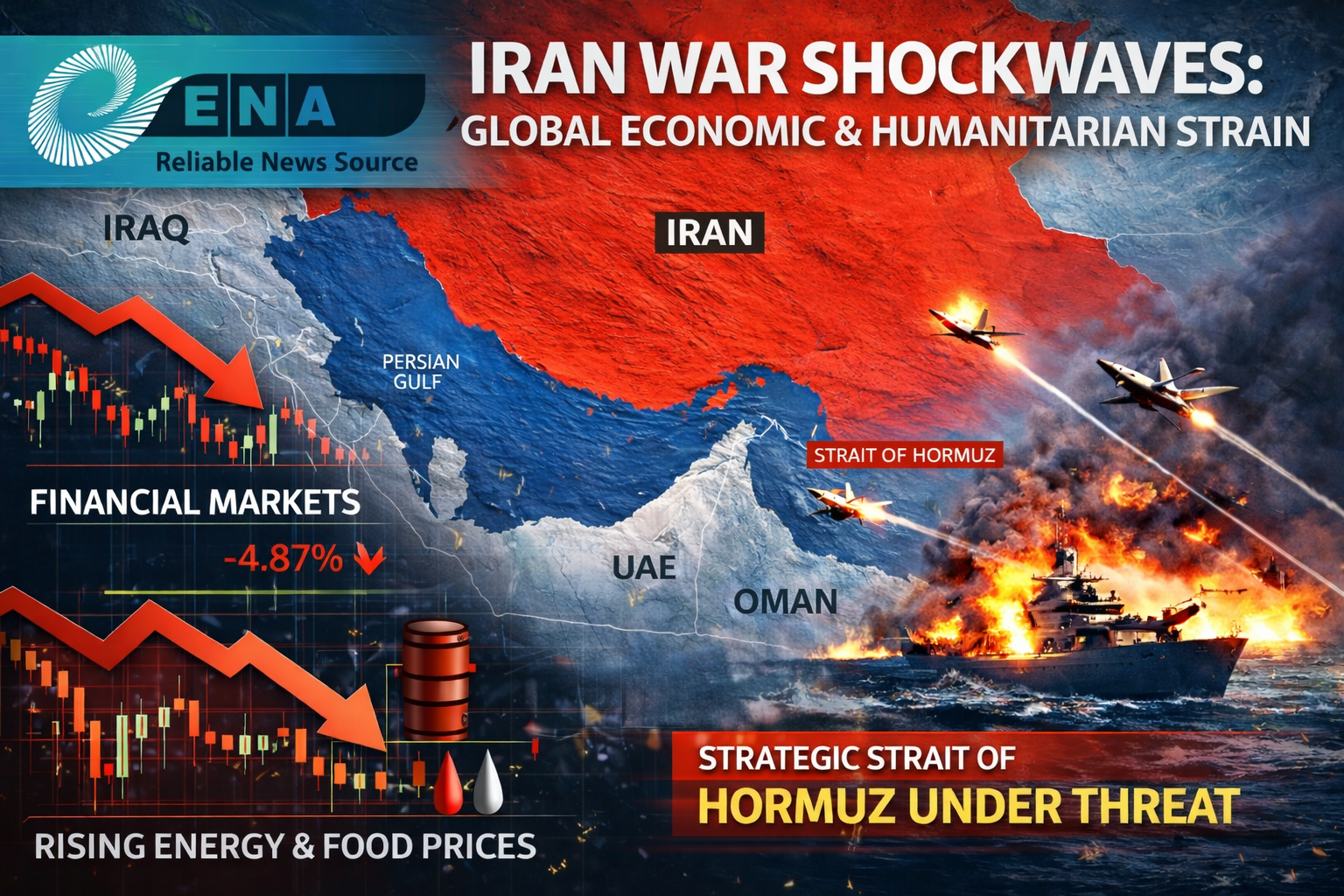
The Strait of Hormuz, through which nearly one-fifth of the world’s oil passes, has become the most critical chokepoint in global energy security. Attacks on shipping lanes and infrastructure have forced rerouting, increased insurance costs, and reduced supply efficiency.
Oil prices have surged past 100 USD per barrel, reflecting both market panic and heightened geopolitical risk. Energy experts warn that any sustained disruption of Hormuz would have immediate and severe global consequences, as alternative routes lack sufficient capacity. The impact extends beyond oil: gas and industrial supply chains are affected, disrupting technology manufacturing and industrial production. The conflict, therefore, is not just an energy crisis—it is a global supply chain crisis.
Tensions escalated when U.S. President Donald Trump threatened to “obliterate” Iran’s power infrastructure if the Strait of Hormuz is not reopened within 48 hours. In a late-night post on Truth Social, he warned of immediate military action if Iran fails to restore access to this strategic route. Iranian officials responded with strong warnings, stating any attack would trigger retaliation against U.S. energy assets in the region. The standoff highlights the precarious balance of power and the potential for rapid escalation.
Rising Food Prices
Energy shocks are rippling into global food systems, intensifying inflation and food insecurity. Fuel is a critical input at every stage of agriculture-from fertilizer production to mechanized farming and transport. Rising energy costs feed directly into higher food prices.
Import-dependent countries are particularly vulnerable, as currency depreciation and limited fiscal space hinder the ability to subsidize imports. Analysts warn that this creates a feedback loop: rising costs increase social vulnerability, which pressures governments to expand spending despite constrained budgets. The crisis highlights the fragility of global food systems, where disruptions in one sector quickly spill over into another.
Policy Shifts and Global Responses
Governments are responding with both immediate measures and long-term strategic shifts. In Europe, energy conservation and efficiency are no longer temporary measures, they are central to economic policy.
Asia is pivoting away from dependence on Middle Eastern energy. Japan is implementing efficiency measures, India is expanding renewables and electric mobility, and China is building reserves while advancing clean energy. Analysts suggest the war may permanently alter global energy demand patterns.
Ethiopia: An Emerging Model of Energy Sovereignty
In Africa, the crisis presents a different set of challenges, as many economies face high exposure to fuel price shocks and limited fiscal buffers. Yet Ethiopia stands out as an emerging example of resilience.
Through strategic prioritization of essential fuel use and sustained investment in renewable energy, Ethiopia is steadily reducing its dependence on imported oil. At the center of this transformation is the Grand Ethiopian Renaissance Dam, a project that symbolizes not only power generation but also economic self-determination.
Complemented by initiatives like the Koysha Hydropower Project, hydropower now anchors Ethiopia’s electricity system. This shift is not merely environmental. It is geopolitical. Unlike oil-dependent systems, Ethiopia’s energy supply is increasingly insulated from global price volatility, offering a model of long-term resilience in an unstable world.
Political Strain
Economic distress in Iran and the Gulf is translating into political pressure. Rising living costs and unemployment are fueling public dissatisfaction, both domestically and regionally. Analysts note that economic instability is increasingly challenging political legitimacy. Iran’s isolation limits its ability to mitigate shocks through international partnerships, while ongoing airstrikes, missile exchanges, and maritime disruptions continue to elevate the risk of escalation.
Humanitarian Impact
The humanitarian situation is deteriorating rapidly. Inflation and infrastructure damage are pushing millions into poverty, while access to healthcare, food, and housing is becoming increasingly constrained. Displacement is rising as families search for safety and economic opportunity, placing further strain on urban centers. Aid officials warn of long-term social instability if conditions persist.
The crisis is global in scope: rising fuel costs are driving inflation worldwide, affecting transport, agriculture, and essential goods. Import-dependent economies, particularly in Africa, face currency pressures and fiscal strain. The ripple effects underscore the interconnectedness of economic and humanitarian impacts.
Long-Term Implications
The crisis is accelerating structural changes in the global economy. Investments in renewable energy, electric vehicles, and decentralized systems are gaining urgency. Businesses are redesigning supply chains to prioritize resilience, and governments are expanding social protection measures to manage volatility. Analysts argue that the war is redefining how nations balance growth, stability, and sustainability, emphasizing that resilience may be as critical as efficiency in an uncertain world.
In conclusion, the war in Iran has evolved into a defining global crisis, reshaping energy markets, economic policy, and geopolitical dynamics. Its effects are widespread, exposing vulnerabilities while forcing nations to adapt rapidly. From energy conservation in Europe to diversification in Asia and resilience strategies in Africa, responses reflect a global recalibration of priorities.
Without diplomatic intervention, experts warn that both the economic and humanitarian toll will continue to rise, emphasizing the urgent need for coordinated international action and long-term structural reform.