At a Glance: Ethiopia in the Spotlight - ENA English
At a Glance: Ethiopia in the Spotlight
By staff writer
Addis Ababa, February 24, 2026 (ENA):
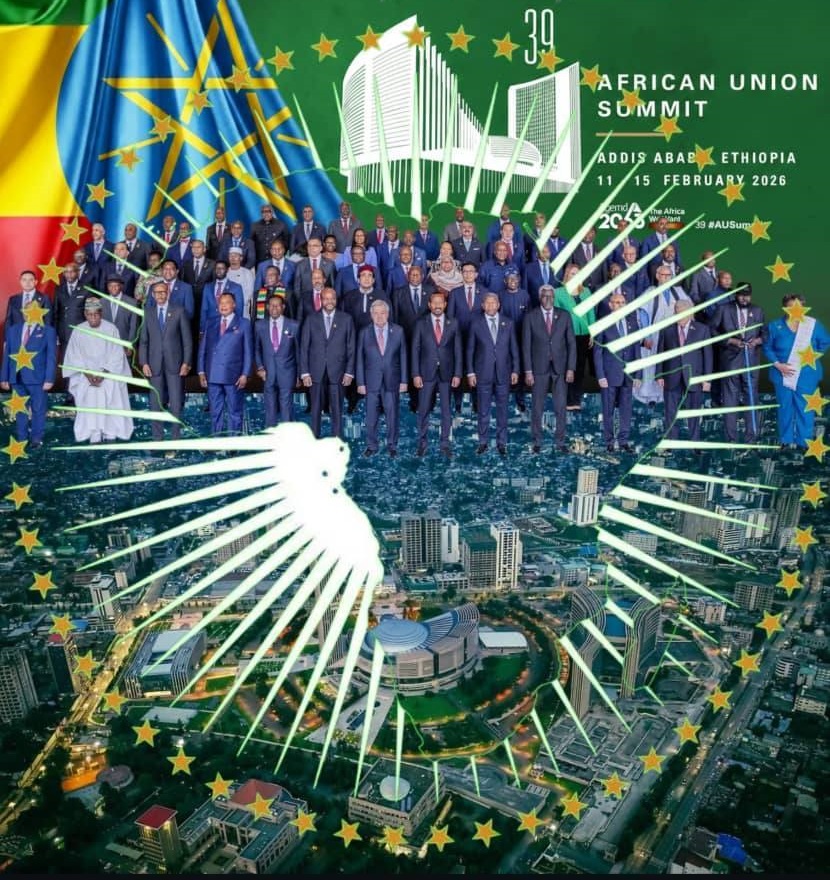
When Africa’s leaders converge on Ethiopia's capital and depart speaking not only of diplomacy but of admiration, it signals that something far greater than protocol is at work. Over the past week, as heads of state from across the continent, alongside high-profile diplomats from beyond Africa — gathered in Addis Ababa for high-level engagements, one message resonated clearly and consistently. This was more than a summit season.
Addis Ababa is not merely hosting Africa. It is shaping its direction, commanding its narrative, and redefining its place in the global order.
A Capital That Commands Admiration
Motorcades swept through newly expanded corridors, past illuminated boulevards and landscaped avenues of Addis Ababa, as presidents and prime ministers from across the continent gathered in the diplomatic heart of Africa.
Among the most striking public reactions came from the President John Dramani Mahama of Ghana, who, after witnessing the city’s transformation firsthand, took to social media to express admiration, declaring that Addis Ababa: “Is a beautiful city, it truly qualifies as Africa’s capital.”
The remark reverberated widely across continental media platforms, symbolizing a broader sentiment shared quietly in diplomatic corridors: Ethiopia’s capital has undergone a transformation that aligns infrastructure with continental ambition.
Other African leaders echoed similar sentiments during bilateral discussions, praising the city’s modern transport networks, green spaces, and integrated development corridors. Diplomats described Addis as a living showcase of African possibility, while visiting delegations noted the speed and coherence of the city’s renewal projects.
For a city long known primarily as the seat of the African Union, Addis Ababa is now increasingly recognized as a symbol of contemporary African urban renaissance.
Diplomacy Reinforced: Ethiopia’s Indispensable Role
The presence of multiple heads of state further underscored Ethiopia’s growing geopolitical centrality.
The recent visit of President Recep Tayyip Erdoğan of Türkiye marked a defining diplomatic moment. Speaking to journalists aboard his presidential aircraft on his return journey, President Erdoğan emphasized that pursuing Türkiye’s African ambitions without Ethiopia is impossible, affirming that Ankara works with Addis Ababa with a sense of equality and brotherhood.
Such a statement from a global actor with expansive African engagement signals a recalibrated diplomatic equation—one in which Ethiopia is not peripheral but pivotal.
Likewise, Prime Minister Giorgia Meloni of Italy’s visit reflected Europe’s renewed strategic attention toward Ethiopia as a stabilizing anchor in the Horn of Africa and a gateway to the continent.
Analysts note that Ethiopia’s demographic scale, military capability, and strategic location along critical maritime corridors elevate its leverage in regional diplomacy. The language of “partnership of equals” is no longer aspirational. It is operational.
The “Addis Miracle”: A Global Social Media Phenomenon
While presidents spoke in meeting halls, another conversation erupted online.
A video of a presidential convoy gliding through Addis Ababa’s modern avenues triggered a viral storm across X and YouTube. The footage showcased wide expressways, synchronized lighting systems, and skyline vistas that many viewers compared to advanced Asian metropolises.
From India to Ghana, from Germany to Türkiye, users expressed astonishment. Some Indian commentators candidly observed that despite their country’s multi-trillion-dollar economy, they struggle to identify a single city matching the seamless modernity captured in Addis.
In Ghana, several radio and online programs reportedly dedicated full segments to discussing infrastructure gaps in their own cities after viewers drew comparisons with Addis Ababa.
Even European commentators admitted surprise, with some noting that aspects of Addis’s new corridors rival infrastructure found in parts of Europe.
Urban development experts attribute this to Ethiopia’s corridor development strategy—integrating transport, green areas, pedestrian pathways, and commercial zones into cohesive urban planning. The result is not superficial beautification but systemic transformation.
In the digital age, perception travels faster than policy. This week, perception worked in Ethiopia’s favor.
A Sovereign Signal: The 65th Anniversary of the Special Operations Command
Beyond diplomacy and infrastructure, Ethiopia projected sovereign resolve during the 65th Anniversary of its Special Operations Command in Hawassa.
Presided over by Prime Minister Abiy Ahmed, the military commemoration was both ceremonial and strategic. Precision formations, advanced equipment displays, and disciplined drills conveyed readiness and deterrence.
The Prime Minister underscored that Ethiopia’s defense posture is anchored in peace-building, declaring that the nation’s preparations are designed to guarantee stability across East Africa and the continent at large. He emphasized Ethiopia’s aspiration to serve as a pillar of regional security, a protector and stabilizing force.
Of particular note was the expansion of training capabilities beyond traditional land and mountainous operations to include maritime competencies, an acknowledgment of evolving strategic realities.
Analysts observe that a nation of more than 130 million people, with expanding economic ambitions, must think in multidimensional terms about security and access.
The message was clear—strength is not a departure from diplomacy; it is its guarantor.
Development on the Ground: Irrigation, Industry, and Self-Reliance
Meanwhile, Prime Minister Abiy Ahmed continued inspecting transformative projects across the country, including large-scale irrigation initiatives and industrial hubs in the Wollega zones.
The Arjo-Didessa irrigation project stands as a cornerstone of Ethiopia’s drive toward food security and agricultural modernization. By expanding irrigated farmland, the project reduces reliance on erratic rainfall and strengthens export potential.
Industrial parks and agro-processing centers in development further demonstrate Ethiopia’s commitment to value addition, job creation, and import substitution—critical pillars for long-term economic sovereignty.
PM Abiy’s engagements underscore a consistent philosophy: diplomacy elevates a nation’s voice, military strength protects its sovereignty, but economic productivity sustains its future.
A Nation Reframed
From the admiration of African presidents to viral global discourse on urban transformation; from strategic declarations by global leaders to measurable financial sector confidence; from disciplined military display to expansive irrigation projects, Ethiopia has occupied international headlines with a distinctly positive tone.
It is not a single event that defines this moment, but the convergence of many.
Ethiopia is no longer merely reacting to regional dynamics. The East African nation is shaping them. It is no longer a peripheral subject of analysis. It is a central actor in continental strategy.
On the spotlight it stands, radiant, sovereign, and ascending with unmistakable confidence.
From conference diplomacy to corridor development, from regional security to agricultural modernization, Ethiopia has captured both global media attention and digital imagination.
Its trajectory, multidimensional and assertive, is redefining how the nation is perceived, and perhaps more importantly, how it perceives itself.
In this season of convergence, Ethiopia is not simply present. It is prominent.