President Taye Urges Trust-Based Global Partnership at World Governments Summit - ENA English


President Taye Urges Trust-Based Global Partnership at World Governments Summit
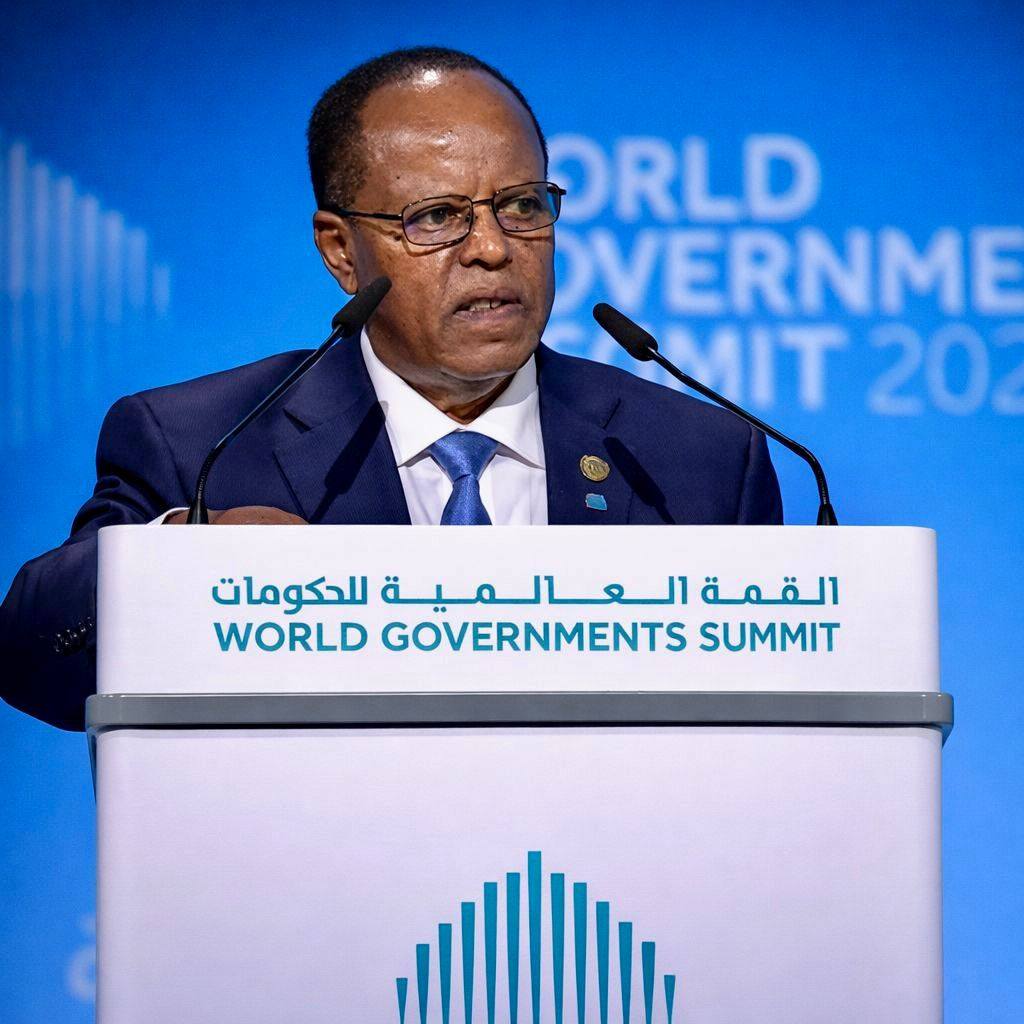
Addis Ababa, February 3, 2026 (ENA)—President Taye Atske Selassie has called for a renewed, trust-based global partnership, saying Africa must be recognized as an active architect of its future amid shifting geopolitical power and declining confidence in multilateral systems.
Speaking at the World Governments Summit today, the President said Africa is at a defining moment of self-introspection as disruptive global changes challenge the old order.
He added that innovations in renewable energy, artificial intelligence, and digital finance offer opportunities to overcome long-standing development barriers.
“For Africa, the changing environment is a clarion call. We don't see ourselves as mere observers for global change, but as architects of our future and our destiny.”
The President emphasized that Africa is not a bystander to global change, highlighting the transformative potential of the African Continental Free Trade Area (AfCFTA) that aims to integrate a market of 1.3 billion people with a combined GDP exceeding 3.4 trillion USD.
According to him, the AfCFTA is a flagship initiative of the African Union’s Agenda 2063 and seeks to eliminate 90 percent of tariff barriers to build regional production networks.
President Taye underscored the importance of continental connectivity, citing major infrastructure corridors linking East, Central, and Southern Africa, including routes connecting Ethiopia with neighboring countries.
“The LAPSSET corridor connecting Kenya, South Sudan, and Ethiopia; and the recently inked multi-million-dollar project connecting Ethiopia with South Sudan remain pillars of African connectivity strategy.”
He said these corridors are not merely transport routes but vital arteries of regional cooperation and economic integration.
Outlining Ethiopia’s development priorities, the President said the country is focusing on three strategic pillars: Energy, food self-sufficiency, and air connectivity.
With the full operation of the Grand Ethiopian Renaissance Dam, Ethiopia is now generating more than 6,000 megawatts of clean energy, he added.
He also highlighted “Ethiopia’s transformation from a wheat importer to Africa’s largest wheat producer” and announced major investments in agricultural productivity, including record coffee production.
“Our coffee production reached 640,000 tons of coffee. We have planted 8.5 billion seedlings of high-quality coffee of premier coffee quality to be available to the world.”
On aviation, President Taye said Ethiopia is constructing a 12.5 billion USD international airport with the capacity to handle 110 million passengers and more than three million tons of cargo annually, further strengthening Africa’s air connectivity.
Despite progress, he acknowledged that Africa continues to face challenges, particularly in financing large-scale infrastructure projects, largely due to capital constraints.
He said Ethiopia is strengthening financial institutions and expanding innovative public-private partnerships, while welcoming the growing role of Africa’s private sector and entrepreneurs.
The President also stressed the strategic importance of secure and reliable trade routes, noting that the Red Sea corridor is vital not only for Ethiopia but for global trade.
“For Ethiopia, the security of the Red Sea corridor is not only critical, but also a vital artery to 12 percent of the global trade. This indeed demands an urgent and collaborative framework, an arrangement or mechanism unburdened by strategic gains and parochial geo-economic interests.”
He called for cooperative frameworks free from narrow geopolitical interests.
President Taye highlighted trust and fairness as central to Africa’s relations with the rest of the world, cautioning against asymmetrical partnerships and pressure to choose sides in global rivalries.
Africa seeks cooperation based on shared interests and mutual respect, he underscored.
The World Governments Summit was established in 2013 under the leadership of His Highness Sheikh Mohammed bin Rashid Al Maktoum, Vice President and Prime Minister of the UAE, Ruler of Dubai.
Since then, the organization and its leadership has continued to champion the mission of shaping future governments and creating a better future for humanity. Working together with its community of partners and members, the Summit has successfully established a new model for international collaboration to inspire and enable the next generation of governments.
The 2026 edition is currently taking place in Dubai from February 3 to 5, featuring more than 60 global leaders, 500 ministers, and 87 scientists.


