Timket: A Living Soul—Where Faith, History, and the Future Flow Together - ENA English
Timket: A Living Soul—Where Faith, History, and the Future Flow Together
By Molla Mitiku
Every January, as sacred waters are prepared and ancient hymns rise before dawn, Timket (Ethiopian Epiphany) draws Ethiopia into a shared moment of faith and reflection. More than a commemoration of Epiphany, the festival stands at the heart of the nation’s living heritage, linking belief with history, culture, social life, tourism and economic vitality. Rooted in centuries old ritual yet fully alive in the present, Timket shows how a single tradition continues to shape identity, foster unity, sustain livelihoods and project Ethiopia’s heritage to the world.
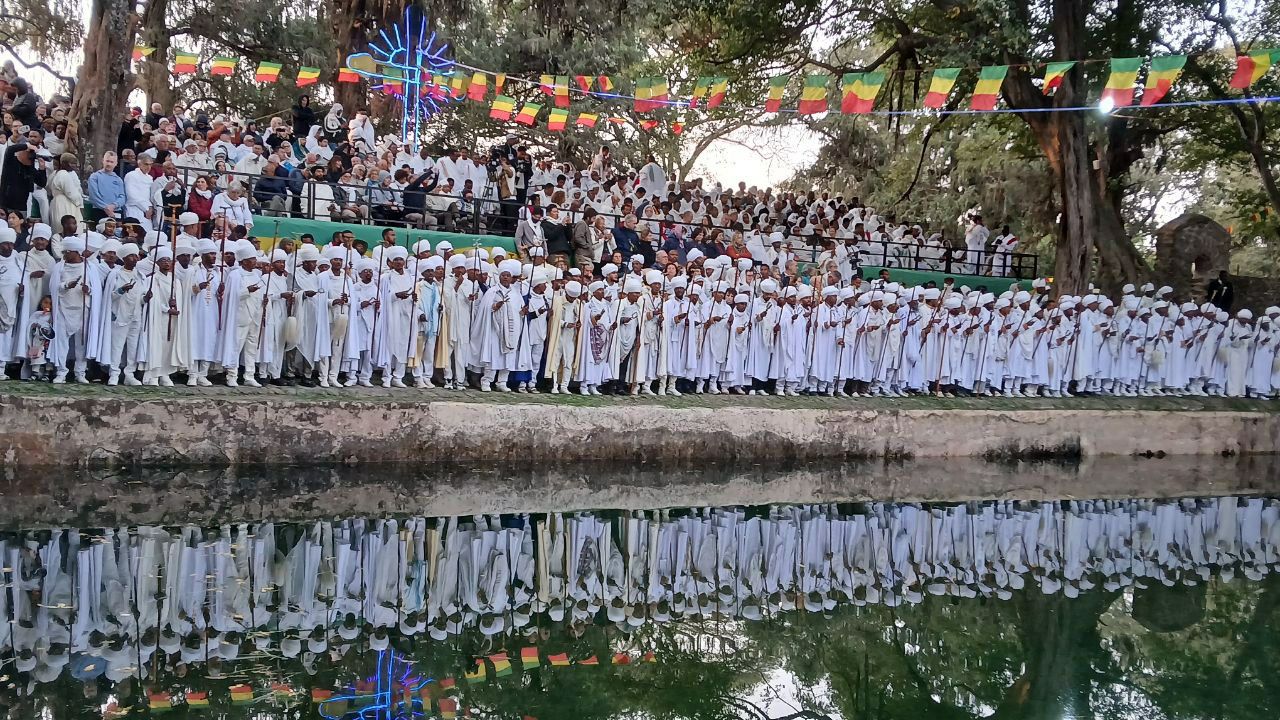
Draped in white cotton garments, millions of Ethiopian Orthodox Christians gather in prayer and song to mark the baptism of Jesus Christ. Timket unfolds not simply as a holy day but as a living national ritual where faith, memory and communal life converge in one of Africa’s oldest public traditions.
Prime Minister Abiy Ahmed has repeatedly described Timket as “a celebration that reminds us of who we are as Ethiopians, a people bound by faith, history and shared values.” The festival, he notes, affirms both spiritual renewal and national continuity. “Our traditions are not relics of the past. They are living forces that guide our present and shape our future,” he has said.
According to religious scholars, the word Timket comes from the ancient liturgical language Ge’ez, meaning immersion in water, a direct reference to the baptismal rite at the center of the celebration. Historical records trace its observance as a national religious festival to at least the sixth century, placing it among the world’s longest continuously celebrated Christian traditions.
Its rituals assumed their formal character during the medieval period, particularly in the fifteenth century under Emperor Zer’a Ya’ekob. During his reign, the ceremonial role of the Tabot, the sacred replica of the Ark of the Covenant, was firmly established. He decreed that Tabots be carried from churches to nearby water bodies for blessing, shaping the majestic processions that now define Timket.
Senior theologians stress that the ritual goes far beyond symbolic display. “Timket is not a reenactment for spectacle. It is a living sacrament. When the faithful receive the blessed water, they renew the covenant they entered through baptism,” one explains.
At the heart of the festival is the dawn liturgy held beside rivers, lakes or specially prepared pools known as Timket Bahir. Long before sunrise, clergy and worshippers gather in prayer as incense drifts over the water and candles flicker in the darkness. When the water is blessed, the spiritual climax is reached. Holy water is sprinkled on the faithful, while many choose full immersion as a sign of renewal.
Timket unfolds over three days, beginning with Ketera, the eve of the main celebration. On this day, Tabots are removed from their sanctuaries in a sacred rite. Ordinarily hidden from public view and accessible only to ordained clergy, the Tabot symbolizes the Tablets of the Law and the presence of God. Wrapped in richly embroidered cloths, the Tabots are carried on the heads of senior priests from churches to designated water sites, accompanied by chanting, rhythmic drumming and vivid ceremonial umbrellas. The night of Ketera is spent in vigil, with prayers and hymns continuing until dawn.
While theology forms its foundation, Timket is equally a powerful cultural expression. Across the country, white shamma and netela garments fill streets and open fields, symbolizing purity and humility. Music and movement are central, as traditional church chants echo through towns and villages. In many communities, solemn worship flows naturally into communal singing and dance.
Historians describe Timket as deeply reverent yet profoundly joyful, reflecting an Ethiopian understanding of faith as something lived collectively rather than privately. Echoing this view, the Prime Minister has noted, “Our strength as a nation lies in our ability to celebrate diversity while standing together as one people.”
Timket also serves as a moment of social renewal. Ethiopians from different backgrounds gather in shared public spaces, where urban professionals stand beside rural farmers and diverse communities move to a common spiritual rhythm. Ethiopians of other faiths often attend as observers, drawn by the atmosphere of inclusion.
In rural areas, Timket has long been associated with reconciliation. Disputes are settled, forgiveness is encouraged and communal meals symbolize restored harmony. This tradition reflects the Prime Minister’s message that “peace begins in the hearts of citizens and is strengthened through shared values and mutual forgiveness.”
For younger generations, Timket remains a vibrant social occasion. It offers space for friendship, courtship and shared memory. Folk customs, such as young men offering lemons to young women as a sign of interest, continue in many areas, showing how tradition adapts while retaining meaning.
Beyond religion, Timket carries deep national significance. Ethiopia, one of the world’s oldest Christian civilizations, views the festival as a living expression of historical endurance. Ancient rites performed in modern cities offer a powerful image of continuity.
In 2019, UNESCO inscribed Timket on the Representative List of the Intangible Cultural Heritage of Humanity, recognizing its role in strengthening social cohesion and transmitting values across generations. The inscription placed Timket alongside other Ethiopian heritages recognized globally, including Meskel, the Gada system of the Oromo, Fichee Chambalaalla of the Sidama, the Ethiopian coffee ceremony, and Ashenda, Shadey and Soleluna celebrations.
Heritage experts say the recognition underscores a broader truth that Ethiopia’s heritage lives not only in monuments but in rituals, social systems and everyday practices. International recognition has drawn researchers, cultural institutions and visitors, while diaspora communities recreate Timket processions and water blessings far from home.
Cities such as Gondar, Lalibela and Addis Ababa become major centers of religious and cultural tourism during the festival. Sites including Fasilides Bath, the rock hewn churches of Lalibela and Jan Meda attract large crowds eager to witness a tradition that remains lived rather than staged.
According to the Ministry of Tourism, Timket has emerged as one of the country’s strongest seasonal drivers of tourism revenue. Ministry assessments indicate that the festival period accounts for a significant share of January domestic travel, with hundreds of thousands of Ethiopians moving between regions. In peak years, Gondar alone hosts close to one million participants during Timket, while Addis Ababa and Lalibela each record several hundred thousand visitors, sharply increasing hotel occupancy and service demand.
Ministry data further show that festival related spending during Timket injects hundreds of millions of birr into local economies within a single week. Accommodation, transport, food services and cultural merchandise register their highest seasonal turnover, while small scale traders, weavers and artisans report income increases of two to three times their monthly averages. The Ministry notes that “Timket creates a unique concentration of economic activity that directly benefits community based enterprises.”
The economic impact extends beyond immediate consumption. Sustained Timket driven demand has encouraged investment in tourism infrastructure, including hotel expansion, transport services and site restoration. Upgrades at heritage locations such as Fasil Ghebbi in Gondar and improved air and road connectivity to Lalibela were partly justified by predictable festival inflows. State Minister of Tourism Sileshi Girma has stated, “Cultural festivals like Timket are not only spiritual assets. They are engines of inclusive growth when managed responsibly.”
Timket also plays a strategic role in Ethiopia’s broader tourism policy, which seeks to lengthen visitor stays and diversify experiences. By promoting authentic cultural engagement rather than spectacle, the country aims to position itself as a destination of depth and meaning. Timket’s religious integrity, combined with its scale and continuity, increasingly attracts international visitors, scholars and diaspora communities seeking connection rather than entertainment.
As Ethiopia continues to modernize, Timket remains a constant that anchors communities to shared values and collective memory. “Modernization does not mean losing our soul. It means carrying our heritage forward with confidence,” the Prime Minister has said.
From quiet prayers at dawn to the vibrant gatherings that follow, Timket endures as a living celebration of faith, culture and community. As holy water is blessed and shared, and as Tabots journey through streets and fields each year, the festival continues to bind past and present with remarkable continuity, offering a powerful reminder of Ethiopia’s enduring spirit.