When Visions Converge: Ethiopian and Indian Leadership in Addis Ababa - ENA English


When Visions Converge: Ethiopian and Indian Leadership in Addis Ababa
Yordanos D.
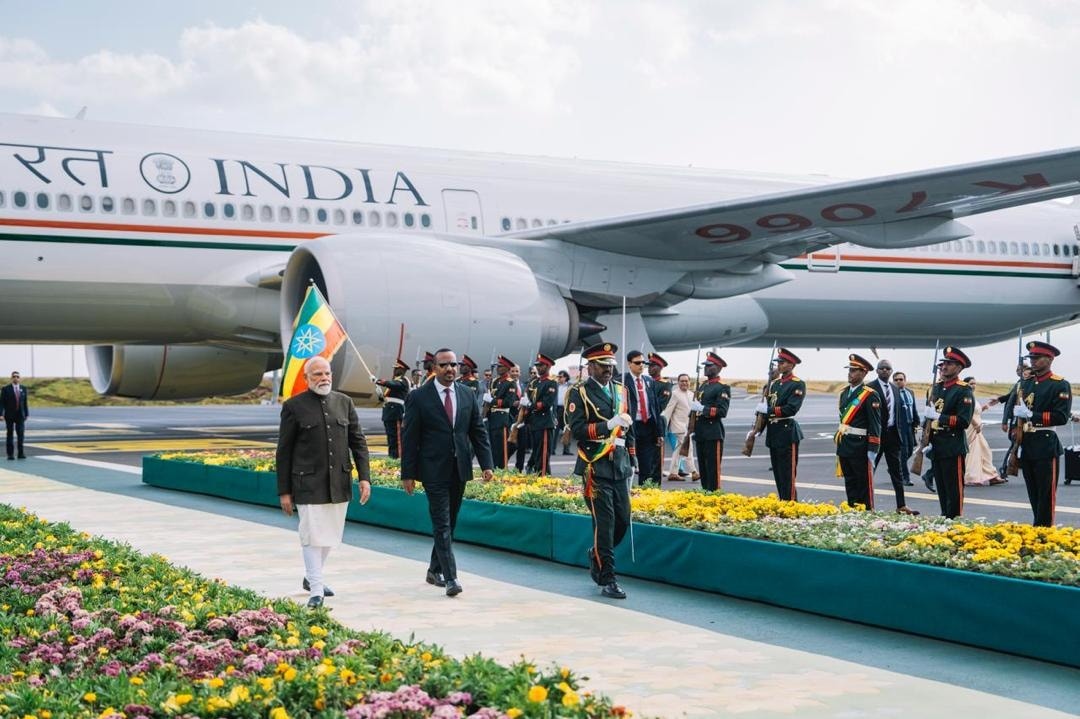
The afternoon of December 16, 2025, was crisp and clear over Addis Ababa. As Indian Prime Minister Narendra Modi's aircraft touched down at Bole International Airport, the moment carried the weight of contemporary urgency mixed with ancient familiarity. This wasn't just another diplomatic visit it was a meeting between two of the Global South's most transformative leaders, coming together at a pivotal moment in world history.
Prime Minister Abiy Ahmed stood waiting at the airport, his trademark warm smile reflecting a leader fully aware of the historic weight of the moment.
When the two leaders embraced, the gesture spoke louder than words. This was a meeting of kindred reformers—men who had fundamentally reshaped governance in their respective nations.
Prime Minister Modi has transformed India’s bureaucracy through digitalization, extending banking access to millions via technology. Meanwhile, Prime Minister Abiy Ahmed has spearheaded reforms that opened one of Africa’s most closed economies, setting Ethiopia on an ambitious path to become the continent’s first middle-income country.
Both leaders are not only accomplished authors and poets but also visionary practitioners of transformation. Modi’s Digital India initiative has built a digital infrastructure serving over a billion people, while Abiy’s “Medemer State” philosophy of synergy has united a nation and unlocked opportunities that had remained closed for decades.
The two visionary leaders are steering their nations at a time when the historic relationship between Ethiopia and India, spanning over two millennia—is transforming into a dynamic modern partnership fueled by growing trade and investment. While their shared cultural ties date back to the Aksumite Kingdom, when Indian merchants traded textiles, spices, and other goods through the Port of Adulis, the two countries formalized their diplomatic relations 70 years ago, in 1950.
In that regard, the chemistry between the two leaders was evident from the start. As they discussed India’s upcoming BRICS chairmanship in 2026, with Ethiopia as the bloc’s newest member, both could clearly envision the possibilities for collaboration and shared progress.
With over $6.5 billion in Indian investment already generating 17,000 jobs in Ethiopia, they spoke about scaling this success. Ethiopian IT graduates were already working for Indian tech companies remotely, while Indian pharmaceutical companies were setting up manufacturing units in Ethiopian industrial parks.
Indian Prime Minister Narendra Modi’s state visit to Ethiopia has now emerged as a pivotal moment in bilateral relations, recasting a historically warm partnership into a broader political, economic, and security alignment shaped by shared strategic priorities.
This is his first official trip in more than a decade and comes as both countries reposition themselves within the Global South and the expanded BRICS framework. Diplomats describe the engagement as timely, pointing to converging interests in strategic autonomy, digital governance, and South-South cooperation.
At the core of the visit are talks between Prime Minister Modi and Prime Minister Abiy Ahmed, expected to focus on trade expansion, investment flows, technology transfer and people-to-people exchanges.
Officials say discussions will also cover manufacturing partnerships, digital public infrastructure, agriculture, pharmaceuticals, and skills development, sectors where Indian firms already maintain a visible footprint in Ethiopia.
This visit builds on a steady pace of leader-level engagement since Prime Minister Abiy took office. His first official visit to India from October 27 to 29, 2018, marked a definitive reset in ties.
Following talks in New Delhi, PM Abiy hailed India as “a reliable development partner with deep historical ties to Africa,” as both sides agreed to deepen cooperation in agriculture, information technology, pharmaceuticals, and human capital development.
Political Convergence
Since then, Modi and Abiy have met repeatedly on the sidelines of major multilateral forums, using these encounters to shape a more strategic convergence.
One such meeting followed Ethiopia’s formal accession to BRICS in January 2024. During the talks, Modi congratulated Abiy on the entry, while Abiy acknowledged India’s support and congratulated Modi on the Chandrayaan mission’s success, terming it "a moment of pride and inspiration for Ethiopia and the Global South.”
The two leaders have met regularly during major international summits, most recently at the G20 Summit in Johannesburg on November 22, 2025, where they discussed expanding cooperation in technology, skilling, and development.
PM Abiy Ahmed has also participated in successive editions of the Voice of the Global South Summits chaired by India, reflecting Ethiopia’s growing profile in Global South diplomacy.
Ethiopia featured prominently during India’s G20 presidency, which culminated in the African Union gaining permanent membership. At the time, Modi described Ethiopia as “a key partner for India in Africa,” highlighting cooperation in digital transformation and manufacturing. Discussions reviewed ongoing Indian-supported projects in Ethiopia and underscored a shared vision for more inclusive global governance.
Pillars of Engagement
Governance reform and institutional capacity building remain another cornerstone of engagement. From May 12 to 18, 2025, a high-level Ethiopian delegation comprising regional presidents, vice presidents, and senior ministers participated in a capacity building programme at India’s National Centre for Good Governance. Ethiopian officials reaffirmed their interest in policy reform, digital governance, and technology-driven public service delivery, drawing on India’s experience in large-scale administrative transformation.
Multilateral Significance
Modi’s Addis Ababa visit also carries wider multilateral significance. With both countries now members of BRICS and India set to chair the bloc in 2026, diplomats expect the talks to inject momentum into broader India-Africa engagement, including renewed discussions on convening the long-delayed fourth India-Africa Forum Summit.
The visit highlights Ethiopia’s growing strategic relevance in India’s Africa policy and India’s expanding role in Ethiopia’s economic and security calculus. With investment, agriculture, mining, digital public infrastructure, and cybersecurity on the table, the talks will test whether long-standing political goodwill can be translated into sustained and long-term outcomes.
Historical Roots
India and Ethiopia are reinforcing a partnership that draws strength from more than 2,000 years of historical contact.
Historical ties date back to the Axumite Empire in the first century AD, when trade flourished through the ancient Red Sea port of Adulis. Indian merchants exchanged silk and spices for Ethiopian gold and ivory, laying the foundation for enduring commercial and cultural links.
Formal diplomatic relations were established soon after India’s independence. Legation-level ties were set up in 1948, and full diplomatic relations were established in 1950, with Sardar Sant Singh becoming India’s first Ambassador to Ethiopia.
Prime Minister Narendra Modi’s visit to Ethiopia on 16-17 December 2025 reflects India’s broader outreach towards the African region. After Mauritius, Ghana, Namibia and South Africa this is Modi’s fifth visit to the continent this year. Ethiopia is a rising economic power, India’s historical and long-standing development partner in the African continent, a member of the BRICS Forum and a diplomatic hub of the region. PM’s visit to Ethiopia will help in reinvigorating India’s partnership with Africa.


