MoFA Urges All Concerned Actors to Condemn Irresponsible Behavior of Egypt - ENA English


MoFA Urges All Concerned Actors to Condemn Irresponsible Behavior of Egypt
Egypt's rejection of dialogue and doubling down on its hostile rhetoric with a clear intention to orchestrate an escalation is an irresponsible behavior that should be denounced by all concerned actors, according to Ministry of Foreign Affairs.
In a statement issued today, the ministry noted that Egypt's rejection of dialogue and negotiation has now become overt unlike in the past when it pretended to engage in negotiations while it obstructed progress and solutions through its intransigence and insistence on its monopolistic claims.
"The policy of pretending to negotiate while refusing to engage in any meaningful dialogue has now been made public and more direct, " it added.
Instead, the statement urged Cairo to move away from posturing and rhetoric and adopt a wiser course of action grounded in good-faith cooperation aimed at shared prosperity.
Learning to live with Ethiopia's development and a commitment to work in good faith towards a cooperative framework for shared prosperity and development will be the wiser course of action rather than the posturing and rhetoric that are keeping Cairo busy, the ministry pointed out.
Ethiopia, it added, remains open to win-win solutions based on principles of fairness and equity, while firmly upholding its right to utilize the Abbay (Blue Nile) River to meet the needs of present and future generations.
Highlighting Ethiopia’s long-standing commitment to Pan-Africanism and its history of supporting anti-colonial struggles, the ministry stressed that Ethiopia is a nation of ancient civilizations with a long track record of African solidarity; and has no room to accommodate the vestiges of colonialism that Cairo is finding difficult to eschew.
The River Abbay, which originates in the Ethiopian highlands, contributes about 86 percent of the waters of the Nile basin. The Abay watershed accounts for 70 percent of the surface water of Ethiopia. Therefore, Ethiopia, like all other riparian states, has a right to utilize this natural resource, it elaborated.
The statement further revealed that Egyptian authorities have undertaken a campaign of destabilization in the Horn of Africa, focused particularly on Ethiopia, with the aim of cultivating pliant, weak and fragmented client states that would do Cairo’s bidding.
This approach, it said, is a failure of imagination and leadership and relies on an obsolete playbook that has never cowed Ethiopia.
Moreover, the statement underscored that Ethiopia has no obligation to seek permission from anyone to use natural resources found within its borders.
The ministry further reiterated that Ethiopia’s development aspirations, particularly the Grand Ethiopian Renaissance Dam (GERD), represent Africa’s broader pursuit of self-reliance and progress.
A cooperative framework based on good faith would be the wiser course of action compared to the posturing and rhetoric currently dominating Egypt’s approach.
It finally noted that what the world needs, what Africa needs, is more cooperation and dialogue, not confrontation and conflict.
Full text of the statement issued by Ministry of Foreign Affairs of the FDRE Office of the Spokesperson
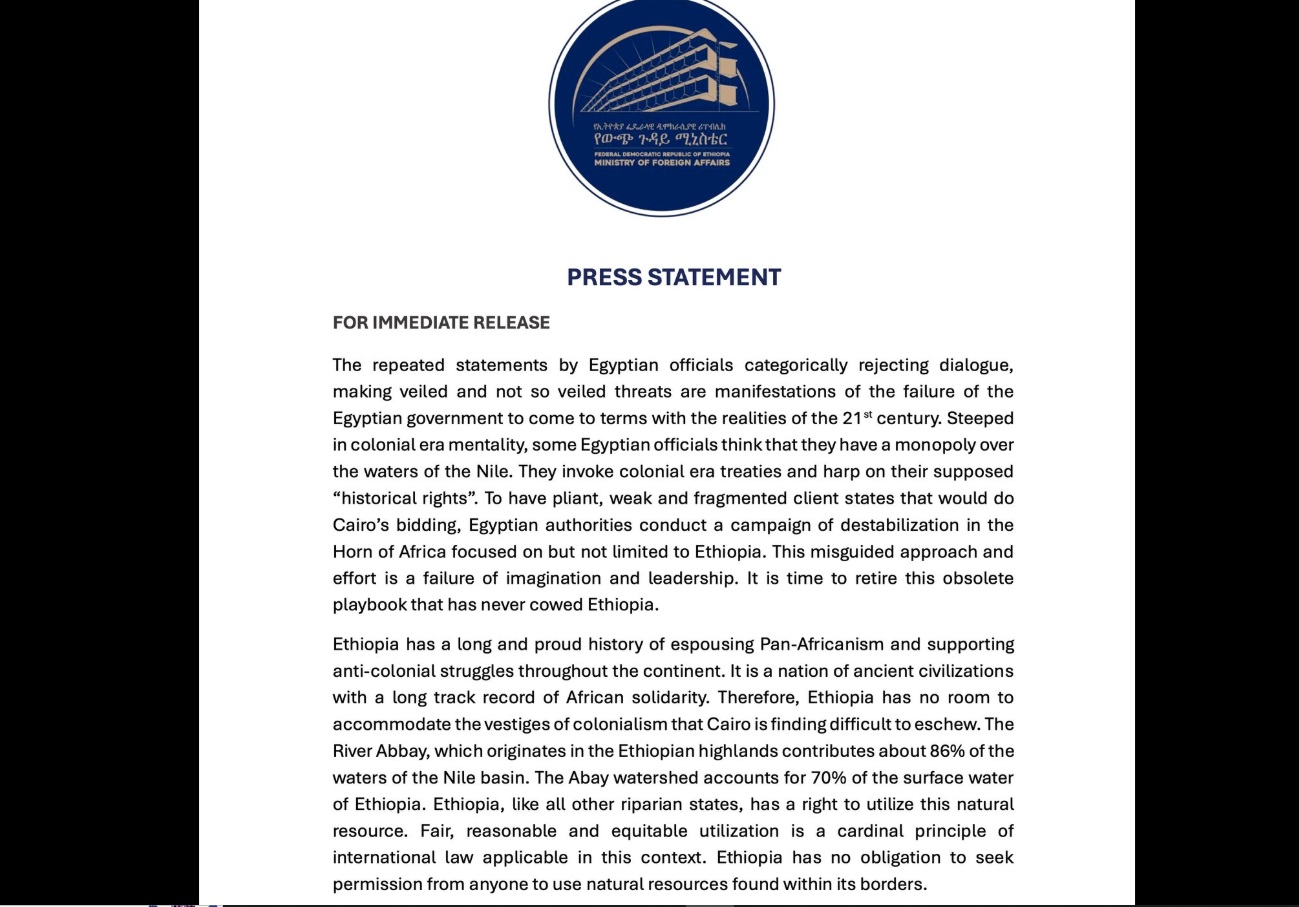
The repeated statements by Egyptian officials categorically rejecting dialogue, making veiled and not so veiled threats are manifestations of the failure of the Egyptian government to come to terms with the realities of the 21" century. Steeped in colonial era mentality, some Egyptian officials think that they have a monopoly over the waters of the Nile. They invoke colonial era treaties and harp on their supposed "historical rights". To have pliant, weak and fragmented client states that would do Cairo's bidding, Egyptian authorities conduct a campaign of destabilization in the Horn of Africa focused on but not limited to Ethiopia. This misguided approach and effort is a failure of imagination and leadership. It is time to retire this obsolete playbook that has never cowed Ethiopia.
Ethiopia has a long and proud history of espousing Pan-Africanism and supporting anti-colonial struggles throughout the continent. It is a nation of ancient civilizations with a long track record of African solidarity. Therefore, Ethiopia has no room to accommodate the vestiges of colonialism that Cairo is finding difficult to eschew. The River Abbay, which originates in the Ethiopian highlands, contributes about 86% of the waters of the Nile basin. The Abay watershed accounts for 70% of the surface water of Ethiopia. Ethiopia, like all other riparian states, has a right to utilize this natural resource. Fair, reasonable and equitable utilization is a cardinal principle of international law applicable in this context. Ethiopia has no obligation to seek permission from anyone to use natural resources found within its borders.
Egypt's rejection of dialogue and negotiation has now become overt. In the past, Egypt pretended to engage in negotiations while it obstructed progress and solutions through its intransigence and insistence on its monopolistic claims. The policy of pretending to negotiate while refusing to engage in any meaningful dialogue has now been made public and more direct. Egypt has rejected dialogue and is doubling down on its hostile rhetoric with a clear intention to orchestrate an escalation. This irresponsible behavior should be denounced by all concerned actors. Ethiopia's developmental aspirations and projects such as the Grand Ethiopian Renaissance Dam (GERD) are embodiments of Africa's self-reliance and progress. Learning to live with Ethiopia's development and a commitment to work in good faith towards a cooperative framework for shared prosperity and development will be the wiser course of action rather than the posturing and rhetoric that are keeping Cairo busy. What the world needs, what Africa needs is more cooperation and dialogue not confrontation and conflict. Ethiopia stands firm in assertion of its right to utilize the Abbay River to meet the needs of present and future generations and its openness for win-win solutions based on principles of fairness and equity.


